
Book Review: Deflective Whiteness, by Hannah Noel
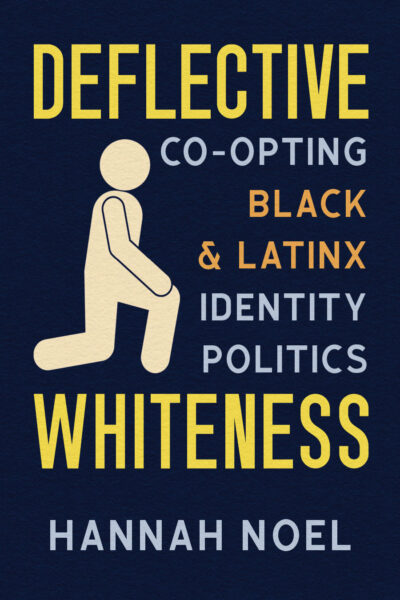
Deflective Whiteness: Co-opting Black and Latinx Identity Politics by Hannah Noel (The Ohio State University Press, 2022), 226 pp.
For critical scholar Hannah Noel, “deflecting” describes shifts in the terrain of discourse that distort memory and agency in ways that matter for racial politics. In Deflective Whiteness: Co-opting Black and Latinx Identity Politics, Noel argues that Whiteness inherently bears the quality of rhetorical deflection. Throughout the book, deflecting means co-opting (9), appropriating (70) and un-witnessing (104) the identity politics of Black and Latinx social movements to promote hegemonic gender roles and nationalist exclusion. From right-wing extremist to liberal poles of Whiteness, Noel demonstrates that capitalist exploitation remains a central motivation for deflective Whiteness, where co-opted meaning fundamentally secures economic power.
Treating deflection as a site of power, the book maps how deflective rhetorics are enacted on discursive and affective registers; deflection is a two step dialectic of aggrievement and appropriation (187) where feelings of White pain are rhetorically managed. Noel traces the dialectic of deflection in transmedia, examining the constellation of intertextual frames that span news media, social media, marketing, and music (5). Employing a Third Wave Whiteness approach to intervene in critical Whiteness studies, Noel’s work is valuable to scholars investigating colorblindness and abstract liberalism as ideologies that “recuperate, reconstitute, and restore” White supremacy.1 Throughout the monograph, Noel frequently cites scholars such as Ian Haney López, Casey Kelly, and Thomas A. Nakayama and Robert L. Krizek to theorize the rhetorical strategies and feelings that socially construct Whiteness.2 White deflection rhetorically secures the contemporary racial formation of Whiteness, which sustains a “new racism” grounded in colorblind ideals and post-racial denial. For critical scholars of race and rhetoric, Deflective Whiteness offers critical insights about how exactly Whiteness shifts discourse to remake itself. Reading Deflective Whiteness in imaginative relation with critical scholars of Whiteness, I suggest that this work offers a critical lens through which to view the fissures in White identity even as it fails to fully consider racial embodiment in the enactment of Whiteness.
The introduction to Deflective Whiteness brilliantly sets into relief the import of deflection across history. Noel’s beginning example shows that the White supremacist phrase “Blood and Soil” is a deflection based on a historical deflection in German, “Blut und Boden,” intended to secure White nationalist power (1-2). Deflection is used to rhetorically articulate a “recovery ideology” of White supremacy, meaning that deflection naturalizes racist imaginations of the past and the present (16). Reiterating that deflective whiteness is a two-pronged rhetorical strategy, relying upon both aggrievement and appropriation, Noel expansively considers how these deflective discursive shifts accompany deflective affects. Victimhood is expressed as different sentiments: “white fright,” “white fragility,” and “white pain,” which is Noel’s primary intervention. White pain happens when desires for racial atonement are eclipsed by forced encounters with painful representations of the effects of White supremacy on people of color (13-14). Deflective Whiteness unfolds in two parts; the first three chapters make up Part 1, which explores overt White deflection, and the last two chapters, Part 2, analyze inferential deflective Whiteness. In the book’s epilogue, Noel reflects on how White people enact racial solidarity, provoking important questions about the future of critical Whiteness studies.
In Part 1, Noel maps the two-step process of white deflection in White supremacist media discourse, which coheres White conservative group politics across gender and class differences. Ultimately, deflective media frames reinforce neoliberal principles of ethical capitalism, which White supremacist extremists understand as patriotic and authentic. Noel’s first chapter introduces “militant victimhood” as a masculine rhetoric of White pain—or White male pain—, which responds to a perceived crisis of hegemonic masculinity with defiant victimhood, an expression of aggrievement (31-32). Then, the meaning of systemic violence is appropriated by removing it from historical and contemporary context. The second chapter of Deflective Whiteness continues the analytic exploration of victimization and co-opting, demonstrating how these rhetorical strategies of White male pain are used by cisgender women, both those racialized as White and non-White. In this chapter, Noel explores how “feminized”3 rhetorics of White male pain reinforce White dominance by positioning cisgender women orators as “vulnerable . . . and therefore as potential victims” of attacks on the privatized heteronormative family (69). The feminized rhetorics of Candace Owens and Nikki Haley, two right-wing women of color, enact “Multiracial” Whiteness, which is, in Noel’s iteration of Cristina Beltrán’s definition, a discriminatory worldview where members of marginalized communities “fall victim” to White politics of domination and dehumanization (6, 67). In the third chapter, Noel argues that a “crass country” credibility in the country-rap and bro-country subgenres of country music enables the commodification of the genre as authentically White, functionally remaking Whiteness in concert with neoliberal ideals (93, 105-108). The crass country deflection, Noel puts forth, strategically “unwitnesses” (104) the complex histories of country music by appropriating Black music traditions and policing authenticity (119). Noel continues to explore capitalist exploitation and Whiteness, charting a Third Wave Whiteness mode of the fissures within White identity politics.
In Part 2 of Deflective Whiteness, Noel explores rhetorical and affective aspects of inferential deflective Whiteness, ultimately drawing a through line between overt and covert White supremacy across alt-right and liberal White audiences. Taking up American Apparel’s neoliberal representations of migrant labor in the fourth chapter, Noel shows that inferential White deflection co-opts marginalized labor struggle through abstract liberalism (127, 145). Noel makes clear that the deflective misrepresentation of liberal Whiteness parallels the aggrieved co-optation of right-wing Whiteness; while both identity frames adhere to political ideals of ethical consumption, the moral ethos for the former is sustained by progressivism while the latter is anchored by patriotism. In the fifth chapter, Noel extends the critique of abstract liberalism to an analysis of NPR’s news coverage of migration in order to show that liberal White frames deflect through decontextualizing stories and centering white victimhood. Here, Noel demonstrates how liberal Whiteness aligns with alt-right White ideals of personal responsibility as a mechanism for citizenship. Noel’s thorough modelling of rhetorical deflection across conservative and liberal White media, charting synergies and divergences, makes Deflective Whiteness an incisive intervention into critical Whiteness studies.
Deflective Whiteness weaves together an anti-essentialist analytic across mediated rhetorics; its transmedia methodology is a novel and notable approach to thinking through the intertextual nature of racial formation in the era of “new racism” by studying the ideological functions of decontextualization, the superficial representation of Black and Latinx identity politics used to secure White dominance. Noel’s transmedia perspective shows that the decontextualized meanings seem complex and accurate to White media audiences because the cross-media circulation of multiple ignorant representations layers to create a totalizing discourse. Illuminating decontextualization as an intertextual style of political meaning, Noel demonstrates how both conservative (32) and liberal (164) media co-opt misremembered politics, sustaining deflective Whiteness in overt and inferential forms. Critical rhetorical scholars of race should attend to Noel’s theorization of intertextuality and racial meaning in transmedia.
Despite my appreciation of Noel’s rich theorization of Whiteness as co-opting and our shared interest in critical rhetorics of race, I fear that I was not Noel’s intended audience as a Black PhD candidate and now as an assistant professor. Deflective Whiteness addresses a White audience from introduction to conclusion. In her introductory arguments, Noel anticipates fragility from a White audience who “may jump to the conclusion that [her] argument is that White people are all inherently ‘bad’” and clarifies that her intentions are simply to assess Whiteness as an institution. In discussing her Third Wave Whiteness approach to deconstructing essentialist accounts of Whiteness, Noel articulates her intentions to “make the differences between Whites . . . more visible, particularly to other Whites” (96). I seem to be listening in on a private conversation as Noel signals a White reader with collective pronouns in an aside for “we Whites,” who “are responsible for our racist present” and “need to move [to a discourse] of White supremacy” (12). At one point, she urges the reader to “forego the privileges of Whiteness” (186). Noel’s concluding meditation on White allies and accomplices in the epilogue assumes White positionalities in anti-racist struggle.
In reflecting on Deflective Whiteness, and potential audiences of this book review, I must express sympathetic understanding to Noel’s rhetorical choices in crafting this manuscript. Still, I am struck by some anxious feeling when I consider the juxtaposition of Noel’s inattention to a potential non-White reader and Noel’s detailed attention to the constructedness of Whiteness from non-White rhetors.
First, in solely focusing on Whiteness as an institution, Noel neglects exploring race in/on the body as it exists in institutions. Although Noel often reiterates that non-White rhetors reproduce deflective Whiteness, such that Whiteness discursively persists beyond the White body, the sticky excess of Blackness in/on/through the body, which always has social meaning, is elided. Consider one of Noel’s examples from the second chapter. Despite her White-allied rhetoric, Candace Owens will never be White—public discourse constantly interprets her rhetorics through tokenizing or self-hating frames, circulating reminders of her marked non-Whiteness in service of Whiteness. “Multiracial Whiteness” is more complex than the non-White adoption and reproduction of deflective White discourse because of how race is marked on the body. Owens’s White allyship is performed through her body, which communicates racial and gendered meaning as a thin, dark-skinned cis Black woman. Instead of overlooking the non-White embodiment of the White-allied right-winger, we might question how, to take a similar example, politician Herschel Walker’s speech and embodiment are tokenized as authentically Black in service of a White evangelical political program. These things are meaningful to Black audiences who know embodied Blackness intimately. The otherness of the right-wing token and their racialized embodiment are never fully erased by their White allyship; rather, the body simply becomes another site to discuss the complexities of racial subjugation.
Second, I wonder how, if at all, Noel’s reservations in addressing an audience of color may shape critical conversations between fellow White people wrestling with the entanglements of Whiteness as embodied by non-White people. How are “we Whites,” if that is the audience, to engage discourse about the expansive complexity of Whiteness across racial lines? As critical Whiteness studies continues its de-essentializing turn, its audience includes critical scholars of race broadly, whether we are directly addressed. Although working from a different racialized perspective, critical race scholars of color do study similar co-opting moves and, thus, will respond to White scholars theorizing the non-White enactment of Whiteness. With these next steps in mind, Deflective Whiteness, through its strengths and gaps, introduces needed complexity in critical scholarship of Whiteness.
Endnotes
- See Bonilla-Silva (2014), Delgado and Stefancic (2017), and Twine and Gallagher (2008). return
- See Kelly (2021), López (1997), and Nakayama and Krizek (1995). return
- In Noel’s definition, “feminization refers to individuals embodying characteristics . . . stereotyped as female. . . . [Feminized] rhetoric often means a focus on female perspectives and ways of knowing” (81). Noel is self-conscious of the cisheteronormativity inherent in this discussion of “female,” choosing to assess how these assumptions affect right-wing women’s political discourse, even as Noel demonstrates scholarly familiarity with critical queer scholarship on gender enactment. Still, Noel’s description of “feminized” rhetoric as it unfolds through contemporary culture wars that target transgender people somewhat brackets queer and trans critiques of binary femininity, even as it critiques White cisheteronormativity. return
Works Cited
Bonilla-Silva, Eduardo. Racism Without Racists: Color-blind Racism and the Persistence of Racial Inequality in America. 4th ed., Lanham: Rowman and Littlefield, 2014.
Delgado, Richard, and Jean Stefancic. Critical Race Theory. 3rd ed., New York: NYU P, 2017.
Kelly, Casey Ryan. “White Pain.” Quarterly Journal of Speech, vol. 107, no. 2, 3 Apr. 2021, pp. 209–33. doi.org/10.1080/00335630.2021.1903537.
López, Ian F. Haney. White by Law: The Legal Construction of Race. NYU P, 1997.
Nakayama, Thomas K., and Robert L. Krizek. “Whiteness: A Strategic Rhetoric.” Quarterly Journal of Speech, vol. 81, no. 3, Aug. 1995, pp. 291–309.
Noel, Hannah. Deflecting Whiteness: Co-opting Black and Latinx Identity Politics. The Ohio State UP, 2022.
Twine, France Winddance, and Charles Gallagher. “The Future of Whiteness: A Map of the ‘Third Wave.’” Ethnic and Racial Studies, vol. 31, no. 1, 1 Jan. 2008, p.12. doi.org/10.1080/01419870701538836
COVER IMAGE CREDIT: The Ohio State University Press
KEYWORDS: whiteness, rhetorics of whiteness, multiracial whiteness, deflective whiteness, racial identity politics

Book Review: Hawhee’s Rhetoric in Tooth and Claw: Animals, Language, Sensation

Writing Assignments for the Prefigurative Classroom: Framing the Rhetoric of Workplace Writing

An Annotated Bibliography of Sport Rhetoric Scholarship
About the Authors
 O.M. Olaniyan (they, them, theirs) is an Assistant Professor of Critical Rhetorics of Race at Northern Illinois University.
