
An Annotated Bibliography of Sport Rhetoric Scholarship
Kyle R. King | Penn State Altoona
I. Introduction

In the preface to Beyond a Boundary (1963), the Trinidadian scholar and intellectual C. L. R. James asked a question that helped dispel the belief that sport was a pastime separate from larger issues of politics, identity, and culture: “What do they know of cricket who only cricket know?“(xxi). It was possible, James suggested, to play or watch a sport and think only about the physical activity on display. Such an understanding was quite limited, however. Instead, James suggested that it was impossible to truly understand a sport without knowing its institutional history, the history and politics of the locations where it was played, and the specific identities and styles of the bodies playing and watching the sport. James’s Beyond a Boundary ignited a scholarly conversation about sport as a tool of British colonialism, institutionalized racism, and cultural soft power. At the same time, James showed how the formation of a unified West Indies cricket team demonstrated the possibility of sport as an anticolonial means of resistance to those very same forces. Because Beyond a Boundary was published roughly concurrently with the rise of the Birmingham Centre for Contemporary Cultural Studies (CCCS), helmed by Stuart Hall and Richard Hoggart, the book might be thought of as sport studies’ first sustained case study in hegemony theory — an attempt to understand how hierarchies of power, status, and values are produced, reproduced, and contested through the cultural institution of sport, in both top-down and bottom-up ways. James himself was a case study in how complex the operation of hegemony and social reproduction could be: while a radical leftist and pan-Africanist decolonial political thinker, he nevertheless internalized and thoroughly believed in many of the decorous personal values he learned from cricket, which had spread to the West Indies to ‘civilize’ predominantly non-White British colonial outposts.
Decades later, sport philosopher William J. Morgan (2021) would use a different vocabulary to explain a similar process of cultural contestation. Morgan explains “the meaning of sport” by drawing on John Searle’s The Construction of Social Reality (1995): sport is full of “constitutive rules,” where “X counts as Y in context C” (40). Consensus over the constitutive rules of a sport is sometimes quite stable. For example, since 1909, a field goal in American football has been worth three points. At other times, the constitutive rules of sport are contested—whether, when, and how to use instant replay technologies (see Grano, 2017); whether certain techniques in basketball, including dunking or the ‘Euro-step’ dribble, are legal; how to categorize athletes in amateur sport, disability sport, and sex-segregated competitions; or how to organize economic reward systems for various players, teams, and sport-related institutions. When discussions about constitutive rules remain exclusive to playing style and limited to athletes and sport organizers, Morgan describes them as part of the “internal purpose” of sport. When discussions about the constitutive rules of sport connect to extrinsic arguments about the ideological purpose of sport (e.g., religious, military, nationalist, gender-performative, capitalist, or other sociopolitical causes), Morgan describes them as part of the “external purpose” of sport. The most salient battles for consensus are inescapably intertwined, in what Morgan describes as the “hybrid internal purposes” of sport in a particular context — purposes that resonate both within and outside of sport in a particular context. As Morgan writes, the purpose of sport “is always in part of a piece with what is going on in larger society, of the various social notions and conceptions circulating at the time of what makes for a worthwhile, valuable way to live one’s life” (50). Because these notions of how to live a sporting life and organize the institutions of sport are richly contextual and contested, mediated and argued through bodies, images, and discourse, they become the purview of rhetorical scholars. As Luke Winslow (2014) has written, sport is “arguably the most important modality through which popular ideas about complex social, political, and economic issues are contested, struggled over, and affirmed” (17). For the past several decades, rhetorical scholars have documented, analyzed, and intervened in these contested cultural conversations.
This annotated bibliography offers one possible organizational understanding of the study of sport rhetoric. This is the first project to attempt to bring together sport rhetoric scholarship from across the disciplines of Communication(s) and English, however those boundaries might be demarcated at specific institutions. Scholarly resources to date have focused on the field of Sport(s) Communication(s), such as Andrew C. Billings and Michael L. Butterworth’s textbook Communication and Sport: Surveying the Field (4th ed., 2021); Andrew Billings’ edited collection Defining Sport Communication (2016); and Michael Butterworth’s edited collection Communication and Sport (2021), part of the Handbooks of Communication Science series. The field’s disciplinary tilt toward Communication(s) is due largely to the exponential growth of the sports industry (including sports media) over the past two decades, which has drawn students and faculty to Sport(s) Communication(s) programs. (Naming conventions differ among programs and scholars, so I’ve opted for the parenthetical “s” for both “sport” and “communication.” Speaking generally, “Communication” tends to refer to programs that grew out of a “speech communication” tradition, while “Communications” tends to refer to programs that grew out of a “mass communications” tradition. “Sport” is generally more common as an adjective and noun in non-American locations and also connotes an air of seriousness for many American scholars, though colloquial uses of “sports” and phrases like “sports media” remain prevalent.)
Lawrence Wenner, the founding editor of the Communication & Sport journal and one of the first scholars to connect the sports industry and media industry as imbricated ideological state apparatuses through the term “MediaSport” (1989), has written about the ambivalence he feels toward those faculty who adopt an uncritical “Sport Communication as Profession” disposition. These faculty focus exclusively on preparing students to become reporters, broadcasters, PR executives, and advertisers. While professional training is important to the viability of these programs, Wenner (2021) cautions that this disposition—which takes the “MediaSport” industry as a given and a status quo which needs little structural reform—risks replicating neoliberal economic principles and a “customer experiences” (863) view of sport. As a result, colleagues can challenge sport studies scholarship as mere “fanship” masquerading as scholarly inquiry, rather than a robust critical-cultural disposition. Although not a rhetorician himself, Wenner suggests that rhetorical studies can offer one toolkit to build pragmatic, professional skillsets without sacrificing a critical lens. That Butterworth, the most prolific scholar and organizer of the study of sport rhetoric in the 21st century, was in 2017 named the first director of the University of Texas at Austin’s Center for Sports Communication & Media while simultaneously serving as a faculty member within one of the most vibrant cross-disciplinary rhetoric faculties in the country, speaks to this suitability. A single scholar’s appointment is not the only recent indication of the growth of the field—but, as sport itself often shows, individual visibility and representation can sometimes be a useful (if murky) measure of group achievement.
Other measures of sport rhetoric’s arrival and legitimation are also available. The National Communication Association Communication and Sport Division offered its first official sessions and awards in 2016, after years as a burgeoning interest group. In 2017, the Rhetoric Society of America Institute hosted a workshop on “Sport, Rhetoric, and the Political,” led by Butterworth and Daniel A. Grano. The workshop leaders shared a draft of what would become the introduction to Sport, Rhetoric, and Political Struggle (2019), an edited collection featuring a host of sport rhetoric scholars and other prominent rhetoricians publishing on sport for the first time. (This workshop is also where the idea for this annotated bibliography emerged, as several participants recalled their difficulty assembling a reading list on sport rhetoric for comprehensive exams.) A follow-up RSA workshop, “Rhetoric of Sports and Protest,” was held in 2019, this time led by Abraham Iqbal Khan and Kyle King. Later in 2019, Khan became the first sport rhetoric scholar to win an NCA-wide scholarly award, the Karl R. Wallace Award for scholarship in rhetoric and public address, for his work on figures such as Curt Flood, Jackie Robinson, Richard Sherman, and Michael Sam at the intersections of Black political traditions, labor, and economics. In 2021, Rhetoric Society Quarterly—a journal that had previously held some antipathy toward various forms of “big tent” rhetoric—published its first essay on sport rhetoric, Linsay Cramer and Andrew D’Onofrio’s “Threatening Whiteness: ‘Angry Russell’ and the Rhetoricity of Race.” Other longstanding rhetorical studies journals and newer upstarts in the field have also begun publishing sport rhetoric scholarship. (More information on publication outlets is below.)
The growth of published sport rhetoric scholarship in recent years is due to a variety of factors. First, discipline-wide interest in sport has increased over the past decade as professional, collegiate, and amateur athletes from a range of sports have fashioned themselves as verbal and iconic rhetors to join movements for social change. Those athletes’ rhetoric has been worthy of study, as have been the responses from sporting institutions, fans, and political actors who have aided, applauded, or resisted these athletes in their efforts. Contemporary athlete activism (and its backlash) inevitably leads scholars to draw historical lineages and comparisons, as well. Second, the discipline of rhetorical studies has broadened its own understanding of public address and the political to include a wider range of media and rhetors, a shift necessitated by sweeping changes to media ecologies. A host of relatively new interdisciplinary rhetoric journals has assisted in this shift. Third, athletics is top of mind at many institutions due to the way that sports continue to shape many colleges and universities (see Milford and Reichart Smith, 2020). It is difficult to disregard sport when it seems to set the agenda in terms of universities’ funding priorities and revenue opportunities, in addition to the aforementioned academic program growth.
Finally—and most importantly—sports are increasingly seen as central to political culture and political contestation. Sports journalism desks at major newspapers and websites now refrain from referring to themselves as the “toy department” of the newsroom (Rowe, 2007; Hardin et al., 2009; Cassidy, 2017), a long-standing epithet designed to signal their divorce from civic concerns. Additionally, both the field of rhetorical studies and sport rhetoric scholars themselves have done a better job of refusing to silo essays concerning athletes, sporting events, and physical cultures. In his introduction to Barry Brummett’s edited collection Sport and Identity: New Agendas in Communication (2014), Butterworth recalls interactions with a journal editor who described his essay about football player Tim Tebow as being difficult to place in a thematized issue because his article was “on sports,” while the editor seemed to downplay Butterworth’s concerns with democracy, citizenship, popular culture, religion, race, and gender (1-2). Less than a decade later, these dismissals of sport have largely gone away, especially as politics has become something of a polarized “team sport” and sports have become yet another battleground in the never-ending American culture wars. As David L. Andrews (2019) has put it, “The politics of/in sport genie has been irrevocably decamped from the bottle in which it previously resided” (3). Regardless of whether the genie-in-a-bottle metaphor is appropriate—sport historians have noted political uses of sport since the medieval period, though often not as explicit as those in the contemporary moment—sport rhetoric has recently become a more prominent object of study within the field as its connection to political culture has become more apparent to broader audiences.
Sport rhetoric is connected to more than just political culture. This provides me with an excellent opportunity to reference the Present Tense annotated bibliographies on LGBTQ rhetorics (Cox and Faris, 2015) and the rhetoric of health and medicine (Eberhard, 2012) that helped inspire me to take on this project. There are clear overlaps among these fields, including an emphasis on bodies and embodied subjectivity, in addition to the social construction and rhetorical production of authority. Take, for example, discussions of tennis player Serena Williams’s pregnancy (Taylor and Glowacki, 2020), or discourses surrounding gay male athlete coming-out narratives (King, 2017; Sloop and West, 2017). While political culture is often figured as the “center” of rhetorical studies around which other subfields orbit, that metaphor is insufficient to account for shared interests among these subfields—yet another factor explaining the recent growth of sport rhetoric in new journal outlets.
II. Methodology
Compiling this bibliography required time and assistance from many people, for which I am grateful. Initial conversations about the project took place at the 2017 RSA Institute workshop on “Rhetoric, Sport, and the Political.” A global pandemic, family priorities, and other academic obligations resulted in a long gestation period for this project. Michael Butterworth assisted by passing along a bibliography of his own in 2022. More aid came from Rebecca Alt, who helped comb through back issues of many rhetorical studies journals to find sport rhetoric scholarship. Although she (wisely) decided not to participate in the annotation and organization process, her initial assistance was incredibly helpful. After we manually searched through approximately two dozen journals issue-by-issue, I began reading and annotating articles and used each essay’s bibliography as a resource to discover other scholarship. Special thanks go to Penn State’s Interlibrary Loan staff, who helped me track down difficult-to-find essays and book chapters. Whenever possible, I reached out to scholars directly for their scholarship, encouraging them to pass along any pieces they had written that I had not yet found. Thank you to Stephen Andon, Meredith Bagley, Michael Butterworth, Sarah Hae-in Idzik, Katherine Lavelle, and Korryn Mozisek for sharing their work in this way. This assortment of acquisition tools and snowball sampling methodology was designed to get as close as possible to retrieving and reading every piece of published sport rhetoric scholarship. Final thanks go to Michael Butterworth and Rebecca Alt again for reading a draft of this introduction and offering useful organizational suggestions for the sections of the annotated bibliography.
The line between “sport rhetoric scholarship” and “sport scholarship with rhetorical inclinations and implications” is difficult to discern because of their shared interest in processes of social contestation. I have made the decision to exclude work by literary scholars, sport historians, sport philosophers, physical cultural studies researchers, and mass communications scholars unless that work draws heavily on rhetorical scholarship or uses an explicitly rhetorical toolkit (e.g., some of the scholarship of Thomas Oates, Yago Colás, Jaime Schultz, or Noah Cohan). Those strictures have been loosened slightly to include generative and undervalued work by international scholars trained in locations without strong rhetorical studies programs (e.g., Scarlett Cornelissen on South Africa’s FIFA World Cup geopolitical maneuvering or Robert Lake’s mixed-methodology tennis scholarship). This is an intentional decision to attempt to broaden the geographic scope of sport rhetoric scholarship, which has to date been heavily American in focus. I apologize for any omissions, oversights, or mischaracterizations I may have made in this process.
As I progressed through my reading, I maintained a large word-processing document with a running list of all scholarship alphabetized by last name, followed by an individual document for each article, book chapter, case study, or monograph. As the list became longer and more unwieldy to navigate, eventually totaling nearly 300 sources, I transferred details about each source into a spreadsheet with the following information:
- Year of Publication
- Author(s)
- Title of Scholarship
- Type of Scholarship (article/case study/book chapter/monograph)
- Publication Outlet (academic journal/edited collection title/university press)
- Sport(s) Featured
- Figure(s)/Sport Institution(s) Analyzed (e.g., WNBA, Serena Williams, NCAA)
- Type(s) of Objects Analyzed (e.g., film, journalism, literature, political discourse, museum, mega-event)
- Key Method(s) & Concept(s), usually known as Tags in these Present Tense bibliographies
This spreadsheet became a reference point that allowed me to organize information more clearly, make tags more consistent across sources, and create rudimentary tables and charts to visualize key questions, many of which are displayed below. Because this annotated bibliography does not collect every single source and makes subjective judgments about how to organize these sources, I wish to share this original “raw data” in ways that are navigable and hopefully useful to other scholars.
Here is a viewable link to the full list of sources and annotations, alphabetized by first author’s last name: Aug. 2023 – Sport Rhetoric Source List, Alphabetized.
Here is the spreadsheet I compiled to manage sources and information: Aug. 2023 – Sport Rhetoric Database.
These files will allow scholars to build from the work I have completed and put it to their own uses, adding, amending, and recategorizing as needed. Any scholars who wish to pass along sport rhetoric scholarship that I should include may reach me at kyle.king@psu.edu; I intend to keep these lists and databases current, though this annotated bibliography represents a snapshot in time.
III. The Past, Present, and Future of Sport Rhetoric Scholarships
The primary purpose of this annotated bibliography is to create a clearinghouse of information for rhetoric scholars—those already publishing in the field of sport rhetoric, those looking to publish in the field, and those looking to advise graduate and undergraduate students about the state of the field. In an ideal world, this project might also be of use to sport studies scholars from other humanistic backgrounds, including sociology, history, philosophy, and kinesiology. In particular, sport rhetoric scholars and “physical cultural studies” researchers within kinesiology departments may have much to teach each other (see Andrews, 2008; Silk and Andrews, 2011; and Silk, Andrews, and Thorpe, 2017). Indeed, scholarship published in Journal of Sport and Social Issues; Sociology of Sport; International Review for the Sociology of Sport; Sport in Society: Cultures, Commerce, Media, Politics (formerly Culture, Sport, and Society); and The Journal of Sport History all appears in this annotated bibliography. (For those sport scholars from other disciplines looking to pick up skills in rhetorical criticism, see Kornfield, 2021, and Kuypers, 2021, as excellent starting points.)
A second, related goal is to better understand the range, depth, and focus of sport rhetoric scholarship. In Table 1, you will see visual representations of some of the initial questions I posed and tried to retrieve from the available data.
Which academic journals have featured sport rhetoric scholarship? How often have they done so, and when were these articles published?
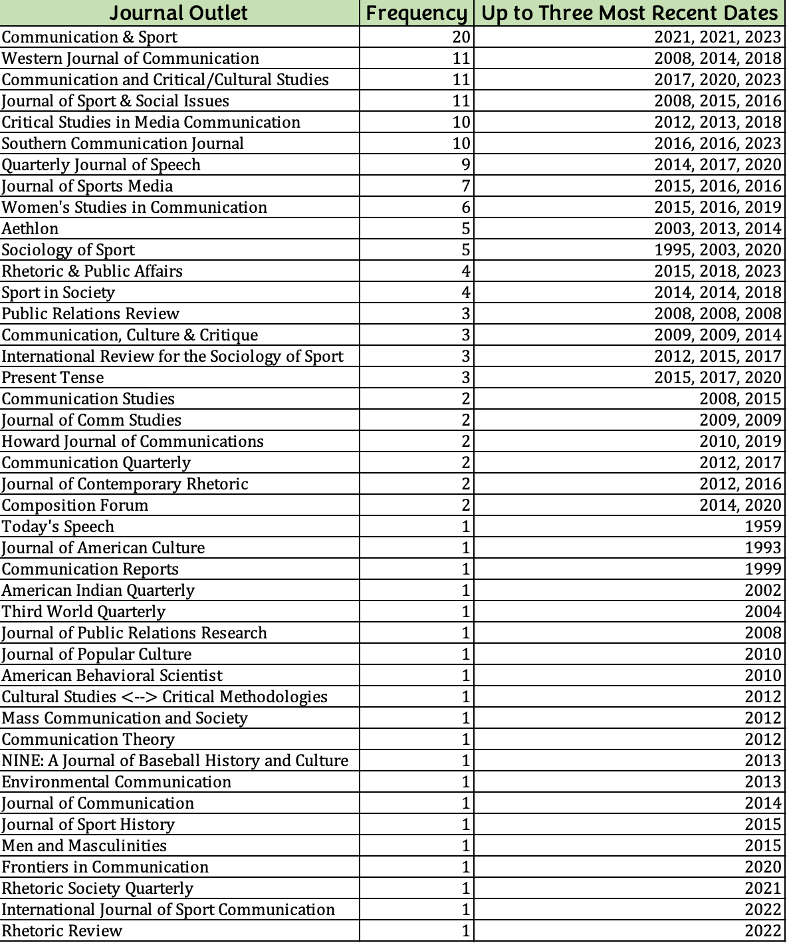
As Table 1 indicates, Communication & Sport has been the most frequent publisher of peer-reviewed sport rhetoric manuscripts, followed by a range of communication and sport studies journals. Certain journals, such as Western Journal of Communication or Aethlon, have not published sport rhetoric articles for a few years. In Western’s case, this is because the journal’s editorial team has moved toward social scientific and communication science methodologies, apart from its famed special issues on rhetorical criticism. In Aethlon’s case, this may be because of its limited circulation and its tilt toward literary scholars and creative writers, both of which have reduced its visibility to sport rhetoric scholars. This table can provide useful information for scholars as they target publication venues that have historically published and are currently publishing sport rhetoric scholarship.
Which sports are written about most frequently?
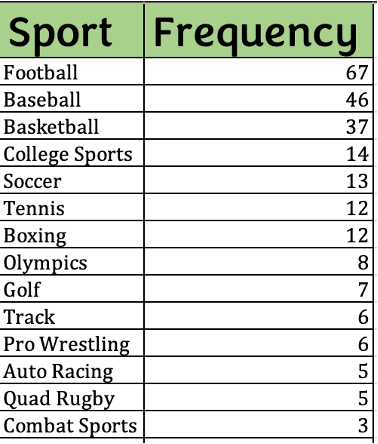
Table 2 reflects football’s hegemonic role in American sports culture. Scholarship was tagged “Football” when it explicitly concerned professional football, college football, or mediated representations of football (e.g., the television show Friday Night Lights). The true number of scholarly pieces on football may be undercounted, as I made a methodological decision to tag pieces “College Sports” whenever a piece focused on the National Collegiate Athletic Association (NCAA) or another issue affecting intercollegiate athletics broadly, even when college football was often the primary sport implicated within a piece of scholarship.
It was also possible to ask similar questions about the athletes, institutions and organizations, and non-athletic figures written about most frequently in sport rhetoric scholarship.
Which athletes have been written about most frequently?
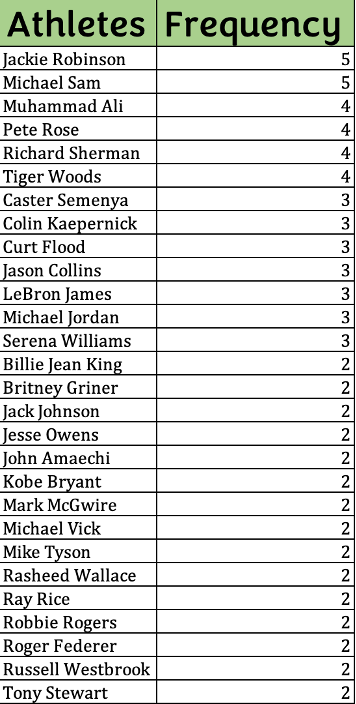
Table 3 includes every athlete written about extensively in at least two pieces of published sport rhetoric scholarship. This count underrepresents key figures discussed in monographs simply because of space limitation, but I believe it provides a rough approximation of the field’s interests, particularly around axes of identity such as race, gender, sexuality, class, and religion. Athletic activists and pioneering figures of racial and sexual equality have been a continual source of interest within the field.
Which sporting institutions and organizations are written about most frequently?
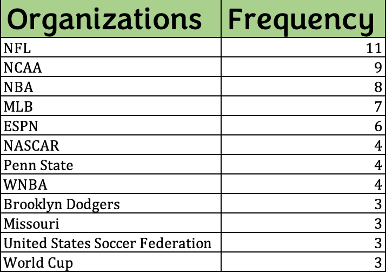
Table 4 includes all sporting institutions, organizations, or events written about at least three times as objects of study within sport rhetoric scholarship. Much of this literature concerns governing organizations such as the NFL, NCAA, NBA, MLB, NASCAR, WNBA, and USSF. The sports media company ESPN makes the list, as a wide array of its programming has become rhetorical artifacts for scholars. So too do the Brooklyn Dodgers, a franchise that devastated a local community by absconding to Los Angeles in 1957. “World Cup” ended up being the most tagged sporting event, often as it concerned the politics of choosing host locations or the treatment of local residents. The “Olympics” (sometimes as “International Olympic Committee (IOC)” or “United States Olympic Committee (USOC)”) is significantly underrepresented due to my decision to tag it as the set of sports under focus, as opposed to the institution being analyzed. Rounding out this list of prominent organizations are two major American universities. Penn State University made the list for its institutional control issues related to the 2011 Jerry Sandusky child sexual abuse scandal and subsequent public memory responses surrounding former head football coach Joe Paterno, while the University of Missouri drew scholarly interest due to its football team going on strike in 2015 over discrimination faced by Black students. That courageous act resulted in the resignation of university system President Tim Wolfe and Chancellor R. Bowen Loftin and has been a symbol of the potential of student-athlete activism in the years since.
Which non-athlete sporting figures are written about most frequently?
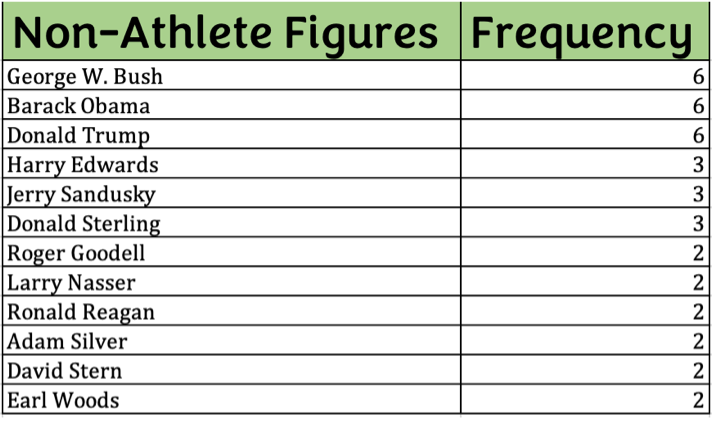
A trio of American presidents tops the list of most commonly featured non-athletes in sport rhetoric scholarship. This finding reflects communication studies’ historical concern with presidential public address, in addition to the ways that American presidents make use of sport for political gain: to signal and assemble key constituencies, to smuggle militaristic and anti-democratic foreign policy ideology through the vessel of sport, or to provoke culture wars that reflect a political coalition’s preferred racial and gender hierarchies. Three commissioners—Roger Goodell, Adam Silver, and David Stern—make the list, as administrative rhetoric ended up being an area of frequent concern. In contrast, the academic sport sociologist Harry Edwards draws interest for his role on the Olympic Project for Human Rights in 1968. Other figures—Donald Sterling, Jerry Sandusky, and Larry Nassar—appear as figures of sporting infamy, tied to either racial discrimination (Sterling, as owner of the Los Angeles Clippers) or sexual abuse (Sandusky and Nassar).
Which methodological and conceptual tags occurred most frequently?
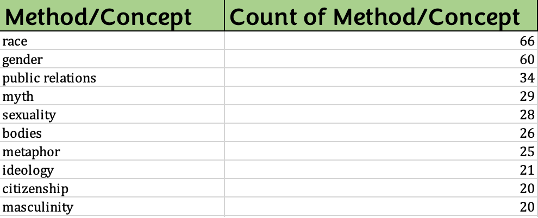
The most subjective process in the work of annotation was to identify appropriate methodological and conceptual tags for each piece of scholarship. While peer-reviewed academic journal articles often include “keyword” tags for other scholars to locate that research, no such author-chosen keyword tags exist for monographs or chapters in edited collections. I did my best to identify broad tags to assist in organizing the overall research project (e.g., “race”), without erasing the specificity of key concepts used by authors (e.g., “Critical Race Theory,” “colorblind,” or “double consciousness”). Database constraints limited me to posting a maximum of ten tags per piece of scholarship. I also created a word cloud visual rendering of the most common tags via wordclouds.com (Image 1).
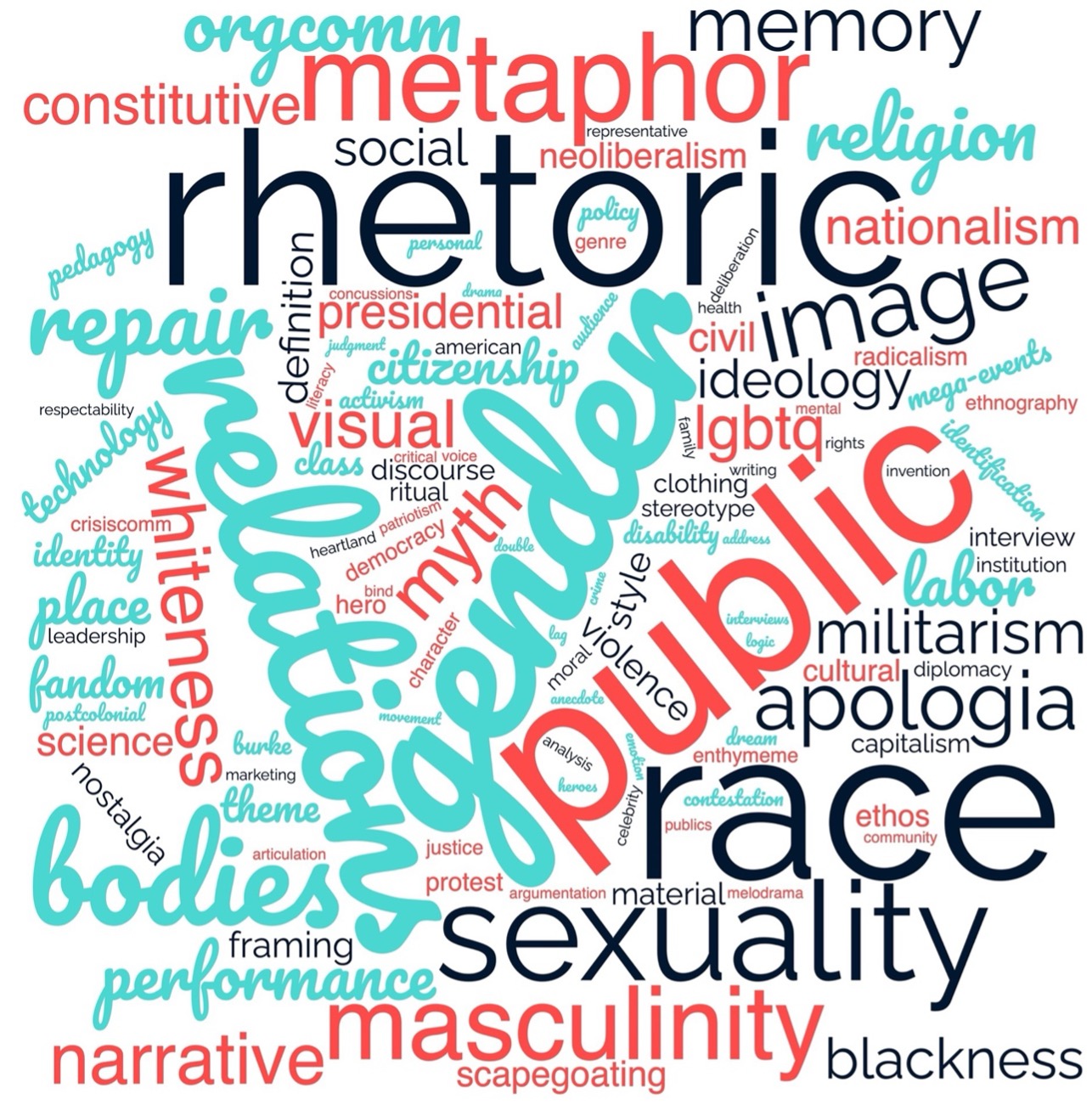
Creating a word cloud helped me to brainstorm and organize the sections of the annotated bibliography that follow, and I recommend it as an organizational device for scholars attempting to manage large reading projects, such as comprehensive exams. Future scholars may be interested in creating citation networks of sport rhetoric scholarship to understand clusters of influence and intellectual traditions, but that is beyond my skillset in this project. A full set of tags is available on the linked files posted above.
A final goal of this annotated bibliography is to identify how the field of sport rhetoric might proceed in the future. What does the field currently do well, and what are possible areas of growth within the field? What are the field’s blind spots? Michael Butterworth’s (2017) chapter in Defining Sport Communication, on “Sport as Rhetorical Artifact,” begins to answer these questions. Rhetorical criticism of sport falls into four primary areas, he suggests: (1) public address in sport (especially through image repair studies); (2) sport as metaphor and the use of metaphor in sport; (3) rhetorical approaches to mediated representations of sport; and (4) rhetorical interpretations of the myths communicated by sport (13–21). I have used Butterworth’s categories as starting points for delineating the work of the field, while trying to drill into specific traditions in greater depth.
Butterworth also offered a few growth areas for sport rhetoric scholarship: a broader range of public address artifacts, better understandings of the intersectionality of identity, and a more global attitude (21–22). Even a handful of years after Butterworth published this chapter, the field has made good on the first two of those areas for development and made progress toward internationalizing. The International Association for Communication and Sport (IACS) held its 2023 Summit on Communication & Sport in Barcelona, co-hosted by the Universitat Autònoma de Barcelona and the University of Alabama—the first time the summit had been held outside the United States. Whether the internationalization of sport communication as a discipline results in more geographically and linguistically diverse rhetorical scholarship is very much an open question. The work of familiarizing oneself with another culture and translating from other languages takes a good deal of time and energy. Promotion and tenure timelines often do not provide enough of either to do this work; furthermore, many universities are firing or nonrenewing colleagues with foreign language expertise suddenly deemed too costly or not appealing enough to retain. Nevertheless, I opened this essay with a discussion of C. L. R. James to suggest one strategy of making good on sport rhetoric’s global aspirations. Sport rhetoric scholars can find the rhetorical toolkit within the work of international anticolonial thinkers, even if they are not “traditional” rhetoricians in the Aristotelian or Burkean modes that may be most familiar, and use that work as a starting point and inspiration for their own methods and objects of study. James, for instance, reveals the possibility and potential of blending cultural criticism with anecdotes and memoir, a method that has elsewhere been popularized by critical race theorists and cultural rhetoricians alike.
Beyond these admirable goals that Butterworth lays out, I will suggest a few other areas currently underrepresented in the scholarship:
- There is a striking paucity of rhetorical scholarship on sport and the environment, especially considering the interest that scholars have in sport and social movements and the growth of environmental communication as a field. The travel and consumption habits of elite sport do not make it an ideal platform for environmental athlete activism, so scholars might consider local and amateur physical cultures as environments worthy of study. There is some scholarship on space and place that considers sport part of a built environment.
- Scholars should consider building more robust understandings of sport media ecologies, including production, transmission, distribution, and spreadability, in addition to power relations and conflicts of interest among sports media outlets, sport organizations, journalists, athletes, sponsors, and audiences. Untangling these webs of mutual interdependence provides an important context and backdrop for understanding the role of rhetoric in a given moment. While not rhetoricians, sport media scholars who interview media executives (Vogan, 2014; 2015; 2018), practicing journalists (Serazio, 2019; Harrison, 2021), or athletes (McClearen, 2021) can offer important frameworks here. How esports, video games, fantasy sports, and the rise of advanced statistics and visual analytics within sports discourse fit into these new media ecologies should also be of interest.
- Given the excellent corpus of sport rhetoric scholarship on democracy, nationhood, and political-economic-cultural conjunctures, I expect to see more scholarship on sportswashing, the processes of individual, corporate, and national reputation laundering through sport, whether via team ownership or hosting mega-events. An emphasis on sportswashing would allow the field to internationalize its scope.
- We have begun to see signs of scholarship on athletes’ mental health at the professional and collegiate level, often in conversation with expected performances of hegemonic masculinity. With time, mental health may become another common axis of identity considered as part of any thoughtful rhetorical analysis. As the scholarship becomes increasingly intersectional, some of the categories I included below may not be dynamic enough to capture the richness and sophistication of the scholarship.
- Transgender inclusion/exclusion in elite, collegiate, and amateur sport has become a political lightning rod over the past few years, often coalescing around argumentation surrounding transgender “rights” against those who claim to be “protecting women’s sports.” That dynamic has not yet made its way into sport rhetoric scholarship but should in the years to come. In general, a greater array of scholarship drawing on feminist rhetorical methodologies (including rhetorical historiography and archival methods), traditionally an English-side research area, could also be developed within sport rhetoric scholarship. Of all the excellent work in sport rhetoric, Kelly Belanger’s Invisible Seasons: Title IX and the Fight for Equity in College Sports (2016) is the monograph that I believe has gone most underappreciated—too much about sport for feminist rhetoric courses in English departments, and too interested in feminist rhetorical methodologies and the micropolitics of a campaign for gender equity in women’s basketball at Michigan State University to register in sport communication programs that often focus on elite sport.
Navigation
This is a reminder, again, that not every piece of sport rhetoric scholarship features in the bibliography curated below. Please see links to the full database and full document with all sources above. Additionally, much of the scholarship cited below could be placed in multiple categories; attempts have been made to identify primary areas of focus within each piece of scholarship. Of course, the best scholarship often contributes to more than one of these categories, while some excellent scholarship does not fit easily into any of the categories listed below. For instance, although very little of the scholarship on Native American identity and performance (such as debates about Native American mascots for sports teams) explicitly frames itself in terms of race, but more often frames itself in terms of citizenship and decoloniality, I made the subjective decision to locate that scholarship in the “sport rhetoric and race” section of the bibliography. Doing so better balances the sections and allows discussions of race and sport to move beyond overly simplified black-white dualistic narratives. Conversations about other possible organizational strategies can generate new scholarly pathways and rejuvenate sport rhetoric syllabi.
- Introductory Overviews, Methodology Essays, and Field-Definers
- Definition, Metaphor, Myth: Three Common Methods of Textual Criticism
- Institutional Rhetorics of Sport (including Image Repair, Public Relations, and Strategic Sports Communication)
- Sport Rhetoric and Race (including Native American Identity/Performance Scholarship)
- Sport Rhetoric, Gender, and Sexuality
- Sport Rhetoric, Physical Ability, and Mental Health
- Moving and Laboring Bodies, Materiality, and Science/Technology (including Writing Studies Scholarship)
- National Identity (including Citizenship, Colonialism, Democracy, Militarism, and Religion)
- MediaSport, Mega-Events, and Economistic Analyses of Sport
- Space, Place, and the Built Environments of Sport
Tags
A comprehensive list of tags can be found here: Aug. 2023 – Sport Rhetoric Database.
Works Cited
Andrews, David. L. “Kinesiology’s Inconvenient Truth and the Physical Cultural Studies Imperative,” Quest, vol. 60, no. 1, 2008, pp. 45-62.
—. Making Sport Great Again: The Uber-Sport Assemblage, Neoliberalism, and the Trump Conjuncture, Palgrave, 2019.
Belanger, Kelly. Invisible Seasons: Title IX and the Fight for Equity in College Sports, Syracuse University Press, 2016.
Billings, Andrew C., ed., Defining Sport Communication. Routledge, 2016.
Billings, Andrew C., and Michael L. Butterworth. Communication and Sport. 4th ed., SAGE, 2021.
Butterworth, Michael L. “Introduction: Communication and sport identity scholarship, and the identity of communication and sport scholars,” Sports and Identity: New Agendas in Communication, edited by Barry Brummett and Andrew W. Ishak, Routledge, 2014, pp. 1-15.
—. “Sport as Rhetorical Artifact.” Defining Sport Communication, Andrew C. Billings, ed., Routledge, 2017, pp. 11-25.
—, ed. Communication and Sport. Handbooks of Communication Science series. De Gruyter Mouton, 2023.
Cassidy, William P. “Inching Away from the Toy Department: Daily Newspaper Coverage of Jason Collins’ and Michael Sam’s Coming Out,” Communication & Sport, vol. 5, no. 5, 2017, pp. 534–553.
Cox, Matt, and Michael J. Faris. “An Annotated Bibliography of LGBTQ Rhetorics,” Present Tense, vol. 4, no. 2, 2015, https://www.presenttensejournal.org/volume-4/an-annotated-bibliography-of-lgbtq-rhetorics/.
Cramer, Linsay M., and Andrew R. D’Onofrio. “Threatening Whiteness: ‘Angry Russell’ and the Rhetoricity of Race,” Rhetoric Society Quarterly, vol. 51, no. 2, 2021, pp. 152-166.
Eberhard, Jessica Masri. “An Annotated Bibliography of Literature on the Rhetoric of Health and Medicine,” Present Tense, vol. 2, no. 2, 2012, https://www.presenttensejournal.org/volume-2/an-annotated-bibliography-of-literature-on-the-rhetoric-of-health-and-medicine/.
Grano, Daniel A. The Eternal Present of Sport: Rethinking Sport and Religion, Temple University Press, 2017.
Grano, Daniel A., and Michael L. Butterworth. Sport, Rhetoric, and Political Struggle, Peter Lang, 2019.
Hardin, Marie, Bu Zhong, and Erin Whiteside, “Sports Coverage: ‘Toy Department’ or Public-Service Journalism? The Relationship Between Reporters’ Ethics and Attitudes Toward the Profession,” International Journal of Sports Communication, vol. 2, no. 3, 2009, pp. 319–339.
Harrison, Guy. On the Sidelines: Gendered Neoliberalism and the American Female Sportscaster. University of Nebraska Press, 2021.
James, C. L. R. Beyond a Boundary. 1963. Duke University Press, 1993.
King, Kyle R. “Three Waves of Gay Male Athlete Coming Out Narratives,” Quarterly Journal of Speech vol. 103, no. 4, 2017, pp. 372–394.
Kornfield, Sarah. Contemporary Rhetorical Criticism, Strata, 2021.
Kuypers, Jim A., ed. Rhetorical Criticism: Perspectives in Action. 3rd ed. Rowman & Littlefield, 2021.
McClearen, Jennifer. Fighting Visibility: Sports Media and Female Athletes in the UFC, University of Illinois Press, 2021.
Milford, Mike, and Lauren Reichart Smith, eds. Communication and Contradiction in the NCAA, Peter Lang, 2020.
Morgan, William J. “The Purpose of Sport.” A Cultural History of Sport in the Modern Age, edited by Steven A. Riess.Volume 6 of A Cultural History of Sport, Bloomsbury, 2021, pp. 37–56.
Rowe, David. “Sports Journalism: Still the ‘Toy Department’ of the News Media?” Journalism, vol. 8, no. 4, 2007, pp. 385–405.
Serazio, Michael. The Power of Sports: Media and Spectacle in American Culture. New York University Press, 2019.
Silk, Michael L., and David L. Andrews, “Toward a Physical Cultural Studies,” Sociology of Sport Journal, vol. 28, 2011, pp. 4-35.
Silk, Michael L., David L. Andrews, and Holly Thorpe, eds. Routledge Handbook of Physical Cultural Studies, Routledge, 2017.
Sloop, John M., and Isaac West. “Heroism’s Contexts: Robbie Rogers and the Ghost of Justin Fashanu,” QED: A Journal in GLBTQ Worldmaking, vol. 3, no. 3, 2016, pp. 1–28.
Taylor, Mary Anne, and Elizabeth M. Glowacki. “The Language of Women’s Pain: Ideology and Critical Cultural Competencies in Pain Literacy,” Frontiers in Communication, vol. 5, (2020), pp. 1–10.
Vogan, Travis. ABC Sports: The Rise and Fall of Network Sports Television, University of California Press, 2018.
—. ESPN: The Making of a Sports Media Empire. University of Illinois Press, 2017.
—. Keepers of the Flame: NFL Films and the Rise of Sports Media. University of Illinois Press, 2014.
Wenner, Lawrence. “At the Buzzer: Parting Shots on Communication and Sport,” Communication & Sport, vol. 9, no. 6, 2021, pp. 859–864.
—. MediaSport. Routledge, 1989.
Winslow, Luke. “Brain, brawns, and the dearth of Black NFL quarterbacks.” Sports and Identity: New Agendas in Communication, edited by Barry Brummett and Andrew W. Ishak, Routledge, 2014, pp. 17-43.
Introductory Overviews, Methodology Essays, and Field-Definers
William L. Benoit, “Image repair and sport,” in Reputational challenges in sport: Theory and application, eds. Andrew C. Billings, W. Timothy Coombs, and Kenon A. Brown (New York and London: Routledge, 2018): 25-38.
Because of the incredibly popular, wealthy, and competitive nature of high-stakes sport, athletes become narrativized as heroes or villains due to various actions and/or transgressions on or off the field (25-26). In the latter case, athletes may rely on image repair to try to regain their status. Benoit briefly outlines Image Repair Theory (IRT), focusing on scapegoating (shifting blame) and mortification (confession) (via Burke, 1970), along with the genre of the apologia (26). IRT assumes that communication is a goal-oriented activity (26-27); that a key goal of communication is maintaining a favorable reputation (27); and that persuasive messages have the potential to repair or protect an image (27-28). IRT asserts that the accused is only at risk if both an undesirable act occurred and the accused is believed (by an important audience) to be responsible for the act, whatever shape that responsibility might take (28-29). Important elements of an attack are blame and offensiveness (29). Five broad categories of defense are denial, evading responsibility, reducing offensiveness, corrective action, and mortification (29-33). Through a set of athletics case studies, Benoit outlines subcategories of denial (simple denial and blame shifting); evasion of responsibility (provocation, defeasibility [lack of information or ability], accident, and good intentions); and reduction of offensiveness (bolstering [by stressing good traits], minimization, differentiation [act less offensive than portrayed…], transcendence [stressing more important values], attacking accuser, compensation) (32). Most research in image repair theory in sport takes the form of case studies, while other research has moved toward quantitative studies and the reception of defensive strategies (33). Benoit outlines recent research across sport (33-36).
Michael L. Butterworth, “Introduction: Communication and sport identity scholarship, and the identity of communication and sport scholars,” in Sport and Identity: New Agendas in Communication (New York and London: Routledge, 2014): 1-15.
Butterworth opens with a brief anecdote about an essay on Tim Tebow being accepted to Critical Studies in Media Communication and his interactions with then-editor Kent Ono about when the article would be published. Though amicable and civil in his reflections, Butterworth demonstrates some frustration that the essay was described as being “on sports,” seemingly placing it outside its concern with democracy, citizenship, popular culture, religion, race, gender, and—broadly—identity (1-2). Butterworth cites the history of sport communication scholarship, including figures such as Michael Real and Nick Trujillo, and surveys all the ways that identity is central to ongoing issues in professional and collegiate sport (2-3). Butterworth’s main goals in this introductory chapter, however, are to convey a sense of the commitments that sport communication scholars should share, in addition to an invitation to hold each other accountable and push the boundaries of the field (4). Among Butterworth’s ideals is the idea that rhetorical critics “should take sides,” (5, italics in original) as critical scholars attendant to the nuances of power and identity, rather than simply replicating the self-promotion of contemporary sports media and other communication practices (5). Communication and sport are analogical inasmuch as they are practices of “contestation” (6), as demonstrated by Debra Hawhee’s work on rhetoric and athletics in ancient Greece. Sport scholars risk replicating practices of “observing” (read: cheerleading) in part because “many of us, myself included, remain passionate fans of sport even as we study it” (7). As an example, Butterworth cites the construction of Joe Paterno as a figure of masculine, paternal leadership at Penn State University over half a century, and describes how that legend was contested and deconstructed—including by locals in central Pennsylvania—following the 2011 Jerry Sandusky scandal (8-9). The university and its fans, however, adopted communication strategies that rehabilitated their collective image “not through imagining better ways of being but through a retreat back into the very communicative practices that shaped such an insulated worldview in the first place” (9). Finally, Butterworth closes by noting that, in his initial engagement with communication and sport, at a 2003 NCA pre-conference, “much of the scholarship presented lacked the critical engagement I thought was necessary” (11). He cites a particular hagiographic treatment of fans’ responses to NASCAR driver Dale Earnhardt’s death, coming from scholars who had previously referred to Earnhardt unproblematically as the “last Confederate soldier” (qtd. 11). While Butterworth acknowledges that unity and comity were necessary to build a scholarly subfield in the early 2000s, more than a decade later, scholars need to pursue greater “academic rigor” (13) so as not to damage the subfield’s “long-coveted legitimacy” (13). Taking a cue from Raymie McKerrow’s “Critical Rhetoric” (1989), Butterworth closes with an insistence that “criticism is a performance” (14) that sport communication scholars must engage in to confront discourses of power.
Michael L. Butterworth, “Sport as Rhetorical Artifact,” in Andrew C. Billings, ed., Defining Sport Communication(New York: Routledge, 2017): 11-25.
Butterworth acknowledges that, despite rhetoric’s ancient origins, sport has only recently become an object of rhetorical study. As he suggests, “[T]he bifurcation of the political and the popular neglects the various ways they implicate one another, something evident when the subject is sport” (11). Butterworth follows Hawhee (2005) and others in noting how an “agonistic attitude” (12) unites sport, the civic, and democracy itself, from ancient Greece to the contemporary moment (12-13). That shared agonism between political discourse and sport makes sport, as a discursive form, an appropriate object of rhetorical study (13). Butterworth organizes rhetorical criticism of sport around four primary themes: “(1) public address in sport, especially through instances of image repair; (2) sport as metaphor and the use of metaphor in sport; (3) rhetorical approaches to mediated representations in sport; and (4) rhetorical interpretations of the myths communicated by sport” (13). Image repair studies sometimes overlap with public relations scholarship, and share an interest in the genre of the apologia (14-15). Rhetorical scholars have studied both metaphor in sport and sport as metaphor (15-17). Representational approaches create a bridge between rhetorical studies and media studies, occasionally including journalism studies, and often implicating issues of race, gender, sexuality, and identity more broadly (17-19). And sport rhetoric scholars are among the best rhetorical critics at understanding myth as a symbolic resource with emotional valences, often but not exclusively at the level of the nation (19-21). Butterworth closes with three suggestions to expand the rhetorical study of sport: a broader range of public address artifacts, a better understanding of the intersectionality of identity, and a more global attitude (21-22).
James L. Cherney, Kurt Lindemann, and Marie Hardin, “Research in communication, disability, and sport,” Communication & Sport 3.1 (2015): 8-26.
This overview of previous scholarship in disability sport and proposal of directions for future study first suggests that media studies scholarship is slowly being complemented and even supplanted by ethnographic and rhetorical methods (9). One scholarly pathway on “the discourse of rehabilitation” (subhead 9) can be understood “as poles in a series of dialectic relationships: (a) inclusion—competition and (b) safety—stigma” (10). The first pole considers manipulations of classification systems (11-12), while the second addresses gender performances of the “supercrip” and “daredevil masculinity” (12). A second scholarly pathway considers “disability metaphors and stereotypes in sport” (subhead 13), including representations and critiques of the “supercrip” stereotype (14-15)—though the authors note that this work has “stagnated to the point of merely reproducing evidence that it is often the sole framing device in media accounts and that it lacks any redeeming cultural value” (15). They offer suggestions for how scholars can ask more meaningful questions about the stereotype’s articulation to traditional hero myths, and to economic and gender systems, etc. (15-16). A third pathway on “sport, public controversy, and disability” (subhead 16) considers legal controversy, fair and unfair advantages, and the tension between inclusion and competitiveness (16-17). Future research in this area could move from discussing elite sport to youth sport and intercollegiate opportunities (17-18). The authors close by discussing the implications of a recent rhetorical shift toward person-first (PF) language in talking about “persons with disabilities” (18-19) before noting their own preference for “disability sport” and “disabled athlete” (19), in addition to “nondisabled persons,” though any language choice has pros and cons. Any choice made should “[encourage] scholars to consider the identity of the people whose lives they research, the physical and social aspects of disability, and the problems of ableist discrimination” (20). The authors close by noting that queer, feminist, and critical race theory can help “expose the way that disability research can actually compound the problem of ableism” (21).
R. Glenn Cummins, “Sports Fiction: Critical and Empirical Perspectives,” in Handbook of Sports and Media, eds. Arthur A. Roney and Jennings Bryant (Mahwah, N.J.: 2006): 185-204.
Cummins opens with a brief synopsis of Playmakers (2003), ESPN’s first foray into scripted, episodic television programming; the show received widespread praise and critical acclaim but drew scorn from the NFL and the players’ union (185). Ultimately, Gatorade pulled its advertising from the season finale, and ESPN decided not to renew the series (186). Nevertheless, ESPN learned “what novelists, playwrights, and Hollywood film and television producers have known for years: that sports serves as an ideal backdrop for telling other stories” (186). Cummins chronicles both the quantity of sports fiction and film (186-187) while highlighting Michael Oriard’s (1982) argument that sports fiction has historically been overlooked and denigrated within scholarship because of its roots in the nineteenth-century dime novel for juveniles and young men (187). Cummins notes both the definitional struggles to define a genre of “sports fiction” or “sports films” (187-188) and these texts’ frequent overreliance on generic and thematic clichés (188-189). Cummins identifies three general modes of scholarly research: on the philosophical conflict between play and sport (189), on the historicization and ideological work of sports fiction (189), and—much more frequently—on thematic analyses of sports fiction texts. Regular attention is paid to gender and sexuality (189-191), women in sports fiction (191-193), race and minorities (193-194), youth and aging (194-195), and religion (195-197). Empirical perspectives attempt to understand the audience work that sports fiction does, focusing on such concepts as catharsis (198), disposition theory (198-199), suspense and arousal (199-200), and newer, sport-specific theory-building that attempts to analogize sports spectatorship with viewing sports films (200-201).
Daniel A. Grano, “Sport as Critical/Cultural Studies,” in Andrew C. Billings, ed., Defining Sport Communication(New York: Routledge, 2017): 26-39.
Within the breadth of critical/cultural approaches, Grano highlights the importance of “radical contextualism” over prescriptive methodologies as a way to solve problems through practice by moving beyond artifacts in isolation to see “larger relations between social forces intersecting through that object or problem” (28). The “critical” within critical/cultural is often a means to signal identity, though a critical/cultural approach never studies—for example—race and sport alone. Instead, a contextualist approach “considers race as an anchoring point around and through which complex social forces are at work” (30). Grano follows cultural studies scholars such as Lawrence Grossberg and Stuart Hall in naming “articulation” as the contingent linkage or connection among different cultural elements (31). Though Grano cautions that there “likely are not any cultural linkages belonging exclusively to sport” (31), he does suggest that certain articulations tend to “take particular shape within, through, and around sport, such that a contextualist approach to their various forms of connection absent sport might be fundamentally incomplete” (31). As an example, Grano cites articulations “made uniquely explicit around concerns over competitive fairness and the ‘natural’ (non-technological, categorically gendered) capacities of the human body” (32) regarding gender, (dis)ability, and sport. In the second half of this chapter, Grano teases out critical/cultural approaches’ understanding of “‘constructionism,’ the idea that reality is socially made rather than predetermined” (32). Discourse becomes an entry point to “thoughtful, rigorous analysis of the referential and figurative qualities of social experience” (33). Grano closes with an extended paean to the cultural studies concept of the “conjuncture,” a turning point or period in time in which structural antagonisms begin to accumulate and meaningful discursive and constructionist change becomes possible (34-35). As Grano suggests, “Contemporary sport is at the center of any number of such ‘critical’ turning points,” including the “disruptiveness of queer athletic bodies”; “rearticulations of race and labor relations in men’s college basketball and football”; “alternative essentializations of violent, hypermasculine bodies through ‘steroid era’ and brain injury controversies”; and “agitated class consciousness over public funding for stadiums” (35). Sport is not “yet another site” for analysis; rather sport is a context “within, through, and around which certain articulations and disarticulations of power take unique shape” (35), which requires its own accounts of how political change occurs (36).
Daniel A. Grano and Michael L. Butterworth, “Rhetoric, Sport, and the Political: An Introduction,” in Daniel A. Grano and Michael L. Butterworth, eds., Sport, Rhetoric, and Political Struggle (New York: Peter Lang, 2019): 1-22.
In this introduction to their edited collection, Grano and Butterworth quickly dispense with the “political fiction” (1) that sports are apolitical through a trio of starting points: Aly Raisman’s public condemnations of and willingness to speak out against Larry Nassar and the sexual abuse scandal rocking US Women’s Gymnastics; the 2018 Pyeongchang Winter Olympics as a geopolitical power story within which was embedded a feud between US Vice President Mike Pence and openly gay male figure skater Adam Rippon, who criticized past comments that seemed to support gay conversion therapy; and Fox News host Laura Ingraham’s assertion that a civic-minded LeBron James should “shut up and dribble” (2-5). Through these examples, Grano and Butterworth begin to suggest that sport can be “a unique site for rhetorical invention” (5). To make the connection between sport and the political, the authors cite work by Debra Hawhee and others on the citizen-making practices of the agon in ancient Greece (5-6), in addition to drawing connections between nostalgia within sport and public memory practices connected to nationalism (6-7). Their most productive point, however, arrives through democracy theorist Chantal Mouffe’s distinction between the political (“a permanent condition in which humans are inevitably defined by conflict” (8)) and politics (“a mechanism for establishing order through practices, discourses, and institutions” (8)), including the practices, discourses, and institutions surrounding sport. Grano and Butterworth spend much of the rest of the introduction insisting that sport cannot become just another site through which to produce cultural critique and analysis; neither should ‘rhetoric of sport’ scholarship be siphoned off from the important conversations within rhetorical studies about social movements, identity, public memory, race, gender, sexuality, etc., nor should scholars “insist upon sport’s importance without demonstrating how relations of power take particular shape within, through, and around sport” (11)—that is to say, noting not just that sport reflects or is constitutive of society, but that it is “productive” and has effects in the world (11).
Davis W. Houck, “Sporting bodies,” in Handbook of Sports and Media, eds. Arthur A. Roney and Jennings Bryant (Mahwah, N.J.: 2006): 543-558.
Houck opens with Raymond Fleming’s 1979 prose poem “The Thrilla in Manila,” about boxer Muhammad Ali, as an exigence to meditate on “sport and the body—how athletic expenditure is bound up with the limits of existence” (544). Sport and the body “exist at the complex intersection of economics, politics, nationality, race, gender, sexuality, science, and technology” (544). The rise of sport studies at these nexuses owes much to the work of Michel Foucault on power, knowledge, surveillance practices, and the body (544-545), including as the work has manifested in sports sociology through scholars like C. L. Cole (545). After tracing a few figures in basketball history, Houck notes that “sporting bodies are bound up in complex networks of knowledge, power, and discourse wherein talent and abilities are often normalized (thus disciplined) along racial lines. Disentangle that network and we find that economics and politics are also implicated” (546). The discourse of sports, which is always material as well as symbolic, and partial and interested, “functions to include and exclude, punish and reward; in the interstices of its many valences do we define who we are or might be” (546). As an example, Houck discusses the deliberate (hetero)sexual investment of sport organizations such as the WTA and LPGA (547-549). Male athletic bodies are also objectified and sexualized, though often while invoking stereotypes of racial threat (549-550). Houck also discusses instances of the glorification and spectacularization of sporting violence, deliberate and incidental (552-556). In his conclusion, Houck implies that part of our fascination with sporting bodies is the human attempt to ward off mortality (556).
Davis W. Houck, “Sport and Political Communication/Political Communication and Sport: Taking the Flame,” in Andrew C. Billings, ed., Defining Sport Communication (New York: Routledge, 2017): 79-91.
Houck opens with two compelling anecdotes—one about Socrates homoerotically engaging in dialectic with the youthful titular wrestler in Plato’s Charmides, another about president-elect John F. Kennedy penning an essay in Sports Illustrated in December 1960 on the Cold War need for improved physical fitness (79-80). Taken together, these anecdotes explain how “bodily health and fitness were the sine qua non of civic health and military prowess” (81) and how “politicians, elected and otherwise, leverage sport for rhetorical ends, even partisan ones” (81). Nevertheless, Houck titles this chapter as he does in order to demonstrate how “contemporary athletes are but a tweet away, and an Instagram photo from the fraught world of policy and politics” (82). Houck’s survey takes him from examples of “active presidential bodies” (82; 82-83) to sporting metaphors in political vernacular (83-84) to presidential invitations of championship teams (84) and sporting diplomacy (84-86). Houck writes of athletes’ political messaging (86), how it intersects with international competition (87), and the role that social media plays in contentious ethical issues in sports (87-88). Houck closes with a coda on the pedagogical importance of getting students to “[think] hard about the popular and taken for granted” (88) and recognize that “significance often lies in the mundane text, the (seemingly) transparent text, and the texts we interact with every day” (88) and urges scholars to complement critical/cultural analyses that privilege “the (pessimistic) voice of the critic” with analyses of audience effects (89).
Abraham Iqbal Khan, “Sport and Race: A Disciplinary History and Exhortation,” in Andrew C. Billings, ed., Defining Sport Communication (New York: Routledge, 2017): 107-120.
Khan opens with the publication of Harry Edwards’s Sociology of Sport (1973) for two reasons: first, to note that the academic study of sport is in its sixth decade; second, to “draw attention to the depth of sport scholarship’s racialized genealogy” (107). Because of its origins in Edwards’s work for the Olympic Project for Human Rights, an avowedly radical and confrontational Black social movement in the 1960s, sport communication “owes its existence (at least in part) to this legacy of Black radicalism; an abiding concern for the entailments of racial difference is in sport communication’s DNA” (108). Edwards helps reveal how sport “is much more than a microcosm of society; it is an expressive force, shaping the contours of social and public life in complex communicative processes” (108). Khan traces his own reading practices of sport sociology texts of the 1990s and 2000s that articulated and historicized race and power relations (108-110), a key process in rendering race contingent by acknowledging race as socially constructed (111): “Race, in short, continues to mean something, to figure into the present, and it must continually be made to mean something” (111). Khan then traces how communication scholars have begun to recognize the meaningfulness of race in the context of sport, through studies of positional stacking, racialized frames used by sports media practitioners, whiteness studies scholarship, and intersectional analyses (111-115). Khan’s closing exhortation argues that “rhetorical scholarship defines its object domain in ways from which the study of race and sport would benefit, and the historical development of the interface of society and sport contains texts, images, and events that rhetorical critics are bound to find provocative” (116). Put more simply: framing devices such as confrontation, the public sphere and counterpublics, and democratic theory can enrich the study of race and sport, just as case studies in sporting contexts can demonstrate the urgency of issues for rhetorical critics (116-117).
Abraham I. Khan, “The Ethos of the Activist Athlete,” in Communication and Sport, ed. Michael L. Butterworth (Berlin: Walter de Gruyter GmbH, 2021): 161-178.
Khan identifies four attributes of Black athlete activist ethos from the original “revolt of the Black athlete” in the 1960s through its renaissance in the 2010s: double-consciousness, risk, solidarity, and poetry (164). Khan finds in sociologist Harry Edwards’s Revolt of the Black Athlete a searing double-consciousness (via Du Bois, 1903), “a critical aptitude arising out of the difference between Black self-perception and white mistreatment” (165). By risk, Khan refers to the “willingness to risk oneself in the pursuit of justice” and holding “conscience above reward” (166), through provocation and against backlash. By solidarity, Khan means both that “the activist athlete’s gathering place draws its energy from collective protest” and that “individuals and groups with dissimilar problems find in each other sources of recognition and support” (166). By poetry, Khan means not only something like Muhammad Ali’s felicity with memorable language, but also that “Ali demonstrated a gift for speaking into existence a world that looked like the one he saw” (167), a “brightly burning beacon of creativity and self-love that drew forceful attention to the gathering place of protest” (167). Khan sketches a history of Black athlete activism’s demise through competing narratives about Curt Flood (168-170) and William Rhoden’s assessment in $40 Million Slaves that “Black athletes have abdicated their responsibility to the community with treasonous vigor” (qtd. 170), suggesting, against Rhoden, that the vocabulary and tactics of Black liberalism and integration simply won out over Black radicalism and Black Power (170). Ethos becomes trickier to understand in the contemporary moment because of the neoliberal extension of market rationality into all aspects of social life. As Khan puts it, “[T]he market colonizes risk, sells it back to us, and then asks us to call the purchase our politics” (172). However, Khan suggests, that may make college sports rather than professional sports a more potent site of Black athletic protest (173), as their risk calculations for political speech differ from those of well-paid professional athletes. Khan bookends his study with the University of Missouri’s 2015 strike as a potent case study in this regard (161-162; 173-174), while also cautioning scholars to remember that the Black athlete activist ethos depends on “intergenerational memory” and a set of rich rhetorical resources (175).
Rachel Kraft and Barry Brummett, “Why Sport and Games Matter: Performative Rhetorics in Popular Culture,” in Sporting Rhetoric: Performance, Games, and Politics, ed. Barry Brummett (New York: Peter Lang, 2009): 9-25.
Kraft and Brummett use this introductory chapter to Sporting Rhetoric to define sport and games. The two terms share a sense of play, choice, competition, physical embodiment, and mental exertion (10-11). Further, as a crucial component of popular culture, they are “persuasive communications, texts that, intentionally or unintentionally, influence the social and political attitudes held by the public” (11). They do this larger by being “performative, that is, taking on a role by exhibiting behaviors, stances, costumes, and so forth that will be widely understood as having social and political meaning” (11). Sport and games are sites where identity is constituted through similarity, difference, and identity (11). They outline research on individual and collective identity formation through sport, with an emphasis on sport as a tool to improve class status, integrate public spaces, and eliminate gender discrimination—but also as a tool to maintain gender expectations and race- and class-based performance (12-15). Kraft and Brummett also identify central ways that sport performance creates forms of difference, with an emphasis on hero-villain narratives (15-17). Finally, they center on sport as performance, by which they mean “enacting a role in public that has social and political implications” (18), through lifestyle, commodification, and new media outlets that have redefined athlete-fan communication and identity (18-22). As they insist, “Sport and games are so connected with who we are as individuals and as groups that we are constantly performing those identities as we engage sport and games” (23).
Definition, Metaphor, Myth: Three Common Methods of Textual Criticism
Roger C. Aden, “Back to the garden: Therapeutic place metaphor in Field of Dreams,” Southern Communication Journal 59.4 (1994): 307-317.
Aden argues that the eponymous “field of dreams” in the 1989 film acts as a place metaphor, “a contemporary Eden in which altruistic production re-energizes the spirits of individuals tired of functioning within a paradigm of consumption” (308). The metaphor is “well suited for America’s ongoing transformation from the industrial age to the technological age” (308). Aden argues that the Edenic field metaphor works at both an individual and a cultural level, connecting to a long tradition of “machine in the garden” understandings within American studies (308-310). Field of Dreams models a threefold therapeutic process: the Protestant ethic of self-sacrifice connects an individual spiritually; the spiritual voice allows transcendence of profane space and time; and transcendence allows individuals “to find their pre-destined home on earth” (310). As Aden summarizes his reading of the film, “Field of Dreams’ plot reinforces the ability of garden-oriented producerism to provide more fulfillment—spiritual and economic—than machine-oriented consumerism” (313), though the field turning into a tourist site complicates that pat reading (314). Aden concludes by suggesting the therapeutic work that place metaphor does: “A retreat back to the metaphorical garden will not stop the development of the technological age, but it can provide individuals with techniques for living comfortably within that age” (315) and for deciding “how they want to engage the changes to come” (316).
Roger C. Aden and Christina L. Reynolds, “Lost and found in America: The function of place metaphor in Sports Illustrated,” Southern Communication Journal 59.1 (1993): 1-14.
Aden and Reynolds argue that scholars can gain an understanding of the relationship between sport and American culture “by identifying the grounds on which sports are metaphorically played” (2). They contend that the weekly magazine Sports Illustrated creates those grounds and calls them “America’s Elysian Field” (2). They synthesize others’ research on the functions of place metaphor and extend it, with a particular emphasis on audience members’ individual interpretations of a speaker-created place metaphor (2-4). As they bring their text into the conversation, they noted that “By reading SI, individuals can escape to an isolated place where all people can succeed if they balance work and play” (5). Through snippets of articles from 1989 and 1990, the authors argue that Sports Illustrated “contrasts the intrusions of big-time sports with the isolation of less popular sports” (6). Through a second section highlighting SI’s treatment of both elite superstars and “Faces in the Crowd,” Aden and Reynolds suggest that the magazine democratizes sport through its credo that “playing as hard as one can” equates to a great deed (8). A third section addresses themes of work-play balance (8-10). Drawing on the “machine in the garden” thesis from Leo Marx in American Studies, Aden and Reynolds conclude that “This [Elysian Field] place metaphor not only offers individuals a place to escape to; it also allows readers opportunities to commit an empowering act of opposition to cultural norms and to symbolically assimilate the tensions of living in a materialist/idealist culture” (12).
Scott Aikin, “A Defense of War and Sport Metaphors in Argument,” Philosophy & Rhetoric 44.3 (2011): 250-272.
Aikin begins with a position that he opposes: war and sport metaphors are bad because they “encourage a conception of argument as an adversarial activity,” they “promote unacceptable argumentative performances,” and they assume “adversarial conceptions of argument are optional” (251). Aikin details the range of ways both kinds of metaphor litter debate and argumentation discourse (252) and highlights scholars who yearn for less agonistic modes of debate (252-254) and argue that agonism distorts the reality of a deliberative situation (254-255). Aikin responds to these arguments by suggesting first that correlation is not causation (the metaphors do not cause the belligerent behavior) (255), and ultimately that argument is a much preferable, pacifistic alternative to actual violence (256-257). To the issue of whether adversarial debates inherently create equity issues, Aikin submits that “argumentative contexts have an essential adversarial core, so this is a problem that cannot be solved, only mitigated” (258). Aikin proffers that the metaphors used to describe argument need not be all-encompassing (and less adversarial metaphors can be cultivated), though he does believe sport metaphors can create conditions in which mutual respect is shown in order to avert “dialectical disaster” (260). Ultimately, Aikin argues that argument is concerned with two distinct concepts—truth and agreement—and “argumentative skill is the coordination of the pursuit of truth with the pursuit of coordination of speakers” (265). Opposed roles are necessary to jointly pursue the truth (266), but Aikin believes there are ways to moderate argumentative escalation in proportionate measure to the seriousness of argumentative errors, the consequences of the issue in dispute, and “the character of those who would reason so shabbily and direct their attention so uncritically when things matter as much as they do” (267). Aikin builds a model that assesses an argument’s likelihood of escalation—featuring iterability, irritability, harm, and heat of the moment—and uses it to acknowledge both those occasions when argument escalates unnecessarily and those moments when argumentative exchanges are “insufficiently adversarial” (269). Aikin reiterates his position in closing: “The bottom line is that war and sport metaphors reflect the intrinsic adversariality of argument,” yet “that does not mean that arguments thereby must be hypercombative,” and nonadversarial metaphors should continue to be developed to manage escalation (270-271).
Stephen A. Andon, “Dos-a-cero: US soccer mythology and Columbus, Ohio,” in Jeffrey W. Kassing & Lindsay J. Meân, eds., Perspectives on the U.S.-Mexico soccer rivalry: Passion and politics in red, white, blue, and green (London: Palgrave Macmillan, 2017): 147-174.
Andon analyzes the “Dos-A-Cero” chant, used on occasions since 2000 when the United States Men’s National Team defeats Mexico by a score of 2–0, as “a living and breathing artifact that is a foundational myth of US soccer cultural identity” (148). Andon first outlines the functions of myths in sports culture (148-151), focusing on their work as storytelling devices invested with communal values. Dos-A-Cero has emerged within a US men’s soccer culture with little history and few myths, especially since the rivalry had, until 2000, been very lopsided in Mexico’s favor (151-152). Furthermore, four of the eight 2–0 victories from 2000–2015 occurred in Columbus, Ohio (152-153), which has achieved a venerated and mythic “home stadium” aura, despite the United States not officially having had “home” stadium like most other nations (153-155). Columbus is a venerated site for other strategic reasons, as well: as a midwestern, medium-sized city, it has fewer Mexico fans than many larger border or coastal cities; the weather is colder and less familiar to Mexican players; and the crowd in a smaller stadium appears louder and more passionate, especially given Columbus’s standing as a city that supports MLS soccer (155-159). Local news outlets invoke a “Heartland myth” in framing Columbus as the spiritual home of US soccer (161-162), akin to Green Bay’s Lambeau Field in American football mythology (164). As Andon writes, “The preponderance of words like ghosts, freaky, spooky, savior, mecca, destiny, fate, history, and psychology cluster around some of the strongest rhetorical phrases: Middle or Midwest America and, more abstractly, the Heartland” (164). This status was further cemented by a Tifo (“the practice of designing and creating handmade, large-scale, and colorful banner displays” (165)) prepared over six months and unfurled during the 2013 game. Several of the banners focused on players with a connection to the Columbus Crew, labeling them “New Heroes,” while one large banner read “HISTORY + HEART + HEROES = HOME,” and another read “E Pluribus Unum USMNT” (166-168). As Andon notes, “Because it lacks a physical permanence, however, it was not surprising to see a bevy of commercial products reaping the financial rewards of the powerful and mature Dos-A-Cero myth” (168). Nevertheless, Andon concludes, the myth remains recallable as needed in future installments of the rivalry (169).
Stephen A. Andon, “From Save the Crew to Saved the Crew: Constitutive rhetoric, myth, and fan opposition to sports team relocation,” Communication & Sport 11.1 (2023): 72-96.
Andon chronicles the “Save the Crew” (STC) campaign, in which supporters of the MLS team Columbus Crew built “a multifaceted, multimedia movement that hailed audiences through identification” (74) and a “historical narrative for Columbus and the Crew that could supersede the capitalist logic of sports franchise relocation” (74). For Andon, constitutive rhetoric is an appropriate frame (heretofore rarely applied to sport) given “sport’s inherent agonistic nature, its reliance upon mythic narratives, its prevalence across a variety of texts, and its focus on collective identity and action” (77). Part of the Crew’s mythic narrative is the role its location and stadium have played in the U.S. Men’s National Team’s “Dos-A-Cero” success against rival Mexico (78-79). In addition to channeling that national history and its standing as a founding MLS club, the STC campaign also succeeded in interpellating soccer fans from other markets and marshalling support from key television personalities because its #BeatTheCrew… #SaveTheCrew social media campaign did not require others to forsake their own team loyalty—instead alerting them to the possibility that their own preferred team’s owner could also be interested in relocating their franchise (79-83). The STC also reoriented the soccer community’s perspective, from thinking the relocation was a fait accompli to “This is not over…” (83-86), that “soccer in the US should be held to a community standard akin to foreign soccer leagues where relocation is inconceivable” (83). After interpellation and perspective shifting, the third step of constitutive rhetoric is for the community to be oriented toward action; the STC launched a “Respecting Your Roots” campaign to make clear that relocating the franchise was inconceivable, in the process serving as a de facto front office for the club (86-88). A letter to a hypothetical new owner also positioned them perfectly as “stewards” who would receive the full support of the Crew supporters, and the team was purchased by majority local ownership in 2018, with a new soccer-specific stadium set to open in summer 2021 (89-91).
Kelly Berg and Allison Harthcock, “‘Brett Favre is a god’: Sports’ fans perpetuation of mythology on newspaper websites,” in Sports fans, identity, and socialization: Exploring the fandemonium, eds. Adam C. Earnheardt, Paul M. Haridakis, and Barbara S. Hugenberg (Lanham, MD: Lexington, 2012): 137-150.
Berg and Harthcock analyze fan responses on news websites to Green Bay Packers and Minnesota Vikings quarterback Brett Favre’s retirements after the 2008 and 2009 NFL seasons through the lenses of myth, narrative, and media representation. They argue that fan responses created diametric oppositions between masculine heroes and villains/fools, casting Favre, fans, and the Packers’ administration in various roles. They explain the moral instruction work that myths do, in addition to their connection to emotions and performances of gender (138-139). New media technologies allow fans to create and rework rather than simply receive mediated mythical narratives (139-140). Berg and Harthcock study and code more than 5,000 fan postings from the Green Bay Press-Gazette, the Milwaukee Journal, and the Minneapolis-St. Paul Star-Tribune (140-147), concluding that reader comments sections allow fans to reify, perpetuate, and construct contemporary sporting mythologies (147).
Jeffery L. Bineham, “Some ethical implications of team sports metaphors in politics,” Communication Reports 4.1 (1999): 35-42.
Bineham outlines “how team sports metaphors in political discourse constitute subjects with a particular ethical disposition” (35) by establishing a hierarchy and insisting on commitment to that hierarchy. Bineham first cites a body of research on how metaphors create realities, with an emphasis on creating hierarchies and cultivating commitments to those hierarchies (35-36). Then Bineham focuses on the values associated with team sports metaphors, with an emphasis on the creation of audiences of vicarious spectators (36-38). Finally, Bineham uses the 1981 case of Reagan administration Office of Management and Budget Director David Stockman, who offered his resignation after a minor controversy, to illustrate first how Stockman broke from the total piety required by the team sport metaphor, and then recovered through extensive use of “team player” discourse (38-40). Bineham closes with the suggestion that not only was Stockman trained in the “team player” ethos, but his public apology was also largely accepted because the American public is accustomed to and welcoming of the team sport metaphor in politics (40-41).
Robert S. Brown, “Metaphor in sport policy debate: Parliament and British soccer violence,” in Case studies in sport communication: You make the call, 1st ed., eds. Robert S. Brown and Daniel J. O’Rourke III (Westport, CT: Praeger, 2003): 159-170.
Brown argues that rhetoricians should study how politicians “employ dehumanizing metaphors to initiate actions against their own citizens” (160), citing the British Parliament’s two-day deliberations surrounding the Sporting Events (Control of Alcohol etc.) Bill of 1985. Brown argues that “members of Parliament used god and devil terms to construct and differentiate a civilized, victimized populace from a dehumanized, aggressive minority present in the same society,” thereby creating a military situation free to disregard questions of civil rights (160). Brown historicizes the role of global football in British society, with British hooliganism in mainland Europe leading to a ban of English football fans in 1985, an exigence for the parliamentary debate whose swift completion was urged by Prime Minister Margaret Thatcher (160-164). Within the debate, “hooligans” were juxtaposed against “ordinary decent people” (165), sometimes cast via cancer and cattle metaphors (166) to designate “some kind of awful force creating a negative atmosphere for humans” (165). Descriptions of “pitch invasions” and “throwing missiles” further warranted military-like action (167-168). The bill that was thereafter passed ultimately limited alcohol sales at games and strengthened policing powers (168-169); however, Brown cites the Hillsborough disaster of 1989 to suggest that the Sporting Events Bill was a “quick-fix reaction to an unusually violent football season” (168) that may not lead to significant change, all while dehumanizing citizens and stripping them of human rights.
Michael Butterworth, “Imagining the citizen-fan: Sport metaphor in American politics and implications for democratic culture,” in Routledge handbook of sport fans and fandom, eds. Danielle Sarver Coombs and Anne C. Osborne (New York: Routledge, 2022): 9-20.
While there is a long history of sport researchers and journalists recognizing “the shared logic and rhetorical practices of politics and sport,” Butterworth argues that more recently, “these metaphorical associations have begun to transform political attitudes and even behaviors” (9). The political scientist Liliana Mason’s Uncivil Agreement (2018) becomes a key citation to demonstrate voters acting as fans of a political party, with winning fandom now seen as preeminent over governance among politicians and political operatives (9-10). Bob Ivie (2005) and Chantal Mouffe (2010) present models of embracing political agonism without resorting to “us”/“them” dichotomies that vow to wipe out an opponent (10); likewise, Butterworth suggests “rivalry” can become a productive feature of democratic culture, using the 2018 Brett Kavanaugh confirmation hearings as a representative anecdote for assessing “both the limitations and possibilities for thinking of political partisanship in terms of sport” (11). In the process, Butterworth sketches research on the “game frame” (e.g., “horse race”) storytelling in the context of elections and campaigning, which skeptics caution “positions voters as mere spectators” (11), and research on “the collapse of the distinction between party affiliation and ideology” (12) as voters come to think of themselves in terms of fandom. The Kavanaugh hearing itself was rife with anecdotes and metaphors about Kavanaugh as a teenage athlete and sports fan: “[W]ith so much focus on athletic virtue and male camaraderie, the merits of Kavanaugh’s nomination and the truth about his behavior were subsumed by the [sport] metaphor” (14). Butterworth notes how the white masculine fraternity of the hearings finds an analogue in sports culture, where non-white males rarely find the same pathways to equitable opportunity, in a culture that reproduces derogatory and demeaning stereotypes of Black men and women (14-15). Butterworth also argues that the discourse of sport becomes an important end-around that politicians can use to avoid making overt reference to a preferred racial or gender hierarchy, or to hegemonic masculinity (15). Butterworth closes with his own preferred democracy theory, drawing on Debra Hawhee’s (2005) concept of agonism as a form of contestation that builds community and circulates honor among participants and spectators (16). The very best sporting rivalries “depend on being able to play again another day” (16) and wish to avoid “complete destruction” of a rival who draws the best out of themselves. As Butterworth writes, “Americans would do well to consider politics as a shared enterprise rooted in consubstantial rivalry” (17), shared with “others who share a common symbolic space, even if they want to organize that space in a different way” (17).
Michael L. Butterworth and Raymond I. Schuck, “American mythology and ambivalent rhetoric in Friday Night Lights,” Southern Communication Journal 81.2 (2016): 92-106.
Butterworth and Schuck argue that the television show about West Texas high school football Friday Night Lights “demonstrates how sport can serve as a vehicle for articulating ambivalence about mythologies” (94). In their view, the show connects mythologies such as the heartland myth, the frontier myth, the myth of the American Dream, and the myth of American exceptionalism “through the portrayals of masculine leadership and how that leadership is exercised through football,” especially Coach Eric Taylor’s relationships with quarterbacks Jason Street, Matt Saracen, and J. D. McCoy in seasons 1-3 of the series (93). In their close reading of the show, they suggest that the paralysis-and-redemption-through-sport arc of Jason Street readies viewers to accept alternative models to hegemonic masculinity (97). Matt Saracen provides a quiet, respectful model of leadership and masculinity. And, J. D. McCoy’s narrative, particularly his confrontation with his sports-obsessed father Joe, “[casts] doubt upon the virtues of hegemonic masculinity in the first place” (99). Within this landscape, Taylor’s character embodies aspects of the frontier myth, the cowboy persona, and hegemonic masculinity: “Such traits coalesce around the idea of the ‘good man,’” an ideal invoked throughout the show (100-101). Furthermore, the show positions high school football in contrast to college football, as “a more authentic and principled version of the game” embodying the frontier myth (101). Ultimately, Butterworth and Schuck conclude, “[E]ven as the depictions of quarterbacks challenge the boundaries of the heartland [myth], they do not contest the premise of the myth itself or the alignment of that premise with the centrality of sport” (102). The show relies on traditional mythological narratives but adapts them in ways that reflect changing cultural norms (103).
Linsay M. Cramer, “Postracism mythology: NBA Commissioner Adam Silver’s ‘heroic’ banishment of racism from the NBA,” Communication & Sport 7. 3 (2019): 271-291.
Cramer analyzes National Basketball Association (NBA) Commissioner Adam Silver’s April 29, 2014, press conference in which he fined then-Los Angeles Clippers owner Donald Sterling $2.5M and banned him from the league for life upon the revelation of racist comments and past discrimination, in addition to analyzing media coverage responding to the press conference (272-273). Cramer argues that media coverage functioned “as a strategic rhetoric to secure whiteness as centralized and invisible” (273) and that “whiteness rhetorics intersect with the rhetorics of hegemonic masculinity via hero mythology to construct Silver as the White masculine protector of postracism both within and beyond the boundaries of the NBA, allowing for hegemonic masculine characteristics to be elevated as desirable and normative” (273). This study pairs with Lavelle (2015), who wrote about TNT game commentary from the April 29, 2014, Clippers/Warriors game that followed Silver’s press conference (274). A key theoretical source for Cramer is Ono (2010) on the rhetorics of postracism. As Cramer notes in her conclusion, the ultimate effect of the postracism discourse in this instance was to relocate the source of racism to the past (for example, in the anti-Black culture of former Commissioner David Stern) and to explicit bigots like Sterling, casting the league as “progressive” and “heroic” and distracting from “structural hiring and promotion practices of the NBA or the culture and policies of the NBA that limit the possibilities for racial and gender equality” (284). The “protector” status granted to “heroic” figures such as Silver subtly reinforces racial hierarchies, as well (284).
Justin Gus Foote, Michael L. Butterworth, and Jimmy Sanderson, “Adrian Peterson and the ‘wussification’ of America: Football and myths of masculinity,” Communication Quarterly 65.3 (2017): 268-284.
Foote, Butterworth, and Sanderson use the 2014 case study of Minnesota Vikings running back Adrian Peterson being indicted for allegedly disciplining his four-year-old with a switch to chart how Twitter responses invoked a discourse of “declining standards of masculinity in the United States” (269) that is common to American conservatism since the Reagan era (269-270). Conservatives looking to make these arguments latch onto sports culture because of institutional sport’s ability to craft myths of “hegemonic masculinity” (Connolly, 1990); one form that masculinity has taken is the “strict father, guided by moral authority and discipline” (271; see also Lakoff 2002). One reason this case study raised such concern is that the coach-player relationship is often seen as analogous to the parent-child relationship, and the appeal to tradition justifying discipline and moral authority runs through both relationships in conservative discourse (273-274). The authors used the Radian6 software program to analyze a sample of 1,307 tweets using “Adrian Peterson” and at least one of a range of keywords: America, nation, country, liberal, government, soft (275-276). Ultimately, the fear of “wussification” invoked through these comments indicates “the resilient nature of the masculine mythology even in the face of a changing, more inclusive landscape” (281).
Zack Furness, “Reframing concussions, masculinity, and NFL mythology in League of Denial,” Popular Communication 14.1 (2016): 49-57.
Furness argues that the Michael Kirk-directed PBS Frontline documentary League of Denial (2013)—originally produced in conjunction with ESPN and based on a book of the same name by investigative journalists Mark Fainaru-Wada and Steve Fainaru—advances a “sophisticated, conjunctural analysis that effectively contextualizes the ‘concussion crisis’ with a matrix of economic, historical, cultural, and political forces that are rarely part of public debate about professional sport in the United States” (50). Further, Furness argues that League of Denial reframes the concussion crisis to counter the National Football League’s (NFL’s) “rationalization of injury” and “normalization of violence” (50) in three key ways: it challenges the notion that head injuries are “part of the game” (50-52); it depicts former Pittsburgh Steelers player Mike Webster as an “unruly” body in a way that contests “the warrior narrative of masculine toughness and bodily sacrifice” (52) in pro football (52-54); and it explicitly critiques sports media’s construction of a mythology and spectacle surrounding pro football that contributed to the concussion crisis, often by celebrating violent collisions (54-56). The film stylistically ironizes the same close-ups, audio, and voiceover narration that Travis Vogan, in Keepers of the Flame (2014), has noted are key to NFL Films’ construction of professional football’s ideology (55). League of Denial “not only interrogates the institutional practices and cultural norms at the heart of the NFL’s concussion crisis, but it also challenges the dominant discourses that normalize and naturalize the violence of the game” through “spectacular representational strategies” (56).
Daniel A. Grano and Kenneth S. Zagacki, “The ‘plantation mentality’: Problems of White antiracist criticism of the NCAA,” in Communication and contradiction in the NCAA: An unlevel playing field, eds. Mike Milford and Lauren Reichart Smith (New York: Peter Lang, 2020): 197-212.
Grano and Zagacki investigate the analogy of the “plantation mentality” in critiques of the NCAA, including from Harry Edwards, Walter Byers, and Taylor Branch (197-198). As they argue, due to its limited and only implicit linking to race, “[T]he radical potential of the plantation analogy to refigure Black collegiate athletes as exploited laborers is reduced to the more palatable possibilities of free-market adjustment, a redistribution of revenues that only partially sacrifices the NCAA’s amateur model in order to keep its larger economic system intact” (198). White journalists’ deployment of the trope with “characteristically acontextual commitment” (198) illustrates “problems of White authority over contemporary plantation memory” (199) and requires “a deepening of the analogy through more thoroughgoing treatments of systemic racism, Black agency, and White complicity as necessary next stages in its development” (199). While they do cite Hawkins’s The New Plantation (2010) as a more thorough material and historical treatment, their primary concern is with journalistic treatment of the analogy (199)—though that superficial figuration begins in Walter Byers’s Unsportsmanlike Conduct (200-202). This superficial figuration, and the attendant problem of White authority over plantation memory, also exists in heritage tourism and popular film (202-204). Grano and Zagacki do offer Patrick Hruby’s Vice Sports essay “Four Years a Student-Athlete” (2016) as an example of a treatment of the plantation analogy that is more than a “mere coda at the end of the list of financial inequities” or is taken as “an admission of guilt and an act of legitimate restitution” (207). Hruby’s essay “drives at problems of structural racism and the complicity of Whites in that racism” (208), a self-reflexive journalistic practice that acknowledges his own “complicity as a White journalist in exploitative practices (he makes a living writing about these issues)” (208).
Karen L. Hartman, “Fields of dreams and gods of the gridiron: The trinity of myth, sport and the hero,” In Myth in the modern world: Essays on intersections with ideology and culture, eds. David Whitt and John Perlich (Lanham, MD: McFarland, 2014): 165-184.
Hartman undertakes a study of the myth of the athlete as a moral hero, a tradition that dates back to Pindar in the 5th century BCE (166). Hartman provides a history of the study of language and myth, focusing on how myths function as speech acts and derive from specific power relations, but are experienced as “natural and eternal truths” (167). Myths about heroes center on particular individuals to embody values and ideals (168). Myths about sports not only create heroes, but also impart a didactic vision of sport as “positive, humanistic, progressive, and ‘civilizing’” (169). Sport’s most famous story is alternatively known as the “monomyth” or “combat myth” (170). Hartman quotes Joseph Campbell (2004, p. 30) on the monomyth at length: “A hero ventures forth from the world into a region of supernatural wonder: fabulous forces are there encountered and a decisive victory is won: the hero comes back from this mysterious adventure with the power to bestow a boon on his fellow man” (qtd. 170). Kenneth Burke nuances the monomyth into the “combat myth,” emplacing the hero in a warrior culture that values physical strength (170-171). Hartman then argues that athlete transgressions and sport institution failures threaten the myth (171-173), but that the myth is ultimately perpetuated, even if tainted, by broadcasters, writers, advertising, movies, books, and novels (173-180), that keep spectators invested in the myth. In her conclusion, Hartman notes one strategy that has arisen: the “recycling” of one hero into another hero as a former hero’s morality is shown wanting (181). Hartman argues for further research on the archetypal symbols common to sports discourse: “identification with the everyman, an ideal of fair play, as a training ground for business, and as preparation for the military” (182).
Karen L. Hartman, “ESPN’s mythological rhetoric of Title IX,” in The ESPN effect: Academic studies of the worldwide leader in sports, eds. John McGuire and Greg G. Armfield (New York: Peter Lang, 2015): 97-109.
Hartman analyzes The Power of IX, an ESPN microsite through espnW, created for the 40th anniversary of Title IX in 2012, which included feature stories, countdowns and lists, video vignettes, social media content, a week of television content, ESPN the Magazine stories, and the ESPN documentary film series 9 for IX. Hartman argues that “ESPN’s rhetorical framing of Title IX ultimately mythologizes the law and diminishes the legal and social realities facing women in sport” (98). Through a discussion of three central themes—equality, opportunity, and pressure for young women athletes—the mythologizing of Title IX “evades any serious discussion of the law or its implementation” and “delegitimize[s] female athletes by creating a separate, distinct rhetorical space where female athletes can be admired or discussed only as a teleological consequence of the Title IX narrative” (98). Subsequently, this mythological language “frames female athletes as a privileged group rather than athletes who remain underrepresented, ignored in the media, and inaccurately blamed for creating a quota system that leads to the dissolution of men’s sports” (98). Hartman convincingly argues that the law is misframed by ESPN because “Approximately 80% of schools are in noncompliance, men receive millions of dollars more in scholarship offerings, and no school has ever had its funding revoked for noncompliance” (108), not to mention disproportionate television coverage that relegates women’s sports to second-class citizenship.
Dale A. Herbeck, “Sports Metaphors and Public Policy: The Football Theme in Desert Storm Discourse,” in Metaphorical World Politics, eds. Francis A. Beer and Christ’l De Landtscheer (East Lansing: Michigan State University Press, 2004): 121–140.
Building off of a growing body of American post-Cold War scholarship that talks about war as a “spectator sport phenomenon” (122), Herbeck analyzes how sport metaphors have infiltrated public policy discourse regarding American military intervention in Iraq in the early 1990s. As Herbeck writes, “repeated references to football in Desert Storm discourse functioned to authorize military intervention, minimize the consequences of intervention, and reinforce a dominant political ideology” (122). Sport metaphors “constitute a powerful form of ideological argument” (123), a sort of cultural common sense. Among the complex invocation of football metaphors, Herbeck focuses on the ways that war was fashioned as an us-versus-them game with coaches, players, and plays (124–128), and thus how the complications of geopolitics were rendered into a simplistic spectator sport to silence critics, sanitize the consequences of conflict, and build patriotic fervor (129–133). Herbeck notes how deeply flawed metaphors—General Norman Schwarzkopf’s description of one well-organized and meticulously planned tactic as a “Hail Mary” pass—were designed to “[cast] a heroic tint to the American victory” (133). Herbeck closes by noting that scholars should neither seek to eradicate sport metaphors from public policy discourse nor promote non-adversarial alternatives; the most fitting response is to continue to research their use and understand “the persuasive appeal of such potent linguistic frames” (134).
Sue Curry Jansen and Don Sabo, “The sport/war metaphor: Hegemonic masculinity, the Persian Gulf War, and the New World Order,” Sociology of Sport Journal 11 (1994): 1-17.
Jansen and Sabo argue that “sport/war tropes are crucial rhetorical resources for mobilizing the patriarchal values that construct, mediate, maintain, and, when necessary, reform or repair hegemonic forms of masculinity and femininity” (1). They maintain that this “homologous relationship between sport and war” (1) legitimated a set of rhetorical practices that “valorized and reaffirmed many of the structured inequalities that comprise the American gender order” (2). They track the use of war metaphors in sport (2-3; 4-5) and sport metaphors in politics, war, and war journalism (3-4). As the media-sport production complex has become exported abroad outside the United States (6), so too have a set of performative values been exported—the androcentric embodiment of “instrumentalism, aggression, and the zero-sum concepts of competition that dominate corporate capitalism” (6). Building off of Connell’s concept of gender order (1987), they argue that sport/war tropes fit into and maintain a common ‘deep structure’ in U.S. society (7-8). As they write, these tropes “lionize and make heroes of strong and aggressive men, and marginalize men who appear to be weak, passive, or pacifist” (9). Furthermore, they marginalize women in the military and authorize homophobia (11-12). As they conclude, “Sport/war media framing devices, which were so widely used during the Persian Gulf War, appear to have tapped into and revitalized the deep structure of patriarchal meanings and values that have pervaded hierarchies of domination in all Western societies for millennia” (14).
Mike Milford, “Full contact: Sexual assault, combat sports, and the myth of self-defense,” Communication & Sport 9.3 (2021): 418-437.
First, Milford documents an extensive pattern of sexual abuse in combat sports, especially by coaches (418-419). Second, Milford notes how this pervasiveness counters the common argument made in these spaces that “self-defense” training in combat sports is the most valuable and successful method by which to repel would-be sexual assailants (419-420). As Milford writes, “[T]his contradiction highlights the rhetorical dimensions of sexual assault in the combat sports orientation” (420). Milford argues that self-defense advice reinforces “hegemonic masculinity as a foundation for scapegoating in combat sports” (420) by privileging power and dominance. The combat sports orientation overemphasizes the physical aspects of sexual assault, focusing on the act of fending off an attacker, while diminishing “emotional and psychological grooming and abuse” (422). The locus of agency is placed entirely on the survivor, capitalizing on women’s feelings of vulnerability (422-423). Sport organizations adopt “a pose of powerlessness” that protects powerful members within their hierarchy (424). Meanwhile, hegemonic masculinity is reinforced in combat sports spaces because of the strong culture of hierarchy and deference from lower-ranked members to higher-ranked members and coaches (425-426). However, there are “revisionists” attempting to shift the orientation “by refashioning the forces of action and motion at work in combat sports” to assign accountability (420). Training in self-defense is combined with “empowering messages of self-determination” (427), denaturalizing the threat of violence and emphasizing “a woman’s dominion over her physical self” (428).
Andrew C. Miller, “The American dream goes to college: The cinematic student athletes of college football,” The Journal of Popular Culture 43.6 (2010): 1222–1241.
Miller locates the arrival of a new genre of sports films set on college campuses from the end of the 1920s until the beginning of World War II (115 films from 1926–1941, most commonly featuring college football). Miller argues that the genre is “powered by a philosophy of self-determination and an ideology of a level playing field” and “follows narrative patterns influenced by both newspaper sport sections and juvenile sports fiction” (1222). In its optimistic guises, the genre encourages individual athletes to become exemplary team players who model correct ways of playing the game; in more cynical guises, athletes fail to beat the odds. Either way, the genre “masks social problems by suggesting that if individuals can gain control over their own bodies they can gain control over their own economic and social destiny” (1223). Miller contextualizes the genre by noting the emphasis on physical fitness as military preparedness in the decades preceding World War II (1224-1225) and the rise of automobile culture increasing the popularity of sports spectatorship (1225-1226). Early important films in the genre include The Freshman (1925) and One Minute to Play (1926). In the 1930s, the genre started to show more of university culture as college life, especially its romantic possibilities, became more important to more Americans (1227); often male characters join sports teams and improve to impress coeds (1229-1230). Class ascension narratives through sports and college are common, as well, especially given the Great Depression context; sometimes the lower-class protagonist wins a paramour over a wealthier antagonist (1233-1234). Nevertheless, the amateur ideal is valorized, so that within the space of college football, even lower-class protagonists should not be worrying about finances (1235). One of the rare critical lenses within the genre is when football-playing characters are forced to disregard or abandon academic plans as a result of their commitment to the team (1235-1236). Miller closes by pinpointing causes for the decline of the drama almost immediately after World War II: the growth of television (and televised sports), the rise of the African-American athlete, and the rise of professional sports (1238).
Matthew Nadelhaft, “Metawar: Sports and the Persian Gulf War,” Journal of American Culture 16.4 (1993): 25-33.
Nadelhaft argues that the World Wrestling Federation (WWF) has “refought nightly” militarized narratives of the Persian Gulf War through its storyline featuring the professional wrestling Sgt. Slaughter, “part of the continual process of justifying conflict through the metaphorical use of sports” (25). Nadelhaft argues that the military-cultural process is bidirectional: while professional wrestling made use of military conflict for use in its scripted narratives, news coverage and military press conferences made use of sport metaphors in the process of “justification,” which Nadelhaft argues is an important part of political life in a democratic system (25). Operation Desert Storm trading cards were made available after the conflict (26), and General Norman Schwartzkopf made a weak “Hail Mary” metaphor to explain the military strategy (26). Ultimately, Nadelhaft argues that sport metaphors function as a tool through which to add entertainment to grim news, and a subtle narrative tool for encouraging military conflict, by framing outcomes in the simplistic win-loss terms associated with sports narratives (27-28). The sports metaphor implied “a binding, egalitarian structure to the conflict” and a site where “victory was decided by merit” (28). That structure is replicated in professional wrestling, understood by Roland Barthes to be a representational site of suffering, defeat, but ultimately, justice (28-29). Drawing on the anthropological work of Victor Turner, Nadelhaft argues that sports are a “root paradigm” in American culture—a central metaphorical paradigm for a culture (31). A central metaphorical paradigm does “not just aid in understand; it alsoinfluenced understanding, imparting to the war a set of meanings that allowed America to construct itself as meritorious and virtuous, and to celebrate victory while hundreds of thousands mourned tragedy” (31).
LeiLani Nishime, “The Case for Cablinasian: Multiracial Naming from Plessy to Tiger Woods,” Communication Theory 22 (2012): 92–111.
Nishime opens with Tiger Woods’s 1996 comments on Oprah that he racially identified as “Cablinasian,” a definitional act of racial exceptionalism that immediately resulted in political polarization between conservative colorblind rhetoric and race-conscious, civil rights-based disavowals of Woods that envisaged a weakening of political power through watered-down “multiracial” discourse (92–93). Rather than engage with previous scholarship on Woods’s racial politics and lack of social advocacy, Nishime instead “argues for the possibilities of an alternative and contestatory language of multiracial nomenclature” (93). Through comparative readings of the dissenting opinion in Plessy v. Ferguson (1896; 95–98) and the failed Tiger Woods Bill (1997; 98–101), Nishime highlights “the rarely acknowledged exploitation of Asians in constructions of both multiraciality and colorblindness in the United States” (93), as well as how “Cablinasian presents a challenge to racial categories by making visible multiple racial allegiances rather than reverting to a celebration of colorblindness” (93). Nishime compares Woods’s invocation of Cablinasian to a Foucauldian heterotopia that portends “a certain racial anarchy” and allows for “identities that may shift over time and space to reflect the particular and contextual lived experience of race” (101). Cablinasian is not a disavowal of racial identity or an erasure of racial hierarchies (101–103), but rather a self-understanding of association and difference from racial categories that “makes it possible for race to be recognized, acknowledged, and displaced at the same time” (103), while simultaneously presenting the possibility of an intersectional, coalitional politics advocated by Black feminist critical race theorists such as Kimberlé Crenshaw (104). In closing, Nishime reiterates that “The racial disordering suggested by the term Cablinasian and its many variations invite us to continue to criticize the practice of racial categorization but still resist the racial effacement of a colorblind rhetoric” (106).
Kathryn M. Olson, “Detecting a common interpretive framework for impersonal violence: The homology in participants’ rhetoric on sport hunting, ‘hate crimes,’ and stranger rape,” Southern Communication Journal 67.3 (2002): 215-244.”
Olson argues that a “common interpretive framework rhetorically informs” the worldview of sport hunters, people who commit hate crimes, and stranger rapists (215). This rhetorical homology—a term Olson draws from Brummett (1988)—has four elements: “(a) the rhetor symbolically constructs and physically initiates an adversarial relationship with non-consenting victims/prey class members [220-224], (b) victims/prey class members are selected opportunistically and constructed impersonally as relatively interchangeable class representatives, [224-228] (c) rhetors distance and impersonalize victims/prey, without objectifying them or diminishing their presumed potency or the status accompanying conquering them [228-230], and (d) rhetors express a desire to physically assert—and take pleasure in exhibiting—dominance and superior hierarchical status [230-236]” (215 abstract). As Olson argues, this symbolic homology “is less a deviation from contemporary mainstream American rhetoric than a systematic variation on this society’s relentless emphases on competition and hierarchical dominance, both by classes and individuals, and so it is a matter of shared responsibility” (216). In her conclusion, Olson suggests that “similarity in discursive form, rather than physically violent particulars, may be the most fruitful conceptual entry point for studying impersonal violence” (236)—she explicitly does not argue that participating in one of these domains creates more likelihood to engage in another (216).
Michael Oriard, Sporting with the gods: The rhetoric of play and game in American culture (Cambridge: Cambridge University Press, 1991).
Oriard crafts a massive history of American literary writers’ use of metaphors, tropes, and figures that position life as play, game, or sport. Oriard seeks to be “representative” rather than “exceptional” (xv) in his history and argues that shifts in metaphor track with a changing work-leisure dynamic in American life from the Puritans to the 20th century (xi-xiii); most of his texts are written by white, male, middle–class authors. In Oriard’s introduction, Owen Wister’s The Virginian (1902) is taken as emblematic of “the cowboy’s metamorphosis into an entrepreneur” (5), where the Western’s unwritten code of honor, the game of capitalism, and the pastoral escape from industry all become prominent themes (1–5). Oriard traces a longer history of the role of sport as ideological; the sporting field became a sort of ethical laboratory for military training, civilizing, and inculcating muscular Christian values in both the British and American empires, especially through figures such as Teddy Roosevelt (10-25). In this period, “sportsmanship” and “gamesmanship” align with antithetical worldviews. As Oriard writes, “Sportsmanship is the code of those who have power, for whom winning and losing will not disturb power arrangements, and playing well in itself confirms the legitimacy of power. Gamesmanship is the code for those to whom winning matters most, and for whom the outcome is in doubt” (26). For example, the Progressive political belief in “fair play,” aligned with sportsmanship, ultimately did not have the power behind it to lead to substantive and lasting social change (26). Part I of his survey covers play, sport, and Western mythmaking (often through the figure of the cowboy) (40-81); play, sport, and Southern honor (often through the figure of the fox-hunting Southern gentleman) (82–116); and gender and “the game of love” (117–150), all in the first half of the nineteenth century. Part II, also on the 1800s and almost exclusively about fiction from the North, considers life “as a game with salvation at stake” (158) in relation to Protestant theology, often considering the existence and nature of free agency. As the naturalist fiction movement grew, “The ‘sport of God’ (or of the gods, of chance, of fate) […] came to represent the tenacious conservative insistence on man’s weakness in a world governed by inexorable forces” (158). Often this dynamic shows up in business novels, with the “game” of speculation or ‘game’ of enterprise featured (192-217), but also in plots that feature an individual’s submission to God’s will (218-249). Part III, on twentieth-century legacies up to the 1980s, tracks continuities and changes as more women and more African Americans entered “middle-class” discourse communities (251-354). Part IV charts a long “countercultural theology of play” (359) from its roots in anti-Puritan broadsides in the 17th century through Transcendentalism in the 1830s to anti-work and anti-middle class sentiments of the Beats in the 1950s (355-476). Oriard offers three broad conclusions at the end of this magisterial survey: America’s sporting rhetoric reveals and reflects perennial longings and anxieties; the desire to transform work into a “game” has increased in the 20th century; and “to envision fulfillment from play has depended to a considerable degree on one’s material conditions” (478).
Scott D. Peterson, “Red Press Nation: The baseball rhetoric of Lester Rodney,” in Ron Briley, ed., The politics of baseball: Essays on the pastime and power at home and abroad (Jefferson, N.C.: McFarland, 2010): 38-56.
Peterson offers rhetorical analysis of the columns and reporting of Daily Worker sportswriter Lester Rodney (of the Daily Worker) from 1937. Peterson historicizes Rodney professionally in contrast to three previous generations of baseball writers, synecdochally represented by the following figures: Henry Chadwick, the father of baseball writing whose “Victorian upbringing” and interest in “the moral subtext of the game” shaped later traditions (40); Charles Dryden and Dana Washburn, who gave the sport an American idiom by inventing words and preferred narrative over objective statements of facts; and Ring Lardner, who embedded himself and traveled with teams and built myths of players that enhanced the image of the sport and its athletes (40-41). Drawing on Kathleen Turner’s concept of “rhetorical history,” Peterson compares Rodney’s alternative press writing with a social conscience to New York Times writers John Kieran (columns) and Roscoe McGowan (reporting). Through an analysis of Rodney’s use of narrative, identification, and myth creation and unmaking (43-54), Peterson argues that “Lester Rodney’s status as an outsider allowed him to unmask the myths created in the mainstream press and call for social change” (42). Rodney urged identification with the players as workers while remaining openly hostile to owners (43-44); in contrast, Kieran and McGowan use pro-owner/anti-player language that implies equal footing between players and owners in labor disputes, without employing narrative, identification, or myth (45-47). Rodney writes a “class parable” (49) and actively solicits feedback from readers on the types of narratives they want to see; Kieran often ceded space in his columns for players to tell their own stories, which focus on personality and tactics and remove issues of class and race (50). Rodney also devotes columns to praising fans with a social conscience, including events to benefit the Scottsboro Boys, Loyalist Spain, and the Young Communist League (52-53); off-season Kieran columns create sketches of conversations with “colorful” players and position the reader as someone who should attempt to be “as witty and urbane and baseball savvy” as Kieran himself (53). While Kieran and McGowan obscure labor issues “except to make examples of the disloyal” (55), Rodney’s sportswriting is relentlessly political, viewing labor and race issues in baseball as representative of “the fabric of American culture” (55).
J. Michael Rifenburg, “‘Student-athletes’ and the rhetorical consequences of naming,” Present Tense 4.2 (2015): http://www.presenttensejournal.org/wp-content/uploads/2015/04/
Rifenburg.pdf.
Rifenburg argues that “The NCAA’s decision in the 1950s to adopt the term student-athlete for students who participate in an NCAA-sponsored sport exacerbates many current problems plaguing college sports” (pdf. 1). Using rhetorical theories of naming and definition, Rifenburg argues that each semiotic component of student-athlete—each word, plus the problematic hyphen—has been “thrust upon over 450,000 student-athletes in higher education” (pdf. 1). The NCAA originally stumbled upon the term by accident, but in the decades since the early 20th century, the term student-athlete has been connoted with highly lauded senses of amateurism (pdf. 2), intentionally restricts political action by separating students-athletes from other campus “employees” with labor rights (pdf. 3), and disallows athletes from marketing themselves or their likenesses, an artificial restriction of free-market economics (pdf. 3-4). As Rifenburg argues, “The NCAA is stripping college athletes of a basis for political action and forcing them to embody a marketable image by intentionally using student as the lead noun in this hyphenated identity” (pdf. 4).
Andrew S. Ross and Damian J. Rivers, “‘Froome with his SKY bodyguards, layers of armour’: The ‘Sport is war’ conceptual metaphor in grand tour cycling commentary.” Communication & Sport 7.2 (2019): 176-197.
Ross and Rivers examine the “Cycling is War” metaphor in commentary from the 2016 Tour de France. They introduce conceptual metaphor theory (CMT), emphasizing the descriptive and cognitive benefits of metaphor (177-180). Then they trace its application in sport communication studies, with an emphasis on the ‘Sport is War’ metaphor (180-182). Moving into the Tour de France, they suggest that the long duration of the event, team structure (wherein there are clear leaders whom teammates support), and global and international cooperation cause war metaphors to be deployed slightly differently than in other sport settings (183-184). The commentary was drawn from English-language broadcasts in Australia (184-185). They tracked 149 instances of metaphor use, 48% of which used the ‘Cycling is War’ frame (186). The metaphors were distributed in five ways, from most to least prominent: competition, strategy, power, teamwork, and sportsmanship (186-193). They suggest that the metaphors provide description and generate interest for the event, which cannot be framed in quite the same nationalist frames that many other international sporting events rely upon (193-194).
Thomas F. Scanlon, “The vocabulary of competition: Agon and Aethlos, Greek terms for contest,” Arete (Aethlon) 1.1 (1983): 147-162.
To better understand historical sporting cultures, Scanlon argues, we need to understand each society’s “vocabulary of competition” (147). Scanlon’s investigation of 5th and 4th-century BCE Greece highlights two key terms: agon and aethlos. Scanlon highlights agon’s general meanings of “assembly,” “place of contest,” and “struggle,” and its Indo-European root, ag, “to lead” or “to drive,” which has more martial connotations (148). Sanskrit parallels favor a warlike disposition, as opposed to the occasional Latin connotations of “festival” or “gathering.” Homeric references to a theion agona, or “divine assembly,” tend to refer to an “assembly with contests,” with a strong association with place (150). On the relation between “leader” and “contest,” Scanlon argues that the evidence suggests that “victors were honored as leaders or contestants acted in the roles of leaders in contests” (153). In contrast to agon, Scanlon argues that aethlos tends to mean “strenuous activity for a goal” (154), through senses such as “toil, strenuous work”; “difficult task”; or “contest” for a prize (154). Athletes later came to mean “one skilled in” something, including sport or war (155). The material award, aethlon, was used in early Greek literature to signal how “contest prizes help ensure an immortal reputation” (156). In closing, Scanlon notes that the diversionary or leisurely sense of “sport” contrasts strongly with the early Greek sense of contestation and toilsome struggle (159).
Raymond I. Schuck, “The rhetorical lines on TV’s poker face: Rhetorical constructions of poker as sport,” American Behavioral Scientist 53.11 (2010): 1610-1625.
Schuck analyzes the term “sport” as a rhetorical construct and ideograph, with a focus on the specific case of poker. He argues that conversation about poker’s categorization relies on five lines of discourse: “(a) physical challenge, (b) competition, (c) strategy, (d) excitement, and (e) the ability of audience members to understand how to play” (1610 abstract). It is important to understand the ideographic work that sport does in terms of “representing practices and persuading others to accept and consume such representations” (1613). Schuck argues that these five lines of discourse connect poker to myths of individualism and the American Dream, especially through the rags-to-riches story of 2003 World Series of Poker champion Chris Moneymaker (1619). These myths perform a stylized, commodified form of masculinity steeped in consumerism that connects to Trujillo’s (1991) understanding of hegemonic masculinity (1620–1621). As Schuck concludes, further analysis of how sports are rhetorically constructed as consumer products is warranted, “including how the term sport advances the ideological and institutional interests that are being represented by such practices of consumption” (1623).
Nick J. Sciullo, “Richard Sherman, rhetoric, and racial animus in the rebirth of the bogeyman myth,” Hastings Communications & Entertainment Law Journal 37.2 (2015): 201-230.
Sciullo uses critical race theory and rhetorical inquiry to analyze Richard Sherman’s 30-second post-game interview following the Seattle Seahawks’ victory over the San Francisco 49ers in the 2014 NFC Championship game as an opportunity “to investigate the complex relationship among sports, race, law, and racial myth formation in the modern NFL” (202). Beyond that immediate context, Sciullo traces a longer history of “the myth of the bogeyman” (202) in racialized media and in a variety of historical contexts. As Sciullo writes, “Richard Sherman, as a relatively dark-skinned Black man, embodies a longstanding fear of darkness that often goes unarticulated in public culture” (203). Sciullo pays particular attention to sideline reporter Erin Andrews’s comments following the interview with Sherman (213), particularly her invocation of “insanity and animalistic rhetoric” (214).
Jeffrey O. Segrave, “The sports metaphor in American cultural discourse,” Culture, Sport, Society 3.1 (2000): 48-60.
Segrave opens with two premises: “culture becomes encoded in metaphor,” and sport is commonly regarded as a metaphor for life (48). Segrave insists on greater specificity in terms of where sport metaphors arise most commonly in American life: warfare, politics, business, and sexual relations (48). Segrave first describes the “conflation of the metaphors and specialized vocabularies of football and war” (49) before suggesting the new arrival of a “video game metaphor” in war discourse, perhaps indicative of “the degendering of war and the escalation of public insensitivity to the realities of war” (50). Both metaphors “sanitize the cruelties of war and both release us from feelings of remorse, guilt, and responsibility” (50). With regard to politics, Segrave notes that the boxing/pugilism metaphors of the early 20th century have “given way to the bombastic football metaphor with its emphasis on teamwork and a win-at-all-cost mentality” (51). He argues that the metaphors connote teamwork, loyalty, coordination, unity, and pious attitudes toward hierarchy and authority while valorizing both technocratic and heroic forms of politics (52). In business, early 20th-century metaphors of the journey have also been replaced by football metaphors: “Success in business, like success in football, is predicated on aggression, instrumentalism, regimentation, and the zero-sum game that epitomizes corporate capitalism as ideology as an ideology” (54). As Segrave recognizes, “While the lingo of football may serve as a malleable dramaturgical device for motivation and persuasion, it can also serve as a rhetorical subterfuge that falsely clarifies moral complexity with images of ethical simplicity” (54). With regard to sexual relations, Segrave charts hunting and angling metaphors in Shakespeare through popular baseball metaphors in the present (54–55) and suggests baseball’s popularity in this regard may come from an “underlying homology” (55) of privacy. As he writes, “All literary romance begins – as Odysseus so well knew – with a journey of discovery, a separation from home, a tour around the base paths, and it ends with a rejoining, a reunion at home” (56). Despite the lyricism, Segrave cautions that the baseball metaphor also “functions as a mechanism for transforming a profound and delicate human relations issue into a problem of strategy” (56). Segrave concludes by challenging scholars not to question “whether any one particular metaphor provides a better picture of a knowable reality than another,” but “what objectives and whose agenda will be furthered by mediating cultural life through certain sports metaphors rather than others” (57).
Leah R. Vande Burg and Nick Trujillo, “The Rhetoric of Winning and Losing: The American Dream and America’s Team,” in Media, Sports, & Society, ed. Lawrence A. Wenner (Newbury Park, CA: Sage, 1989): 204-224.
Vande Burg and Trujillo argue that the dominant value emphasized by American sport is “success” (204), and that sports journalism “is the primary vehicle through which these maxims about winning (and their attendant stories) are passed from generation to generation” through dramatic narratives, which “re-present and reconstruct sport reality” (205). As a result, sports journalism is an important site of study through which readers hone their own definitional understanding of success and failure (205). They contextualize common definitions of success as “product,” connoted positively and negatively with ideas of forcefulness, assertiveness, initiative, and competitiveness (206); and as “process,” connoted with self-betterment, sportsmanship, self-discipline, and actualization (207). They argue that American sport has traditionally (but not exclusively) passed down a product-oriented understanding of success (207–208). In a case study of the Dallas Cowboys across 28 seasons, they identify five “phases” of metaphorical coverage. In phase 1 (1960-1964), the Cowboys were “beaten but not cowed” through language such as “newborns,” “underdogs,” and “spirited” (210–212). In phase 2 (1964-1965), “the days of wine and roses,” the Cowboys became “stars on the rise” and had their first non-losing season (212–213). In phase 3 (1966-1970), the Cowboys were “always a bridesmaid, never a bride,” earning trips to the playoffs but stalling in the postseason (214–215). In phase 4 (1971–1983ish), the “hero” Cowboys formed a “machine”-like dynasty of success that included multiple Super Bowls (215–217). In phase 5 (mid-1980s), the Cowboys were treated as dying legends who had “rejoined the mortals” (217–219). As Vande Burg and Trujillo conclude, “Sports discourse can constrain and liberate readers by enriching or restricting interpretations of sports reality for the readers” (219), including through the use of metaphor (219–220), through the invocation of history and contextual emplacement (220–221), and through the epideictic rhetoric of praise and blame that ultimately overvalues outcome at the expense of process and self-reflection (221-222).
Ron Von Burg and Paul E. Johnson, “Yearning for a past that never was: Baseball, steroids, and the anxiety of the American dream,” Critical Studies in Media Communication 26.4 (2009): 351-371.
Von Burg and Johnson open with a historicization of cracks in baseball’s preferred “American Dream” self-narrativization during the 1994 labor struggle (351-352). Fan disillusionment was swayed via storylines of Cal Ripken, Jr., breaking Lou Gehrig’s consecutive games played streak and the 1998 home run race between Mark McGwire and Sammy Sosa (352). Soon after, the pervasive practice of performance-enhancing drugs cast a pall on such reclamation narratives (352). Sports media coverage recognizes tensions and contradictions in “American Dream” discourse, and “the rhetorical dynamics of the steroids era complicate the [Burkean] process of scapegoating” (353) by eliminating the possibility of singular purgatives to restore a community’s authority. Instead, sports media attempted a second-order purgation of the entire steroids era, toward “an inherent nostalgic longing for a more ‘pure’ era where heroes were heroes” (353). As Von Burg and Johnson argue, “The performance-enhancement era demonstrates a Burkean progression where guilt moved baseball writers from blaming single players to blaming organizations to the current confusion over how to treat the steroids era in the annals of baseball history” (354). The authors chart the tradition of nostalgic longing within rhetorical studies and within baseball (354-357) and the usefulness of scapegoating within baseball history (357-358). As Von Burg and Johnson write, “Baseball operates as an imaginative realm where the constructed cohesion of individual accomplishments is necessary to sustain a transcendent and emotional mythos” (357). They cover discourse on McGwire (358-362) and on the Congressional hearing on steroids (362-365) and media’s inability to construct a suitable individual scapegoat. As they write, “A figure like McGwire enables a morality play fueled by our nostalgic desire for ‘pure’ baseball” (365)—and casting McGwire and other players aside displaces the guilt of sportswriters who may have been complicit in promoting narratives “of these individuals as paragons of American idealism” in a corrupt era (366). Von Burg and Johnson suggest that the steroids debate causes myths of rugged American individualism and baseball as a pure and natural arena for the elevation of greatness to collide, especially due to baseball’s reverence for past quantifiable measures of success (366). In their conclusion, they highlight how sports media used a different narrative frame to talk about Barry Bonds’s 2001 season, a sort of prospective retrospective lens in order to signal an upcoming end to the hopefully-soon-to-be-over steroids era (367-369).
Stephan R. Walk, “The footrace metaphor in American presidential rhetoric,” Sociology of Sport Journal 12.1 (1995): 36-55.
Walk calls for the study of sport metaphor in political discourse—and he argues in favor of a “constitutive” rather than a “representationalist” approach to how metaphor works (37). Representationalist approaches to metaphor imply an “accuracy” test where “sport language successfully distorts an established, true picture of the world” (38), whereas a constitutive or anti-foundationalist approach to metaphor focuses more on “the political efficacy or social impact of the speech act or acts that include the metaphor in question” (39). Walk’s case study is “the notion that American economic life is essentially a footrace whose competitive conditions are the central focus of political debate” (37). He historicizes and analyzes speeches by Presidents Lyndon B. Johnson (41-45) and Ronald Reagan (45-51) that employ the metaphor of the footrace. In a 1965 commencement address at Howard University, Johnson invoked the footrace in a discussion of racial and economic equality of opportunity, asserting that “in the absence of equal conditions there can be no race” (43). As Walk summarizes, “the metaphor of the footrace operated on the cognitive appeal of capitalistic competition as a race; the moral appeal of the injustice of sponsoring races that are run unfairly; and the normative consideration that, to ensure that fair races are always run, the policy of government should be direct fiscal outlays to those most disadvantaged in American society” (43). In contrast, Reagan’s 1981 commencement address at University of Notre Dame invokes Knute Rockne and George Gipp to stress that, “during times of economic hardship, all competitors in the race rely on their own efforts and individual character to get through” (46). Walk derives similar conclusions from a later 1981 address in which Reagan cites Herb Brooks and the 1980 Miracle on Ice hockey team to challenge Republicans in Reagan’s own party to accept his economic plans (47-48). In 1983 remarks at Howard University, Reagan implied that full-scale integration and economic opportunity had been achieved; therefore, full-scale individual responsibility was now required (48-49). Walk concludes by reaffirming the need to study metaphor “by the circumstances of its use, its actual delivery in speech, and its apparent political consequences” (51).
Institutional Rhetorics of Sport (including Image Repair, Public Relations, and Strategic Sports Communication)
Rebecca A. Alt, “To Create Our Own Legacy: Penn State Football Players’ Rhetorical Response to the NCAA Sanctions During the Sandusky Scandal,” in Terry Retner and David Burns, eds., Case Studies in Sport Communication: You Make the Call (Routledge, 2018), 65-76.
In this chapter, Alt analyzes organizational discourse within the Penn State/Jerry Sandusky scandal that does not stem from official sources and from perspectives beyond image management. Considering the NCAA’s sanctions on Penn State Football as a crisis within a larger crisis (for better or worse), Alt explores how team captains Michael Zordich and Michael Mauti, in their spontaneous joint statement to the press in July 2012, address the particular exigence of the sanctions and how they communicate a discourse of renewal. Alt draws on theories of organizational identity in the context of big-time sport, traces an essential timeline of the Sandusky scandal, and situates their discourse within the theory of discourse of renewal (Burns & Bruner, 2000). In this case, wrongdoing was not the salient exigence addressed by the speakers. Instead of assessing blame or cause, this case showed how organizational members generated “support for rebuilding and rejuvenating” relationships and community (Seeger & Griffin Padgett, 2010). Discourse of renewal is characterized by four orientations: first, it is prospective and describes activities related to future goals and recovery efforts; second, discourse of renewal recognizes opportunities inherent in a crisis; third, renewal discourse is provisional rather than strategic; finally, discourse of renewal is characterized by ethical communication grounded in core values (p. 68). Alt analyzes Zordich and Mauti’s address through this framework and concludes that while imperfect (importantly, the address did not meet the requirements of ethical communication), it is a helpful way to understand the unofficial discourse of this case. Alt argues that it is important to study the “many discourses in a crisis situation” to reconsider our understanding of organizational rhetoric (p. 71).
William L. Benoit and Robert S. Hanczor, “The Tonya Harding Controversy: An Analysis of Image Restoration Strategies,” Communication Quarterly 42.4 (1994): 416–33.
Benoit and Hanczor argue that communication scholars should spend more time studying apologia by sports figures—before doing just that (416-417). Their case study is figure skater Tonya Harding’s image restoration efforts following the attack on fellow competitor Nancy Kerrigan in the lead-up to the 1994 Winter Olympics, focusing on Harding’s February 1994 appearance on Connie Chung’s Eye-to-Eye news show. Benoit and Hanczor outline image repair strategies—broadly, these include denial, evading responsibility, reducing offensiveness, corrective action, and mortification (418-421)—before chronicling the allegations against Harding, which revealed a possible motive (421-422). Analysis of Harding’s appearance on Eye-to-Eye reveals three primary image restoration strategies—bolstering, denial, and attacking her accuser—in addition to defeasibility (422-425). Ultimately, they suggest that Harding’s arguments were largely ineffective for two reasons: Harding’s image in the interview clashed with publicly available evidence about her (425-426), and Harding’s defense rested almost solely on her own words, without any other forms of evidence (426-427). Benoit and Hanczor offer alternative ways that Harding could have been more successful, including through mortification (427-428), general guidelines for athletes facing apologia (428-429), and public poll data backing up their assertion about Harding’s ineffectiveness (429-430).
Josh Boyd and Melissa Stahley, “Communitas/corporatas tensions in organizational rhetoric: Finding a balance in sports public relations,” Journal of Public Relations Research 20.3 (2008): 251-270.
Boyd and Stahley conduct a close textual analysis of the National Collegiate Athletic Association’s (NCAA’s) “Stay in Bounds” community relations program to argue that the NCAA always “serves two masters—both corporatas and communitas” (251). They suggest that this tension between community and corporation is ever-present throughout sport organization rhetoric (252). Expanding on work by Nick Trujillo (1992), the authors explain that communitas ethos is epitomized by the sporting cliché “It’s not whether you win or lose—it’s how you play the game,” while the corporatas ethos is epitomized by the sporting cliché “Winning isn’t everything; it’s the only thing” (254). The authors offer an extensive list of communitas/corporatas tensions as “endpoints on a continuum” (Table 1, 258). The NCAA’s “Stay in Bounds” is a community relations program designed for the youth of central Indiana, near the NCAA’s base, intended to teach citizenship through sport (253). It is one of the organization’s foremost attempts to instill a communitas ethos (260), but that community-building instinct is undercut throughout by “the paradox of sacred rules,” which manifests in three ways: “(a) implicit versus explicit sacred rules, (b) voluntary obedience versus required obedience, and (c) sacred instruction versus technical knowledge” (262). Boyd and Stahley close by suggesting the NCAA’s need (and difficulty) in achieving balance: “Publics committed to one end or the other of the communitas/corporatas spectrum might begin to question the legitimacy of an organization that presents itself as one while rhetorically enacting the commitments of the other” (268).
LeAnn M. Brazeal, “The image repair strategies of Terrell Owens,” Public Relations Review 34 (2008): 145-150.
This brief case study analyzes NFL wide receiver Terrell Owens and agent Drew Rosenhaus’s unsuccessful press conference attempt to repair the damage done when Owens demanded a renegotiated contract after one season and, not receiving one, became critical and confrontational with the Philadelphia Eagles coaching staff and quarterback to the point that he was deactivated from the team. Brazeal’s rhetorical approach to the public relations apologia emphasizes information, framing, and interpretation (146). Brazeal applies Benoit’s theories of image repair to argue that Owens’s primary rhetorical strategies were “bolstering and mortification” (147). The attempt to convince audiences that he was not self-centered likely failed due to previous media framing and public information, and the apology made directly to multiple audiences did not come with the requisite admission of wrongdoing to be successful. Rosenhaus, meanwhile, attacked his accusers, bolstered, mortified, and signaled good intentions (148-149). Ultimately, the duo’s attempt to get Owens reinstated failed, and he was cut from the team shortly thereafter. Brazeal suggests they only gave “lip service” (149) to team sport ideals and failed to signal that Owens’s remorse was sincere (150) or that he would adapt in the future (149).
LeAnn M. Brazeal, “Belated remorse: Serena Williams’s image repair at the 2009 U.S. Open,” in Repairing the athlete’s image: Studies in sports image restoration, eds. Joseph R. Blaney, Lance Lippert, and J. Scott Smith (Lanham, MD: Lexington, 2013): 239-252.
Brazeal uses Benoit’s image repair typology to analyze how tennis player Serena Williams attempted to repair her image after “threats, profanity, and an aggressive posture” toward a line judge during a 2009 U.S. Open semifinal match against Kim Clijsters (239). First, Brazeal describes and contextualizes Williams’s actions (240-241), before analyzing four public statements following the match: her post-match press conference on Sept. 12, 2009 (242-245); a written statement issued through her public relations agency on Sept. 13, 2009 (245); another written follow-up statement on Sept. 14, 2009 (245-246); and a post-match press conference following her women’s doubles victory with sister Venus on Sept. 14, 2009 (246-247). In her immediate press conference, she enacted denial and answered questions with questions in ways that seemed evasive, without practicing any form of mortification or remorse (248). The first written statement similarly did not accept responsibility or apologize (248-249). The follow-up statement did apologize to the lineswoman, Clijsters, and others she “may have offended” but seemed too brief and disingenuous to be effective (249). The final press conference was most effective, since Williams seemed humbled and acknowledged that further apology and corrective action were warranted, though she never apologized directly to the lineswoman (249). From this case study, Brazeal emphasizes the importance of timeliness and remorse to image repair strategies, noting that Williams’s initial failures may have “compounded” the threat to her reputation (249-250). Additionally, Brazeal notes that each sport has its own culture and values, and athletes who struggle to rhetorically engage those values—in tennis, “personal integrity, honor, and etiquette”—may struggle to rebuild their reputation (250). Finally, Brazeal notes that athletes need not rehash all the details of their perceived transgressions in order to be effective at repairing their images (250-251).
John Carvalho and Michael Milford, “A transcendent game plan: Bill Tilden’s rhetorical strategy in defying the USLTA,” in Robert J. Lake, ed., Routledge Handbook of Tennis: History, Culture and Politics (New York: Routledge, 2019): 58-66.
As their exigence, Carvalho and Milford take up American tennis player Bill Tilden’s April 1924 resignation from the US Davis Cup team, an extension of his back-and-forth battle with executives at the United States Lawn Tennis Association (USLTA). The USLTA had sought to curb Tilden’s writing career, which Tilden used not only to make money but also to help athletes recognize their status, as constructed through athletic talent and public image (58). Their analysis of three of Tilden’s statements reveals a rhetorical strategy that appealed to “transcendence,” which “minimize[d] and reverse[d] the [USLTA] charges by broadening the context in which they [were] viewed” (59). This strategy was effective in part because the USLTA’s edict against writing framed as a violation of the amateur ideal, was so obviously a targeted attack against Tilden (60). Citing image repair theory scholarship, Carvalho and Milford note how Tilden instead appealed broadly to ‘the good of the game,’argued that his writing opened up a broader geographical appeal for a sport that at the time was confined in popularity largely to the northeastern US, and attempted to reframe definitions of amateurism in terms of spirit rather than salary (60-62). Tilden’s final resignation statement moves toward vindication, “offering himself up as a faux martyr in an effort to expose the absurdity of the committee’s decision” (63). Tilden’s status as a “showman” (64), in the sport aligned with “the greater interests of the game” (65), helped him win the public relations battle with the USLTA completely.
Yago Colás, Ball don’t lie: Myth, genealogy, and invention in the cultures of basketball (Philadelphia: Temple University Press, 2016).
Colás charts a series of “myths” in the cultures of basketball that uphold a “white basketball unconscious,” “a hypothetical repository of psychological and cultural fears and fantasies arising from the fraught feelings that accompany [cultural and social changes inside and outside of basketball], the desires they stimulate, and the threat they appear to present to the stability of whiteness as a privileged identity” (13). Each chapter excavates a myth through “genealogical” investigation, attempting to understand the conditions in which it came to be—and came to be accepted as naturalized (11). Subsequently, each chapter also foregrounds an alternative account or counternarrative via “inventions,” which often combine close reading of on-court phenomena with elements of literary or rhetorical theory (12). Colás divides his monograph into three chronological sections: “Myths of the Basketball Republic” (1891-1949); “Myths of the Modern Basketball State” (1949-1991); and “Myths of the Basketball Empire” (1991-present). The first section includes chapters on the original rules of basketball (19-35) and the origin story of the National Basketball Association (37-52). As Colás writes, “The myth of creation narrated the origin of basketball to preserve—in the face of challenges to white male privilege—the fantasy of basketball as an unchanging configuration of athletic, tactical, aesthetic, and moral qualities. Similarly, the myth of foundation narrates the origin of professional basketball to preserve the fantasy that only control by capitalist owners prevents the sport from disintegrating into chaos at the hands of ‘incorrigible’ basketball players” (38). The second section includes chapters on “the myth of the rivalry” between Bill Russell and Wilt Chamberlain (55-70), which creates oversimplified narratives that associate Russell with the “intangible” values of whiteness (65); on “the myth of the garden” and the New York Knicks of 1970 (71-86), which highlights the unselfishness of Bill Bradley and dignity of Willis Reed while diminishing the influence of Julius Erving during the time period; and on “the myth of the amateurs” and the relationship between Larry Bird and Magic Johnson (87-101). The third section includes “the myth of the greatest of all time” (105-120), on Michael Jordan’s fulfillment of a bildungsroman plotline that resolves the tactical and moral tensions in basketball through his combination of the dunk and the jump shot; on “the myth of blackness” as exhibited by Allen Iverson (121-136), but also with excurses on the University of Michigan’s Fab Five and its “autonomous indifference to the cultural norms of the white basketball unconscious” (128); on “the myth of the right way” as it wends through the 2004 Detroit Pistons but then into the Argentine national team and Manu Ginobili (137-150); and “the myth of the man” (151-165), a set of discourses attempting to limit—in all senses of the word—LeBron James’s “free agency” upon his decision to sign with the Miami Heat in 2010. Throughout the monograph, Colás “emphasizes the creative prerogative of players and the ways in which their innovations are shaped by, and shape, broader cultural and social phenomena, ultimately disrupting the myths that would feed off and confine them” (16).
Josh Compton and Jordan L. Compton, “College sports, losing seasons, and image repair through open letters to fans,” Communication & Sport 2.4 (2014): 345-362.
Compton and Compton use Benoit’s typology of image repair to analyze how college sports coaches and administrators respond to losing seasons through open letters to fans. They argue that losing seasons can rise to the level of crisis through financial hardship, dwindling attendance, and reputational damage (346-347). Open letters are a genre of interest because of their semi-public reach while maintaining the generic conventions of interpersonal communication. Through their case study of open letters written by Kevin O’Neill (University of Southern California), Kevin Anderson and Randy Edsall (University of Maryland), and Pete Boone (The University of Mississippi), Compton and Compton find that these administrative figures rely on three primary image repair strategies: evading responsibility, reducing offensiveness, and corrective action (350-354). In their conclusion, they assert that “Open letters to fans during struggling seasons fit within a larger context of college sport teams trying to build more personal relationships with fans” (354) and highlight five key takeaways: on the importance of audience consideration; the relevance of corrective action as an image repair strategy; the need to praise rather than attack would-be accusers, since those accusers are often fans; the value of transcendence as a tactic that moves the discussion to more abstract values; and the pros and cons of defeasibility as a deflection tactic, which highlights ways that losses are out of the writer’s control yet run the risk of suggesting a lack of steady leadership (354-357). They close with the suggestion that the open letter might be considered not only a useful tool of image repair, but a useful tool of “image prepare” if a difficult season lies ahead (358).
James R. DiSanza, Karen L. Hartman, Nancy J. Legge, and Zac Gershberg, “Adding narrative to the Situational Crisis Communication Theory: The case for crisis ‘narrative management’ in sport,” in Reputational challenges in sport: Theory and application, eds. Andrew C. Billings, W. Timothy Coombs, and Kenon A. Brown (New York and London: Routledge, 2018): 56-70.
In the initial formulation of Situational Crisis Communication Theory (SCCT), Coombs (2007) advocates for “instructing information” about what “stakeholders must do to protect themselves from any physical threat a crisis can cause” and “adapting messages” to describe what happened, to describe what is going to be done to prevent similar crises in the future, and to express concern for any victims (57). The authors argue that this adapting work is done via narrative, and therefore “narrative management” is a crucial act within SCCT. Through case studies of the NFL’s Ray Rice domestic violence case and the NBA’s Donald Sterling race crisis, the authors show how narrative management conceptually explains why some adapting messages succeed where others fail (57). Within the field of sport communication research, this approach also hopes to merge rhetorical approaches with a professionalization disposition, grounded in communication dynamics (57). Their approach to narrative coherence and fidelity draws from Fisher (1985). The authors highlight NFL commissioner Roger Goodell’s narrative incoherence and cynical rationale in his belated suspension of Ray Rice (61), while also subtly blaming the victim through insinuation, a move he later recanted (62). In contrast, NBA commissioner Adam Silver outlined a much simple narrative that expressed sympathy to those who take offense to Sterling’s words and actions (63). In short, Silver followed the SCCT model and delivered a complete, believable, followable, and coherently structured narrative that appeared reasonable, logical, and fair (64-65). Silver’s argument about how Sterling fell afoul of the league’s value system also demonstrated narrative fidelity (65-66). The authors close with brief proscriptions for sport crisis communicators. To manage narrative coherence: “the adapting narrative should include all the elements from SCCT”; the adapting narrative should be appropriately detailed and complete;” and the adapting narrative should insert the speaker via “I” statements, as opposed to the corporate “we” (67). To manage narrative fidelity: “the adapting narrative should explain how the precipitating event represented a violation of norms and values shared by the organization and audience;” “the adapting narrative should explain what will be done to prevent the problem in the future;” and all expressions of sympathy must connect how harm occurred to the violation of shared values and principles (68).
Karen L. Hartman, “Intertextuality and apologia: Rhetorical efficacy through shared values as illustrated through the firing of coach Bobby Knight,” Speaker & Gavel 45 (2008): 19-35.
Hartman argues that men’s college basketball coach Bobby Knight was able to overcome the reputational damage of a high-profile firing at Indiana University and go on to coach Texas Tech University by issuing an apologia that played to shared audience values and beliefs (19-20). Hartman first offers a literature review on apologia research, focusing on how failures often occur due to mismatched values between apologist and audience (21) and how shared cultural values are created over time and sedimented in communal texts (21); as a result, successful apologies are often “intertextual,” making reference to these texts, as well as contextual (21-22). Among the intertextual factors that Knight referenced were the basketball “cathedrals” of small-town Indiana high school gymnasiums, the state high school playoff system, and nationally screened movies, such as Hoosiers (22-26). Knight’s farewell address on September 13, 2000, three days after he was fired for allegedly grabbing a student, succeeded because he found shared values that linked well with these intertextual factors: family, hard work, and helping others (26-32).
Karen L. Hartman, “‘There’s no media plan for the first gay player in the NFL’: A case study of the St. Louis Rams drafting Michael Sam,” in Terry Retner and David Burns, eds., Case Studies in Sport Communication: You Make the Call 2nd Ed. (Routledge, 2018), 5-11.
In this pedagogical case study, Hartman contextualizes the St. Louis Rams’ decision to draft Michael Sam, the NFL’s first openly gay player, in 2014 (5-6), before providing the Rams’ public relations response, based on interviews with Artis Twyman, then-senior director of communications. Twyman spoke with both Rams head coach Jeff Fisher and Michael Sam at various points before formulating a public relations strategy, which blended traditional public relations with unique responses to the occasion, such as inviting former NFL player and gay rights activist Wade Davis to speak to team personnel (7) and making initial contact with Howard Bragman, Sam’s publicist, who had already lined up several media commitments (7-8). Twyman mediated negotiations between the team and Bragman and nixed one planned media appointment, an Oprah Winfrey Network (OWN) documentary about Sam’s life, which team officials believed would distract from football (8). Twyman also tried to honor media requests to speak to Sam but limit his press conferences to once per week (8). Hartman argues that the team’s strategy utilizes three public relations concepts: message framing, recognition of publics, and proactive advocacy (8-10). As she concludes, the “football first” message was so strong that competing frames—such as ESPN reporter Josina Anderson’s report on Sam’s showering habits—were criticized and ridiculed within and outside the team (10). Educating players and staff was prioritized, and messages to fans were received only secondarily, through other media sources (10).
Karen L. Hartman, “Contesting the meaning of collegiate football: Competing narratives at the birth of the NCAA,” in Communication and contradiction in the NCAA: An unlevel playing field, eds. Mike Milford and Lauren Reichart Smith (New York: Peter Lang, 2020): 47-61.
Hartman historicizes debates over the “inherent value of football” (47)—as either an inculcator of social values or as violently harmful and in opposition to the university’s educational mission— back to an important exigence in the late 19th century: in 1905, three college and 18 high school players died, and 167 college players suffered serious injury (48). Using Fisher’s (1987) concept of “narrative fidelity” and narrative’s possible evolution into myths that affirm value hierarchies (Burke, 1961), Hartman tracks competing narratives at the turn of the 20th century (51-54), with a special focus on Theodore Roosevelt’s defense of football as a builder of social character (53-55). Roosevelt, a stalwart defender, and Harvard President Charles William Eliot, a vocal critic, eventually “led a reconciliation between the two competing narratives” by “[developing] a new set of rules to reform the game and reduce its violence” (56). In her conclusion, Hartman argues that new constitutive rhetorics continue to work upon these two competing narratives even into the present day, though it is unclear whether “the NCAA will have an additional ‘1905 moment’” that will require further structural changes to the sport (58).
Davis W. Houck, “Earl’s lions—or inventing Tiger Woods,” in David L. Andrews and Ben Carrington, eds., A companion to sport (New York: Wiley Blackwell, 2013): 564-681.
Houck opens with a titillating roundup of the extramarital affairs of Tiger Woods circa 2007-2009 (564-565). Houck’s primary argument seems to be that the carefully constructed rhetorical invention of “Tiger” that suppressed his unseemliness and promoted “Gandhi-Mandela-Ashe-Ali” (565) comparisons was primarily the work of his father, Earl Woods, whose own home life was fraught, in conjunction with a sports media that profited off this careful construction. Houck traces the early professional days of Woods’s career, in which Earl served as a sort of prophetic figure for sports media: “in that narrative of golfing precocity and godly revelation, race—and racism—became central” (567). Houck argues that Earl insisted on the importance of race to Tiger’s narrative, while the golfer himself downplayed race unless forced to consider it by sports media (568), such as when he “slay[ed] the racial ghosts still haunting the National” by winning the Masters in 1997 (569). Houck then digs into Earl’s rhetorical invention, especially through his writing of Training a Tiger (1997) and Playing Through (1998), texts that craft him into a father-coach figure for Tiger while eliding details about his failed marriages, technical bigamy, and other children (570-571). Houck questions the veracity of a story about racism that Tiger faced while in kindergarten, which emerges unsourced in the mid-1990s and changes in detail over the course of several years (573-574). While he praises journalist Dave Zirin (2010) for covering Woods’s former teacher Maureen Decker’s demand for an apology and citing it as a more important story than Woods’s sexual proclivities, Houck faults Zirin’s command of the facts and unwillingness to challenge the Woods family’s carefully crafted narrative about surmounting racism (574-575). Houck closes with an account of Tiger and Earl being on distant terms due to Earl’s philandering, their reconciliation shortly before Earl’s death in 2006, and how Earl was rhetorically reinvented in a 2010 pre-Masters commercial as part of Tiger’s image repair strategy (575-576).
L. Paul Husselbee and Kevin A. Stein, “Tiger Woods’ apology and newspapers’ responses: A study of journalistic antapologia,” Journal of Sports Media 7.1 (2012): 59-87.
Husselbee and Stein analyze sports journalists’ antapologia (response to apologia) following Tiger Woods’s February 2010 tightly scripted and one-directional apology directed to friends, family, and sports media members who were not allowed to ask questions, after the discovery of his serial philandering (59-61). The study of Woods’s apology and journalistic responses illustrates “that words themselves are often not enough to adequately account for an indiscretion” (60), a contribution to image repair theory. Further, they argue that this case study is noteworthy because of the “84 days of seclusion” (59) between Woods’s high-profile domestic-dispute-related car accident and his apology (61). They review literature on apologia and image repair among athletes and celebrities (61-63) and news coverage of apologia (63-65) before diving into their case study. Along the way, they replicate a useful table of antapologia strategies (Stein, 2008) that strengthen the initial apologia (identify the speaker’s concessions, refine the speaker’s attacks on others) and that weaken the initial apologia (note untruths, note contradictions, note a lack of taking responsibility, responds to attacks made by the speaker, argue that the apology itself causes harm, suggest the apology has negative motivations, argue that the apology is repetitive or lacks uniqueness) (66). Husselbee and Stein track pre-apology coverage and post-apology coverage from a number of prestige newspapers, organizing the common strategies and tones quantitatively. Golfing peers quoted in stories were much more neutral than crisis PR professionals, who were almost uniformly critical (78). They suggest that future research should analyze how nonverbal elements, such as delivery, affect the perceived effectiveness of apologia (79).
Angela M. Jerome, “Toward prescription: Testing the rhetoric of atonement’s usefulness and applicability in the athletic arena,” Public Relations Review 34.2 (2008): 124-134.
Jerome argues that “the rhetoric of atonement” (Koesten and Rowlands, 2004), a prescriptive typology of apologia for irrefutable and unjustifiable transgressions, can be moved productively from political case studies to the world of sports, as part of crisis communications within sports public relations (124). Jerome positions her case study, which assesses the image repair campaign run by race car driver Tony Stewart following his attack of a cameraman in 2002, alongside previous work on image repair in sports communication (Benoit and Hanzcor, 1994; Kruse, 1981; Nelson, 1984). Jerome outlines the case background and rhetorical situation (125-126) and elaborates on the rhetoric of atonement, a “purgative-redemptive device” (Koesten and Rowlands, 2004, p. 69) that accepts guilt as a way to begin creating a new image through five criteria: repentance, inward-looking reflection, reparation/restitution, evidence of mortification, and a public confessional (126-127). Jerome also suggests that Stewart’s potential to win the 2002 NASCAR championship may have played a role in his ability to earn forgiveness (127). Jerome explains that Stewart needed to satisfy several primary audiences in his campaign to earn forgiveness—NASCAR, Home Depot (his primary sponsor), and Joe Gibbs Racing (his car owner)—and that those audiences would also be swayed by media, fan, and Home Depot consumer/investor reaction, (127-128). Stewart’s approximately five-month-long image repair campaign can be divided into four stages: an initial public apology and acceptance of guilt; a victory at the next week’s race that allowed him a post-race “platform for his atonement” (129) and public confessional; a later face-to-face meeting and apology with the photographer he attacked (130); and a championship victory and subsequent speeches that outlined a respect for the media, designed to earn back the trust of a key audience outside of NASCAR (130-131).
Angela M. Jerome, “A death, a family feud, and a merger: The image repair of Teresa Earnheardt and Dale Earnheardt, Inc.,” in Repairing the athlete’s image: Studies in sports image restoration, eds. Joseph R. Blaney, Lance Lippert, and J. Scott Smith (Lanham, MD: Lexington, 2013): 297-318.
Jerome explains how widow Teresa Earnheardt managed Dale Earnheardt, Inc. (DEI), in the years following the driver’s death, with an emphasis on drivers Michael Waltrip (2005) and Dale Earnheardt, Jr., (2007) leaving DEI after disputes with the structure of the organization (297-299). Jerome argues for three key constraints that have prevented Teresa Earnheardt from successfully repairing her reputation: the myth of the “wicked stepmother” (299-300), the effect of the micropolitics of nonresponse on an image repair campaign (300-301), and the importance of winning to repair a tarnished image (301)—and explains how they influenced the case (301-314). Jerome ultimately argues that Teresa Earnheardt faced an unenviable position as the widow of the dead legend who, despite her rightful ownership claims to DEI, was expected to relinquish her ownership role to her driver stepson. Nevertheless, Jerome argues that Teresa Earnheardt unnecessarily ceded the rhetorical stage and chose not to defend herself (314-315).
Angela M. Jerome, “The function of counter-arguments built on charges of absurdity and ridicule: Compelling change in the NCAA,” in Communication and contradiction in the NCAA: An unlevel playing field, eds. Mike Milford and Lauren Reichart Smith (New York: Peter Lang, 2020): 117-138.
Quite simply, Jerome opens by stating, “for every argument favoring the NCAA’s amateurism and impermissible benefits policies and violations decisions, voluminous counter-arguments have been waged by an exceedingly vocal opposition,” and those counter-arguments are largely based “on charges of absurdity and ridicule, focusing on punishment inconsistency and the inconsistency between NCAA policies and the core values of its, largely, American audience” (119). Via Perelman and Olbrechts-Tyteca’s The New Rhetoric (1969), Jerome argues that such charges of absurdity and inconsistency, once revealed, compel an institution to implement organizational change (119). Scholars looking to promote organizational overhaul within the NCAA should look to places where they can crack open the value inconsistencies and chain them out (cf. Bormann, 1972) into “a rhetorical vision of [the] organization as absurd” (121). As but one example of many, Jerome cites NCAA critic Jay Bilas’s revelation that Texas A&M quarterback Johnny Manziel could not profit from his name, image, and likeness—but that the NCAA was selling jerseys with his number (127-128). Former UCLA basketball player Ed O’Bannon’s lawsuit does much the same work (131-133), becoming a key catalyst for NCAA President Mark Emmert’s rhetorical “system abandonment” (129). If it ever hopes to redeem itself rhetorically, the NCAA must demonstrate “how its new policies [align] with core American values of as many facets of its composite audience as possible” (134).
Angela M. Jerome and Mattie Russell, “The rhetoric of sorrow: A subgenre of organizational apologia,” Western Journal of Communication 82.5 (2018): 537-553.
Jerome and Russell propose a “rhetoric of sorrow” as a new subgenre of organizational apologia, through a case study of NASCAR driver Tony Stewart’s response to the 2014 death of Kevin Ward, Jr., who was killed after Stewart’s car hit him under disputed circumstances during a race. The authors contextualize constraints that Stewart faced as NASCAR’s “Bad Boy,” with a history of on-track violent conduct (538). After a review of organizational apologia as an “ontological genre” (Rowland and Jerome, 2004) and the “rhetoric of atonement” (Koesten and Rowland, 2004) within the realm of sports (Jerome, 2008), Jerome and Russell conclude that “situational factors profoundly constrain strategy choice and the purposes that can be fulfilled in an apologia campaign, making it impossible to propose one all-encompassing, prescriptive typology of apologia” (540). The subgenre of the “rhetoric of sorrow” arises specifically because it comes out of a situation of profound loss (540-541). Structurally, the rhetoric of sorrow organizational apologia tends to demonstrate the following elements: sorrow for the loss incurred; cooperation with official investigations; and the avoidance of blame shifting, provocation, and attacking accusers—especially among those whose responsibility or guilt may be ambiguous (540-541). Following the release of an official report, rhetors then need to adjust their strategies according to whether they have been assigned guilt or responsibility (541). Within the case study itself, Jerome and Russell note how Stewart’s participation in the official investigation offered him a justification for not answering media inquiries (546). Following the official report’s verdict of an “accident” frame, Stewart released multiple statements affirming the official investigation and redirecting sorrowful attention to Ward, Jr. (547). Although the finding was not accepted by the deceased’s family, most stakeholders within NASCAR accepted its conclusions and Stewart’s rhetoric of sorrow as an image repair strategy (547-548). In a brief postscript, the authors note that Stewart’s legal team’s strategies in a civil case have been much more aggressive and victim-attacking than his public campaign, which may contribute to changes in Stewart’s public image moving forward (549).
Kyle R. King, “Tennis’s constellational response to COVID-19,” International Journal of Sport Communication 13.3 (2020): 344-351.
King argues that institutionalized professional tennis has adopted “constellational” rather than “hierarchical” leadership in response to COVID-19. By constellational, King refers both to “clusters of tour events that are linked through geography, court surface, governing bodies, key sponsors, and other forms of patronage” and “iconic figures on- and off-court who speak and act in ways that carry outsize importance to the game’s audience” (345). This constellational leadership has sometimes prioritized public health and sometimes prioritized self-interest or financial interests. Finally, this period has also been used to raise the possibility of a merger of two key stakeholders, the ATP and WTA, into a gender-unified tour. King first accounts for the language practices of tournament directors and websites (345-347) before contrasting the leadership demonstrated by Roger Federer (348-349) and Novak Djokovic (348) during the pandemic’s early stages. As King concludes, “Tennis’s constellational governance and leadership model has made it adept at adjusting to the immediate risks of the pandemic, as individual events were able to cancel and reschedule much more quickly than a unified organizational model” (350), though its disjointed structure means it will be difficult for “all the stars [to] be aligned” to create a unified tour (350).
Noreen Wales Kruse, “Apologia in team sport,” Quarterly Journal of Speech 67.3 (1981): 270-283.
Kruse contributes to the study of apologia, “those statements of self-defense produced by individuals whose conduct has led society to judge them as immoral or unethical,” with the first study of apologia in sports (270). Apologia are needed in sport because of its “affective dimension, its emotional import for spectators” (271), its ritual, mythic, and religious pull that draws fans in as family (271-272). Due to the ethic of team sport, which requires “the public display of absolute devotion and commitment toward the team, the game, and the world of sport” (274), athletes may need to apologize to fans, teammates, coaches, etc. (273-274). As examples of “those who threaten team unity [and] violate the sport ethic by placing egocentric needs above the good of the group and by demonstrating lack of commitment to the organization” (275), Kruse talks about Don Sutton, Pete Rose, Tony Dorsett, Garry Templeton, and Minnesota Twins president Calvin Griffith (275-278). She then discusses circumstances not requiring apologiae (278-279) and key conventions of the discourse: differentiation, justification, bolstering, expressions of regret, and expressions of sorrow (279-281). Kruse writes that, in general, the apologia is quite short, vague, and underdeveloped, and that sports fans likely prefer the demonstration of good or redeemed character through concrete actions on and off the field of play (282-283).
Katherine L. Lavelle, “Great expectations: An analysis of the fan base for WNBA’s 2008 Expect Great,” in Sports fans, identity, and socialization: Exploring the fandemonium, eds. Adam C. Earnheardt, Paul M. Haridakis, and Barbara S. Hugenberg (Lanham, MD: Lexington, 2012): 237-252.
Lavelle uses critical discourse analysis (CDA) to analyze 27 critical blog posts written in response to the first three advertisements in the WNBA’s 2008 “Expect Great” campaign, which sought to combat demeaning stereotypes about the league and its players. Lavelle details the league’s struggle for legitimacy and its audience demographics, in addition to the role of the female athlete in American society (238-240). Lavelle explains the use of CDA to understand the creation and perpetuation of stereotypical language (241). Her analysis of the blog posts highlights four interrelated themes: why the campaign didn’t work, terms used to describe the WNBA, bloggers’ interpretations of “Expect Great,” and general reactions to the advertisements (242-246). In her conclusion, Lavelle questions how the league will survive in a hypermasculine, hostile environment (246-247).
Katherine L. Lavelle, “No room for racism: Restoration of order in the NBA,” Communication & Sport 4.4 (2016): 424-441.
Using the permanent banning of former Los Angeles Clippers owner Donald Sterling following racist remarks in 2014 as its exigence, Lavelle surveys communication and sport scholarship on race and the NBA and examines Commissioner Adam Silver’s decision. Lavelle notes that the league celebrates Black culture “while attempting to regulate any potential consequences from the ‘messiness’ of its identity” (425). Silver’s actions appear to be precisely this type of regulation, but, according to Lavelle, they “obscured larger issues of institutional racism and power in the NBA” (425). To track the restoration of order, Lavelle uses Kenneth Burke’s (1961) Terms of Order, “which traces the cycle of guilt, scapegoating, and restoration of order in a rhetorical event” (429). Lavelle tracks this cycle in TNT game commentary from the April 29, 2014, Clippers/Warriors game (430-435). In her implications section, Lavelle pauses to consider how Sterling’s comments differ from other instances of racism in the league that failed to receive serious punishment; she concludes that “the existence of publicly released comments is the only thing that makes racism unacceptable” from the NBA’s perspective (436). She closes with an insistence that player-owner power dynamics in the league are currently unfair (though they may be shifting slowly toward the players); furthermore, when Sterling can be labeled racist as a tool to obscure “structural and inferential racism,” the league ultimately benefits by spotlighting him before removing him (437).
Katherine L. Lavelle, “A ‘fireable’ offense?: Jemele Hill and the rhetoric of public correction,” in ESPN and the changing sports media landscape, eds. Greg G. Armfield, John McGuire, and Adam Earnheardt (New York: Peter Lang, 2019): 127-145.
Lavelle argues that ESPN’s punishment of sports opinion journalist and anchor Jemele Hill’s tweets against President Donald Trump and Dallas Cowboys owner Jerry Jones can be understood through Kenneth Burke’s “Terms of Order,” as practiced by Milford (2015). ESPN’s punishment of Hill differed from previous instances of outspoken political speech by anchors and journalists due to what Burke calls “cultural lag”; while ESPN executives, as community arbiters, would normally fire employees for such commentary, they were unsure how to respond because Hill’s tweet calling Donald Trump a “white supremacist” stemmed from actual incendiary and racist comments by the President of the United States (130). ESPN had previously observed cozy “presidential partnerships” (132) with George W. Bush and Barack Obama, due in part to their love of sports; they had no playbook by which to assess how to proceed with a president who actively criticized athletes and disinvited championship-winning teams from the White House (131-132). This is “cultural lag” for a community; in these instances, the community’s “priests”—CEO John Skipper and ombudsperson Jim Brady—are less effective than a community’s “prophets”—outside figures such as former ESPN sportswriter Bill Simmons—who help to revise the “community orientation” (132). Therefore, the resulting discourse focused more on ESPN’s policing of its employees’ Twitter spaces and the triangulated relationship between Trump, athletes, and journalists, rather than a strict focus on Hill’s specific tweets (132-133). Lavelle outlines how a range of priest and prophet figures responded to Hill’s situation (133-138), with a conclusion/epilogue on how Hill later left ESPN—first, for The Undefeated and later for The Atlantic (138-139)—while ESPN has yet to fully navigate and control employee political speech except through an inconsistent, case-by-case approach.
Todd F. McDorman, “The rhetorical resurgence of Pete Rose: A second-chance apologia,” in Case studies in sport communication: You make the call, 1st ed., eds. Robert S. Brown and Daniel J. O’Rourke III (Westport, CT: Praeger, 2003): 1-26.
McDorman analyzes Pete Rose’s appearance at Game 2 of the 1999 World Series as baseball honored its “All-Century Team,” where Rose repeatedly refused to apologize for betting on baseball to on-field interviewer Jim Gray (1). After highlighting the study of apologia in communication studies and specifically applied to sport (2-4), McDorman suggests that Rose’s case is unique due to his extensive use of denial and “second-chance apologia” ten years after his initial self-defense, and is illustrative of the “fragmentation of culture” that extends apologia into a range of formats and media (4). McDorman tracks Rose’s career and banishment from baseball, then summarizes how Rose marked the ten-year anniversary with a range of public relations efforts (4-7). McDorman offers three reasons for Rose’s partial redemption: “the passage of time, the sympathy evoked by the Gray interview, and the disappearance of many of the scandal’s key figures from the public eye” (7). Rose’s case illustrates “what happens when an apologia is reintroduced at a time when the public seems amenable to forgetting the past” (10). “Time and public sentiments” may be enough to make the same, previously unsuccessful apologia more successful (13). Similarly, hand-picking sympathetic online outlets in an age of cultural fragmentation—as Rose did through sport discussion forums and sports merchandising retailers—increases the likelihood of weaving together fragments of a successful defense (14-15), even though “a single apologetic text remains absent” (17). McDorman closes by noting that a full-throated apology may redeem his image further and gain him readmission into baseball and its Hall of Fame—though at the cost of his “consistency,” one of his most endearing qualities as a rhetor (19).
Todd F. McDorman, “#14Forever: Nostalgia, Pete Rose, and the Cincinnati Reds,” in Reputational challenges in sport: Theory and application, eds. Andrew C. Billings, W. Timothy Coombs, and Kenon A. Brown (New York and London: Routledge, 2018): 153-169.
McDorman writes of June 2016 celebrations for former Cincinnati Reds baseball player and manager Pete Rose, the “#14Forever weekend,” as “an exercise in nostalgia designed to encourage fans to focus on the past as a way to control—and obscure—the present” (154). Both the Reds and Rose used nostalgia, “a sentimental longing for the past,” to create “a sense of comfort and security that can soothe uncertainties of the present” (154). The Reds promoted restorative nostalgia to create comfort and stability during a period of painful rebuilding; this strategy also allowed them to acknowledge Rose’s compromised status while paying homage to him. McDorman gives a trajectory of Rose’s on-field success, off-field disgrace for gambling on baseball, and various attempts at apologia, which lacked consistency, coherence, and repentance (155-156). A more recent phase of image repair in 2010 appealed to transcendence (the value of baseball), acknowledging while attempting to minimize his misdeeds (156). McDorman then outlines work on nostalgia and baseball, with a particular emphasis on “restorative nostalgia,” the desire to return home and rebuild what was lost in the creation of an idealized past (157). McDorman argues that the Reds’ events appropriately acknowledged Rose’s contributions to the game while simultaneously reflecting critically on Rose’s problems (160-161). The team accepted Rose’s actions as known history without trying to explain or justify them (163), while Rose appealed to humor and, through a “post-apologetic rhetoric” (163), directed the bulk of his speech to his teammates, the fans, and Cincinnati (163). McDorman closes with suggestions for further research on critical nostalgia in a sporting context (165-166).
Steve Martin and George F. McHendry, Jr., “Kaepernick’s stand: Patriotism, protest, and professional sports,” Journal of Contemporary Rhetoric 6.3-4 (2016): 88-98.
Martin and McHendry draw on the genre of the apologia to understand Colin Kaepernick’s and others’ “responses to the demands that he both stand up during the anthem and explain himself” (88). They argue that Kaepernick used strategies of defense to transform his protest into a discussion on race relations in the United States, while others defended his right to protest in a free society without commenting on the race relations discourse (90). Together, Kaepernick and his supporters attempt to reorient the discussion toward “American principles of freedom, liberty, and justice for all” (90). Martin and McHendry outline image restoration and justification strategies: reformative strategies such as denial and bolstering, and transformative strategies such as differentiation and transcendence (91-92). Then they argue that Kaepernick “works to transcend the specific act of choosing not to observe the national anthem ceremony by instead focusing attention on violence against people of color by the police” (92), while Kaepernick’s team and some of his supporters differentiate between the rights of players and the organization’s neutral stance on police violence (92). The latter discussion occurred when team social media accounts and statements attempted to define protest as patriotic (94). Through this strategy of differentiation, Martin and McHendry warn that supposed supporters of Kaepernick “still unwittingly prevent a conversation about violence against marginalized communities” (96).
Gray Matthews, “Epideictic rhetoric and baseball: Nurturing community through controversy,” The Southern Communication Journal 60.4 (1995): 275-292.
Matthews analyzes Major League Baseball (MLB) Commissioner Bart Giamatti’s 1989 press statement banning player/coach Pete Rose from baseball for life for betting on games as “a unique form of epideictic rhetoric, one that endeared him to not only baseball fans, but also to the larger sports community” (275). Matthews argues that Giamatti’s statement succeeds in “defining and nurturing the baseball fan community, an effect that was further enhanced through editorials of praise and blame from sportswriters in general” (276). Matthews provides an overview of epideictic rhetoric as inspirational, emotional, often concerned with praise or blame, and sometimes connected to rituals that transmit cultural content (276-277). In this particular instance, Giamatti uses epideictic rhetoric for the “rhetorical management of public controversy” (277). As he moves into his analysis of Giamatti’s press release, published in full in USA Today, Matthews applies Condit’s (1985) multi-functional framework for epideictic rhetoric: definition/understanding, building/shaping community, and the eloquence of display/entertainment. Matthews concludes by suggesting that Giamatti’s statement reorients traditional understandings of epideictic rhetoric’s eloquence. “Perhaps eloquence,” he suggests, “is not as much a matter of substance and style as it is a matter of inspiration and evocation” (285).
Mike Milford, “Giving them the ol’ misdirection: The NCAA and the student-athlete,” in Repairing the athlete’s image: Studies in sports image restoration, eds. Joseph R. Blaney, Lance Lippert, and J. Scott Smith (Lanham, MD: Lexington, 2013): 283-296.
Milford presents the discrepancy between the NCAA’s financial power and the amateur ideology of the NCAA synecdoche “student-athlete” as an instance of what Kenneth Burke (1954) calls “cultural lag” (283). The criticism that the NCAA has faced over the past 20 years indicates the problematic nature of organizations closely associated with synecdochic figures (284). As Milford writes, “Organizations that fail to maintain their synecdoches fall victim to cultural lag, exposing ideological inconsistencies that can undermine the organization’s image in the public sphere” (284). Milford presents a literature review on the synecdoche as ideological image (284-285) before outlining the NCAA’s use of student-athlete as its organizational synecdoche (285-289). The hyphenated nature of the term allowed critics to question which component the organization prioritized, and, as Milford argues, an analysis of 2008 public service announcements and NCAA website rhetoric demonstrates that “the gap between the core ideology and the enacted ideology of the NCAA is too wide to be spanned by the fixed image of the student-athlete synecdoche without a significant overhaul” (289). The PSAs engage in “rhetorical misdirection” (292) that foregrounds emotional appeals about hypothetical impoverished athletes over rational argument that considers real circumstances. Ultimately, Milford argues, the NCAA PSAs “come off as non-sequiturs” and expose the organization’s “soft ideological underbelly” (293).
Mike Milford, “Kenneth Burke’s punitive priests and the redeeming prophets: The NCAA, the college sports media, and the University of Miami scandal,” Communication Studies 66.1 (2015): 45-62.
Milford opens by contextualizing the 2011 University of Miami football team scandal, in which booster Nevin Shapiro broke a variety of laws regarding his lavish treatment of players, while the school committed many NCAA rules violations (45-46). Yet it was the NCAA that was targeted in much of the subsequent media coverage, rather than the booster or the university (46-47). To account for this dynamic, Milford relies upon Burke’s (1973) scapegoating dynamics of blame, shame, and destruction. Milford fleshes out some of the details of Burke’s “priests,” who “uphold a given orientation through rituals such as scapegoating,” and “prophets,” who “come from outside the governing structure and work to revise the community’s orientations” (47). In the Shapiro case, the NCAA is a powerful priesthood that retains the ability to scapegoat, while the sports media functions as prophets who “seek not the destruction of scapegoating but the maintenance of redemption,” reforming and realigning NCAA community values (47). Prophets become necessary when institutional orientations suffer from “cultural lag,” a fossilized ideology no longer fit for contemporary circumstances (49). As Milford writes, “[P]rophets can function as a corrective mechanism by exposing the governing body’s sins from outside the hierarchy in an effort to revise the orientation” (51). In this case, the sports media cited inconsistent priestly behavior, hypocrisy, and lax oversight on the part of the NCAA; Milford suggests that the sports media may have been less likely to challenge teams because of the access required to cover and broadcast games (51-54). Shapiro became a representative of larger corruption, already slated for a long prison sentence due to his role in a Ponzi scheme, rather than an isolated scapegoat for the college sports community (55). Milford closes by noting how this framework may be useful in understanding the preservation and realignment of orientations in priesthoods inside and outside the domain of sports.
Mike Milford, “Penn State, the NCAA, and the rhetoric of accusation: Power through victimage,” in Communication and contradiction in the NCAA: An unlevel playing field, eds. Mike Milford and Lauren Reichart Smith (New York: Peter Lang, 2020): 139-150.
Milford first explains the purported sexual crimes of former Penn State assistant football coach Jerry Sandusky and administrators’ purported cover-ups, in addition to the NCAA’s unprecedented “consent decree” with the university (139), before highlighting media and scholarly reactions to the NCAA measures (140). Drawing on Burke’s (1973) concept of the priesthood in charge of community values, Milford argues that “The NCAA scapegoated PSU for failing to adhere to the values of the community, but instead of a purgative measure, the NCAA used scapegoating punitively, making an example of a powerful member in order to affirm its authority” (140). These actions reveal how “the NCAA rules with a paper fist, relying heavily on discourses of power and dominance to retain order and relevance,” in what Burke understood as processes of “victimage” (140). As Milford concludes, “The NCAA justified its involvement in the criminal actions at PSU by asserting a moral obligation to act in the interest of the community” (146), primarily as a display of power and “a warning to other member institutions” (147) that its domain extended “from constitutional issues to matters of moral justice” (147).
Jeffrey Nelson, “The defense of Billie Jean King,” Western Journal of Speech Communication 48.1 (1984): 92-102.
Nelson writes about tennis player Billie Jean King’s apologia upon revelations that she had engaged in a homosexual love affair with her former secretary, Marilyn Barnett. King’s affair threatened the association that fans make between athletes and the American Dream: “The practice of homosexuality represents one of the most intolerable deviations” (92). Nelson sketches the four most common tactics in apologia/image repair—denial, bolstering, differentiation, and transcendence—and attempts to understand both King’s apologia and reactions by her peers and the media. As Nelson writes, “Through bolstering and differentiation techniques, [King] attempted to show the American people that if they understood her true feelings, beliefs, and motives, they would refrain from condemning her” (93). King bolstered by positioning her husband Larry prominently in her press conference and media interviews, and by speaking highly of marriage and family life (93-94). King further bolstered by emphasizing her honesty, forthrightness, and acceptance of responsibility (94)—though she shifted much of the blame onto Barnett (94-95). Differentiation occurred when King distanced herself from the category of “homosexuals,” though she also claimed tolerance and understanding (95). King’s peers bolstered by emphasizing “the tremendous good she had accomplished not only for women in tennis but in all walks of life” (95). They also attempted transcendence by arguing that King deserved a private personal life (95-96). Media coverage over several weeks from five major dailies asked for “understanding and tolerance by the American people for King and others who engage in homosexual liaisons” as well as four additional arguments: the right to privacy; fundamental equality of gays; the positive value of honesty and pride; and the lack of research on homosexuality (98). As Nelson wryly notes in his conclusion, “King’s associates may have approved of her lesbian activity more fully than the tennis star herself” (99). As a result, “The King episode demonstrates that in offering an effective line of defense, the apologist and cohorts need not employ the same apologetic factors as each other” (100).
Michael E. Pfahl and Benjamin R. Bates, “This is not a race, this is a farce: Formula One and the Indianapolis Motor Speedway tire crisis,” Public Relations Review 34.2 (2008): 135-144.
The context for this study is a “tire crisis” at the Indianapolis Motor Speedway during Formula 1’s United States Grand Prix in June 2005 that resulted in only six cars racing, with teams using Michelin tires pulling off the track after the conclusion of the warm-up lap. Pfahl and Bates study the personal interviews, memoranda, and other information distribution—the collective apologia—done by racing teams, Michelin, the sport’s governing body FIA, and Formula One Management (FOM) to reassure fans, sponsors, and other stakeholders about the sport. They use close textual analysis and Benoit’s (1995) typology of public relations measures and image repair strategies. The FIA appealed to transcendence and chastised Michelin for bringing the wrong tires to the race and not accepting any recommendations, instead proposing alternatives that violated the sporting integrity of the event (138-139). The FIA apologized to fans and suggested Michelin should reimburse fans by paying for their tickets to the 2006 event (139). Michelin appealed to safety and criticized the FIA for not approving any of their proposals, while vowing to continue the investigation (139-140). Then Pfahl and Bates study responses from individual Michelin teams, IMS, Bridgestone and its teams, and Formula One Management (140-141). In particular, the willingness of Max Mosley in Formula One Management to scapegoat others rather than leave internal deliberations private is perhaps indicative of a scholarly need to study organizational culture and leadership in image repair situations (142).
Ryan S. Rigda, “Reputational challenges in the Olympics: The LGBTQ paracrisis in Sochi,” Reputational challenges in sport: Theory and application, eds. Andrew C. Billings, W. Timothy Coombs, and Kenon A. Brown (New York and London: Routledge, 2018): 104-116.
Rigda writes of a critical organizational threat that the United States Olympic Committee (USOC) faced as the 2014 Sochi Olympics grew close, due to Russia’s anti-LGBTQ policies (104-105). Rigda frames this threat as “paracrises” (Coombs and Holladay 2012) in the “rhetorical arena” (Frandsen and Johansen 2016). The concept of the rhetorical arena attempts to build a more polyvocal understanding of crisis communication, in contrast to image repair theory, and a more sophisticated understanding of context, media, genre, and text (106). Rigda furthers the concept by applying it to crisis mitigation, as opposed to post-crisis communication. He highlights paracrisis communication in the rhetorical arena of the USOC (109-112); President Barack Obama (112); and Putin’s Russia (113). Much of the USOC framing emphasized refutation, insisting on the importance of athletics and denying that athletes play any political role; when that framing proved insufficient, the USOC revised its non-discrimination policy to include sexual orientation (110-111). Obama bolstered support for LGBTQ athletes by sending an athlete delegation (as opposed to political one) consisting of multiple LGBTQ athletes, including former tennis player Billie Jean King (112). Russian politicians’ initial refutation that homosexuals existed in many of Russia’s cities along with their equating homosexuality with pedophilia failed; as a result, they were forced to create free speech zones surrounding Olympic sites and admit to values inconsistent with the Olympic charter (113).
Raymond I. Schuck, “‘Where my Falcons at?’: The Stroh Center Rap and representation of organizational identities in college sports,” in Sport and Identity: New Agendas in Communication (New York and London: Routledge, 2014): 223-241.
Positioning this chapter within critical organizational communication and critical rhetoric, Schuck highlights the “Stroh Center Rap,” a three-minute video that narrates the funding and building of Bowling Green State University’s eponymous arena, built in 2011, as an example of “organizational rhetoric” connected to branding, marketing, and recruitment that privileges some constituencies while marginalizing others (223-224). Schuck argues that by highlighting donors and marginalizing students, the Stroh Center Rap constitutes a vision of “intercollegiate athletics as a beneficial experience provided to students by wealthy and generous philanthropic donors,” part of a larger discourse about sports as a tool of social and financial value that draws potential students to universities and adds to their educational experience (224). In the process, the video also simultaneously elides students’ financial contributions to the building of the Stroh Center, as well (224). As Schuck notes, $14M came from donor contributions ($8M from the named donors), while $22M came from $50/semester fees charged to every student (227). Nevertheless, while high-profile donors have entire verses of the Stroh Center Rap dedicated to them and their contributions, students within the music video are portrayed merely as cheerleaders with little agency who benefit from donor largesse (227-233). In his conclusion, Schuck acknowledges that further analysis could center on the erasure of faculty and staff from the video or hegemonic masculinity given that the female partners of the four largest donors were omitted from the video, while the entirety of higher education could benefit from further research on the rhetoric of philanthropy for intercollegiate athletics (233-237).
Raymond I. Schuck, “What we aren’t when we are Penn State: Dissociation strategies in the Penn State sexual abuse scandal,” Journal of Global Sport Management 5.2 (2020): 184-201.
Schuck analyzes the organizational apologia rhetoric of Penn State University leadership (outgoing president Graham Spanier, incoming president Rodney Erickson, and the Penn State Board of Trustees) in the wake of the 2011 news that former assistant football coach Jerry Sandusky had allegedly sexually abused boys at university facilities. Schuck argues that these statements practice “dissociation, which for organizations include dissociation of appearance from reality, dissociation of an individual from the group, and dissociation of an act that occurred from the organization’s essence” (185; cf. Hearit 2006). The essay also uses Giddens’s (1984) structuration theory to posit how “universities both structure and are structured by their leaders’ organizational rhetoric” (185), and uses this framework to argue that university leadership maintained football’s centrality to the organizational culture through the scandal (185). Schuck offers a literature review on the Penn State scandal (187-188) and a case study of organizational leaders’ dissociative responses (189-192). Erickson, in particular, justified the continuing organizational priorities by interpellating constituencies of students, fans, and athletes and positioning them as the ‘best’ of Penn State (192-193). In his conclusion, Schuck notes that Penn State is hardly alone in experiencing sexual abuse scandals and employing similar patterns of organizational crisis communication response (195-197).
Steven R. Thomsen and Harper Anderson, “Using the rhetoric of atonement to analyze Lance Armstrong’s failed attempt at redeeming his public image,” Journal of Sports Media 10.1 (2015): 79-99.
Thomsen and Anderson analyze cyclist Lance Armstrong’s apologetic and atonement strategies during a two-part interview with Oprah Winfrey in January 2013, following the United States Anti-Doping Agency (USADA) stripping him of his titles and banning him from professional cycling in October 2012. The decision to stage a public confessional was surprising, given that Armstrong vehemently denied allegations of doping and attacked accusers for 14 years leading up to the USADA report (79-80). The authors evaluate Armstrong’s purported mea culpa through the lens of image repair rhetorical strategies and apologetic discourse (81-83). Thomsen and Anderson argue that Armstrong’s “attempts at a public apology were undermined by his continued evasion of responsibility and his failure to outline a corrective course of action” (abstract, 79), in addition to his refusal to describe his actions as cheating and insistence on labeling himself a victim of the doping culture in professional cycling (86-88). Armstrong’s apologies (“mortification”) never came without qualification (88-89) and struggled to appear authentic (89-90). Thomsen and Anderson cite a range of postinterview media reactions (“antapologia”) to conclude that Armstrong’s efforts at redeeming his public image were largely unsuccessful for two reasons: he claimed to stop doping in 2005, despite evidence to the contrary; and he was unwilling to cooperate with USADA investigators (91-93). While Armstrong met two of the accepted criteria of atonement rhetoric—presenting evidence of personal suffering and expressing sorrow for his actions—he failed three others: admitting sin, accepting responsibility, and outlining a strategy for corrective action (93). As the authors write, “Atonement rhetoric must convey evidence of a personal, internal change”; Armstrong admitted remorse, but that seemed to come only from external pressures (93-94).
Nick Trujillo, “White knights, poker games, and the invasion of the carpetbaggers: Interpreting the sale of a professional sports franchise” in Rhetorical and Critical Approaches to Public Relations, eds. Elizabeth L. Toth and Robert L. Heath (Hillsdale, NJ: Lawrence Erlbaum, 1992): 257-278.
Trujillo argues that “the sale of any company is socially constructed by members of the organization and the mass media” (258), through a case study of the purchase of baseball’s Texas Rangers by a group of investors fronted by George W. Bush. Trujillo first contrasts “functionalist” approaches to public relations that emphasize “how organizational reality ‘determines’ public relations” with his own preferred “interpretive” approach, which emphasizes “how public relations ‘creates’ organizational reality” (258). Interpretive approaches emphasize five aspects of organizational realities: subjectivity, dynamism, relativity and contextuality, voluntarism, and pluralism (259-260). This kind of approach can unlock multiple and conflicting interpretations that rely upon different contexts, while revealing possible alternatives (260). Trujillo outlines sportswriter and newspaper incentivization structures (261-262), in addition to the public nature of a professional sports franchise (262-263). Trujillo then charts the trajectory of stories appearing in various news outlets, important because of contested claims about which bidding group would eventually purchase the team (264-268). Mediated representations of the ‘facts’ of the story “were packaged into dramatic conflict-oriented stories” (268); Trujillo focuses on metaphorical representations of various ownership groups as the titular “white knights” and “carpetbaggers,” while the process itself is presented through the metaphor of the “poker game” (268-273). This final metaphor presents baseball “not as a game for ballplayers or for fans but as a game for businessmen” (272). Drawing on anthropologist Viktor Turner (1974), Trujillo cautions that the poker game interpretation threatens views of sport as an important site for the creation and maintenance of cultural “communitas” (273-274), instead presenting sport as “corporatas”, “wherein the company and the community are commodities to be exploited by corporate owners or[…]a bargaining chip in a bidding game played by high-stakes gamblers for power and profit” (275).
Sport Rhetoric and Race (including Native American Identity/Performance Scholarship)
Andrew C. Billings and Jason Edward Black, Mascot Nation: The Controversy over Native American Representation in Sports (Urbana: University of Illinois Press, 2018).
Billings and Black explore the Native American mascot controversy from both social scientific and rhetorical perspectives in communication. The authors were motivated by a problematic Washington Post poll that claimed “9 in 10 Native Americans aren’t offended by Redskins name,” a poll where no safeguards were offered to ensure the respondents were, in fact, Native American; and where other methodological concerns emerged. Their aim is to not only be descriptive but also to engage surveyed and public voices; to examine the foundations of the Native American mascot; to critically study the debates; and to assess the possible middle grounds of the controversy. Mascot Nation is not focused on whether the NFL team in Washington should change its mascot but rather on the presumptions cultivated within those discussions and those embedded in the hundreds if not thousands of Native American mascotting circumstances throughout sports culture. Merging empirically driven social scientific data and a humanistic approach undergirded by both rhetorical and cultural criticism, the authors employ a variety of theories (self-categorization and postcolonial theory) and methods (surveys, textual analyses, case studies, interviews). The surveys became a baseline for understanding, while the case studies provided nuance for the survey results, offering a sense of how each Native American mascotting issue unfolds within its own context and unique time frame. The first two chapters lay out the theoretical framing: self-categorization theory and postcolonial theory, respectively. Chapter 3 explores a YouTube “debate” (featuring one pro- and one anti-mascot YouTube video for analysis) to examines the types of arguments used on both sides. Anti-mascot arguments and strategies include humanization, homology to other cultural groups, ironic sentiments, and alternative naming. Pro-mascot arguments and strategies include inoculation, inconsequentiality, celebrations, and stifling of free speech. It is from this heuristic that chapters 4-6 proceed. These chapters analyze how names, images, and rituals play out in different ways. Each of the “deconstruction” chapters begins with the results of the national survey to provide a baseline of understanding. Then, cases of names, images, and rituals are analyzed according to the theoretical and critical frameworks developed in the preceding chapters. The authors conclude that whether one agrees or disagrees with the findings of the quantitative analysis or the tone and valence of the more decolonial and critical treatments of mascotting case studies, one common denominator is that mascots both mean and matter. The controversy is not going away any time soon. Billings and Black argue that the endgame is to stop appropriating and controlling Native names, images, and performances in neocolonial ways that are reflective of long-standing logics such as territoriality, control, and benevolence. The authors propose five avenues for change: changing the name of the worst offender (“R-dskins”) so that others will follow; education, in particular mainstreaming American Indian history; economic pressure, such as boycotting; journalistic protest (such as refusing to use the R word); and legal challenges.
Jason Edward Black, “The ‘Mascotting’ of Native America: Construction, Commodity and Assimilation,” American Indian Quarterly 26.4 (2002): 605–22.
Black opens with an athletic booster appeal letter that addresses him as “Dear Seminole,” referencing his Florida State University alma mater, as an entry point to three key questions: “Why do universities insist on employing Native mascots? Why are American Indians upset at collegiate appropriations of their culture? Most importantly for this study, how does the appropriation of tribal identity affect Indigenous peoples?” (605). Black argues that “the mascotting of American Indian culture further perpetuates white hegemony” (607) by creating generic representations that reduce mascots to appropriated commodities and subsume their culture within “assimilation-minded universities” (607). Black focuses on mascot controversies at Florida State University and the University of Illinois at Urbana-Champaign, citing university-sponsored commentaries, pro-mascot organization white papers, American Indian protest narratives, and organizational opinion pieces. Additionally, Black suggests that American Indian communities have used mascotting controversies as attempts to “(re)claim their identity” (607). Black’s critical/cultural perspective inclines him to suggest that Native American mascots are not tools for commemoration but rather tools “used as ciphers to collect more money” through commodification (612), a form of “reconquering” American Indians (613). Black’s conclusion suggests that “the only solution to the Native American mascot controversy is retiring the collegiate Indian—if for no other reason than to ‘honor’ Native America by, for once, listening to what it has to say and internalizing how it feels on the issue” (617).
Jason Edward Black and Vernon Ray Harrison, “A Native American ‘playing’ Indian: Internal colonization in professional wrestling rhetoric,” International Journal of Media & Cultural Politics 14.2 (2018): 173-185.
Black and Harrison discuss the case of Chris Chavis, a Lumbee Nation professional wrestler who had to rebrand himself with the Lakota Sioux name “Tatanka” and attire himself with “essentialized Plains Indians images” in order to get over in the World Wrestling Federation from 1991 to 1996 (173-174). Chavis’s “native identity depended on logics of stereotype” and required him to “engage in a hyper-play of indigeneity” (175). Having to do so is one of the ways that “Native histories, memories and lifeways may come to disappear or be refracted” (175). To make their case, they draw on Stuckey and Murphy’s concept of “rhetorical colonialism,” which they paraphrase to refer to “the discursive practices that perpetuate the contemporary colonization of American Indians in a US context” (177), and Endres’s concept of “internal colonization,” which they paraphrase as “the hegemonic process through which external control becomes shifted to the shoulders of the oppressed” (177). The case of Tatanka is a rare example of a Native American himself “playing Indian,” a concept usually reserved for Anglos dressing up as mascots (178-179). The authors do not speculate as to what degree Chavis’s Tatanka persona has been created by WWF and to what degree he has been internally colonized (180), only that “the perpetuation of neocolonization proceeds through the circulation of Native images via an American Indian agent such as Chavis/Tatanka,” and that “the harm done here can be symbolically violent and materially detrimental” (182).
Daniel C. Brouwer and Katrina N. Hanna, “(Re)Articulations of Race, Sexuality, and Gender in U.S. Football: Investigating Tyrann Mathieu as Honey Badger,” in Daniel A. Grano and Michael L. Butterworth, eds., Sport, Rhetoric, and Political Struggle (New York: Peter Lang, 2019): 115-128.
Brouwer and Hanna introduce “articulation theory”—a “perspective on language [that] permits social critics and scholars to unearth how ideological elements cohere within a given discourse and how specific articulations do or do not become ‘linked’ to create (temporarily) new meanings” (116-117)—as a method through which to gauge how the football player Tyrann Mathieu came to be associated with and subsequently navigated the nickname/persona “Honey Badger,” which originates in a 2011 meme consisting of documentary footage of the animal overlaid with a distinct and atypical voiceover by a gay-sounding man named Randall. Articulation has three salient characteristics in this analysis: it “assumes a dialectical relationship between discourse and materiality, including the materiality of differently raced bodies” (117); articulations “can be transformed and altered into different versions based off the original” (117); and “subjects have agency within a given articulation, but the ‘choices’ available are dictated within the perimeters of the meaning rooted within discursive and material structures” (117). Mathieu exercised rhetorical agency in conjunction with sports journalists who gave him the rhetorical space to disarticulate the Honey Badger identity away from LSU, an institution he left after two years owing to multiple failed drug tests and an arrest on charges of marijuana possession, and rearticulate it to values of hard work and becoming a role model, in conjunction with a racial redemption narrative that acknowledges the difficulty of his home life; as Brouwer and Hanna write, “The conditional framing is noteworthy: instead of being fatally compromised and requiring rejection, Honey Badger retains its status as an honorific that one has to earn through living up to its standards” (121). Brouwer and Hanna also spend time working through the implications of the gay-sounding voice of Randall in the original meme; in Mathieu’s public comments, they notice “a rich silence” that suggests the queer sound of Randall’s voice is not to be feared (120)—though in a 2015 podcast, two sports journalists sound a note of queer panic about “Honey” as an intimate form of male-to-male address after struggling with Mathieu’s racially marked given name (121-122). Ultimately, they argue, the meme of Honey Badger functions as a supplemental identity that Mathieu can appropriate for his own redemption narrative—serving as a medium for change and a measure of character that he, by his own account, initially fails and then lives up to. As such, “Mathieu is a vernacular practitioner of articulation” (126).
Michael L. Butterworth, “Race in ‘the race’: Mark McGwire, Sammy Sosa, and Heroic Constructions of Whiteness,” Critical Studies in Media Communication 24.3 (2007): 228-244.
Butterworth argues that the 1998 Major League Baseball (MLB) home run race served as a distraction from the Clinton-Lewinsky scandal and the repercussions of the 1994 MLB work stoppage—though precisely due to its political values, as opposed to any sort of apoliticism (228-229). Butterworth contends that “print journalists articulated problematic ideas about size, individualism, and race in American culture” that “elevated Mark McGwire to heroic status and diminished Sammy Sosa’s role in the pursuit of the home run record” (229). Butterworth first traces a body of literature on myths with archetypal, superhuman heroes that “accomplish the task of sociocultural reproduction by inscribing their values and sense of shared identity on those who are its members-in-the-making” (Lincoln 1996, p. 168; qtd. 230). The rugged individualist myth of American exceptionalism is implicitly coded white (230-231). As Butterworth then contends, sport is a site for this mythological enactment because “it is driven by performance, the ability to conquer uncharted territory, and the prominence of individual acts of greatness” (232). Diving into journalistic coverage, Butterworth argues that the “construction of McGwire as an archetypal hero according to his size and strength created the image of an individual carrying the weight and burden of an entire community” (235). While Sosa was not negatively portrayed, more often the implicitly white archetypal myths surrounding McGwire worked to diminish Sosa and define him explicitly in terms of his Dominican heritage, “the grateful, dark-skinned buddy just happy to be along for the ride” (238). As Butterworth concludes, “Only by revisiting and critiquing the rhetorical constructions of race, especially in the ever-present sports media, can we hope to move beyond the currently limited conceptions of racial inclusion and representation” (240).
Michael L. Butterworth, “The passion of the Tebow: Sports media and heroic language in the tragic frame,” Critical Studies in Media Communication 30.1 (2013): 17-33.
Obsessive, intense public discussion of Tim Tebow’s Christianity—both positive and negative—demonstrates “the uneasy space religion occupies in American public culture” (18). Butterworth insists that a sports media that seems to “have mistaken Tebow for Christ himself” (18) and framed Tebow through the lens of evangelical Christianity and WASP racial and gender norms has not helped lower the intensity of these conversations (19). Butterworth argues that the sports media have used a Burkean “tragic frame” in their heroic, transcendental coverage of Tebow; what is more appropriate is a Burkean “comic frame,” which, according to Burke, “deals with man (sic) in society” (1984, p. 42; qtd. 21). Butterworth goes on to analyze two key framing devices in media coverage: Tebow as quarterback (22-25) and Tebow as missionary (25-28). Butterworth closes by addressing “three byproducts of the sports media’s reliance on the tragic frame”: implied absolutes and the presumed embodiment of perfection (28-29); failures in athletics and personal failures (29-30); and the inversion of ‘hero’ language into ‘villain’ language (30-31). Butterworth concludes with a succinct summary: “Although there is much to admire about Tim Tebow, the tragic framing of his persona requires that critics, fans, and media alike learn to recognize the tendencies of language that, far from bringing us together, only risk driving us further apart” (31).
Noah Cohan, We average unbeautiful watchers: Fan narratives and the reading of American sports (Lincoln: University of Nebraska Press, 2019).
Cohan argues that the “consumptive, receptive, and appropriative behaviors” of sports fans “are fundamentally acts of narrative interpretation and (re-)creation” (3). That is to say: sports fans make meaning out of sports by absorbing stories, as narrated by others, and by creating their own self-reflective narratives. Like other modes of fandom, sports fandom is concerned with building a coherent sense of self and what Paul John Eakin calls a “narrative identity system” (qtd. 4). Cohan’s choices of artifacts and close readings are designed to illustrate how form and genre influence and manifest thematic concerns about fandom (7). Taking primarily an American studies and comparative textualist approach, Cohan puts into conversation a wide range of fictional and non-fictional artifacts to theorize and analyze sports fandom as a distinct mode of fandom, with no predetermined politics or positive or negative connotations. The first chapter juxtaposes the baseball fiction of American novelists Don DeLillo and Robert Coover, arguing that both DeLillo’s Pafko at the Wall and Coover’s Universal Baseball Association work through Linda Hutcheon’s concept of “historiographic metafiction”; while DeLillo’s characters see themselves as part of history, Coover’s protagonist J. Henry Waugh’s total absorption into a fictional world turns fandom into a socially debilitating break from reality (17-52). Frederick Exley’s A Fan’s Notes and Matthew Quick’s The Silver Linings Playbook include semi-autobiographical “narrator-protagonists [working through mental illness who] mesh their literary influences with sporting interests when attempting to make sense of their own life narratives” (55; 53-72). A comparative study of basketball memoirs by white authors (Bill Simmons, Scott Raab, and David Shields) and black authors (Spike Lee and John Edgar Wideman) illustrates how the white authors practice an “aspirational homosocial ventriloquism” in which they “imagine, appropriate, and in fact give voice to the personas of their beloved athletes such that they reveal and embrace a reductive erotics of racial difference” (80), though the black authors are also forced to wade through “the inescapable influence of socially constructed racial meta-narratives even in self-constitutive efforts that would attempt to resist them” (119; 73-119). A fourth chapter works through sport fandom’s failed masculinities in four films: The Fan, Fever Pitch, Big Fan, and Silver Linings Playbook (120-151). Cohan also identifies a set of non-traditional sports blogs—FreeDarko, Fire Joe Morgan, and Power Forward—that “co-evolved with the metatextual architecture of web-based narratives” (200) and read against the grain of prevailing sports media narratives through particular critical practices; FreeDarko rejects hometown affiliation, Fire Joe Morgan valorizes sabermetric epistemology, and Power Forward is explicitly feminist and socially conscious (152-200). The conclusion, on Stacey May Fowles’s Baseball Life Advice, continues to valorize politicized and transformative fan narratives that demand more from our sports (201-210).
Yago Colás, “‘Ball don’t lie!’ Rasheed Wallace and the politics of protest in the National Basketball Association,” Communication & Sport, 4.2 (2016): 123-144.
Colás opens with an anecdote from a 2012 National Basketball Association (NBA) game, when veteran forward Rasheed Wallace was ejected after shouting “Ball don’t lie,” a phrase he called out after a player missed a foul shot when Wallace believed the initial referee’s foul call had been made in error (124). Colás engages in a contextualized “close reading” (125) of the “cultural fragment” and argues that “Ball don’t lie!” is a “pragmatic intervention in a material and discursive contest between a player and a referee” (125) that imports ongoing cultural power struggles over who owns the meaning of the game, between a largely Black population of NBA players and a largely White economic and administrative structure (125). Colás argues that “Ball don’t lie!” “offers an alternative to this arrangement by affirming the capacity for autonomous self-governance” for Black, poor populations outside this structure (126). In the process, he sketches a history of the creation of the mostly White economic and administrative structure, with a focus on the created powers given to referees through speech acts (126-128). In this way, Wallace’s “Ball don’t lie!” can be understood as pragmatist dissent (128-130). By granting power to the ball, Wallace exposes and dissents from the referee’s “quasi-divine powers to bring a foul into being,” calling into question “the hierarchical structure of the sport whereby a referee is uniquely endowed with the powers to create and define reality” (130). The phrase’s origins in “pickup” basketball, where players call their own fouls, indicate Wallace has already “made a stand in favor of autonomist (or horizontalist) politics” (130) and in opposition to what Colás calls the “White basketball unconscious” (131), a set of fears and fantasies often expressed in the form of “moralizing truisms, common sense, nostalgias, myths, and legends, and apparently contradictory messages or policies” (132) that he traces in the second half of his essay (132-135).
Lisa M. Corrigan, “Touching Ali: Rhetorical Intimacy and Black Masculinity,” in Daniel A. Grano and Michael L. Butterworth, eds., Sport, Rhetoric, and Political Struggle (New York: Peter Lang, 2019): 85-99.
Corrigan coins the term “rhetorical intimacy” to describe the iconic but ephemeral rhetorical and political closeness between Malcolm X and Muhammad Ali. To Corrigan, building from Michael Herzfeld’s notion of “cultural intimacy” and Shannon Walters’s notion of “rhetorical touch,” rhetorical intimacy is “the kind of political and social closeness that builds the architecture of iconicity” (88). Rhetorical intimacy, uniquely suited to the mode of spectatorship required for engaging sports and tied to the collision of icons from different social spheres, “is produced and documented through photography, recollection, and memorialization where icons discuss their relationship to one another through their shared understanding of fame and its monstrosity,” especially as a bulwark against “the hostility of white public culture” (89). From their first meeting in June 1962 to Malcolm’s assassination in February 1965, they maintained a “layered emotional intimacy” (87) that also reminds viewers that “sharing and re-sharing private moments is a way of creating and reinforcing perceptions of intimacy in networks that amplify social capital” (87). Such closeness circulates from icons to the public that consumes images of rhetorical intimacy: “This feeling of closeness connects icons to their publics in ways that fuse memories to create microcohorts or to define generations because the intensity of the private closeness is publicly palpable” (90). As Corrigan argues, the “rhetorical dimensions of their friendship chartered new public pathways for black men to occupy affective space that had a tremendous impact on the representational politics of social activism” (87-88). Focusing in particular on Bob Gomel’s photographs of the duo in Miami in 1964, Corrigan concludes that “Ali softened Muhammad’s stern visage and Malcolm gave Ali a political edge” (96).
Linsay M. Cramer, “Cam Newton and Russell Westbrook’s symbolic resistance to whiteness in the NFL and NBA,” Howard Journal of Communications 30.1 (2019): 57-75.
Cramer argues that NFL quarterback Cam Newton and NBA guard Russell Westbrook “rhetorically perform an alternative Black masculinity that symbolically contests whiteness’s surveillance via their performance of cool pose” (58). Analyzing these rhetorical performances is essential “to contribute to the positive social reconstitution and redefinition of black masculinity” (58). In response to cool pose, Cramer argues that leagues, media, and fan reactions “continue to inscribe controlling images of Black masculinity on Black male athletes to strategically further whiteness’s racial power” (58). To augment her analysis, Cramer traces a history of cultural scripts about Black masculinity (58-60) and the surveillance of Black male bodies in sport (60-61). Cramer draws on a variety of sources to explain the combination of Black male expressive and conspicuous style inside and outside sport, as connected to traditionally white performances of restrained masculinity in order to explain the concept of cool pose as a tactic of both contestation and conformity (62-63). Cramer details Newton’s expressiveness and whiteness’s reframing of Newton (62-66) before concluding that such responses “fail to understand Newton’s expressions as a form of individuality and resistance to a legacy of racial control and surveillance in the United States” (66). A similar section on Westbrook’s style follows, with particular note of his interest in high fashion and “nerd chic” aesthetic (66-68). Whiteness’s response credits former NBA Commissioner David Stern’s dress code, as if “racial surveillance practices” foster rather than suppress individual expression (70). Ultimately, Cramer argues, “the continued strategies of whiteness within sport maintain current ideologies that dehumanize men who occupy Black positionality and support systemic inequalities evident in policing and incarceration rates that disproportionately target men who occupy Black positionality” (71).
Linsay M. Cramer and Andrew R. D’Onofrio, “Threatening whiteness: ‘Angry Russell’ and the rhetoricity of race,” Rhetoric Society Quarterly 51.2 (2021): 152-166.
Cramer and D’Onofrio open with a body of research that indicates how sport leagues and sports media coverage “rhetorically construct White and non-White identities, and specifically Black masculine identities, in ways that marginalize individuals who occupy Black masculinity” (152). Whiteness is centralized and connected to loaded terms like “character”; in contrast, Black masculinity is marked as threatening and risky (152-153). This research is extended by their study of “Angry Russell,” a characterization of National Basketball Association (NBA) guard Russell Westbrook’s interaction with a White Utah Jazz fan who shouted racist and homophobic taunts at the player during a March 2019 game in Salt Lake City. The “Angry Russell” (157-159) characterization “fashions the discourse around Westbrook, and in turn Black masculinity, in harmful ways that amalgamate corporeality and cultural narratives” (157). In summarizing the characterizations of Westbrook, Cramer and D’Onofrio write, “Westbrook as a representation of Black masculinity reveals the ontological weakness of race: he resists racial categories via his performance of Black masculinity, yet rhetorics of whiteness place him back into an established perceptually inferior racialized category” (162). To conduct their analysis, Cramer and D’Onofrio rely on Lisa Flores’s concept of “racial recognition” (153), including spatiotemporal collapse and spatiotemporal excess (156). Racial recognition “sees” race as a means by which to fix bodies in racial hierarchies (155-156), “the rhetorical resource through which race survives,” part of “the discursive construction of race” (156). In their conclusion, they note that “How race is discursively constituted, known, experienced, and acted on by those who occupy the cultural spaces of whiteness, including both institutions and individuals, relies on the rhetoricity of race in sports and media” (162). Westbrook’s “continued recalcitrance against racism and whiteness” (162) combats this discursive constitution in ways distinct from other forms of athlete activism that center on “change in league institutional and cultural practices” (162).
Catasha R. Davis, Michael C. Thornton, and Sean Moxley-Kelly, “A contested cultural space: Color-blind rhetoric in discussions of college football,” Communication & Sport, 6.4 (2018): 457-476.
Davis, Thornton, and Moxley-Kelly craft a 20-question multiple-choice and open-ended survey assessing students’ views about race in college football and its athletes. Three hundred and sixty-five undergraduate responses from the spring 2012 semester were open-coded, consistent with Bonilla-Silva’s (2010) frames on color-blind racism. The authors found two common frames, present in the students’ responses, that minimize race and four frames concerning cultural racism (463-469). As they note, “The great majority of our respondents looked for nonracial reasons to explain the success and/or lack of inclusion of Black football players or Black undergraduates generally at a predominantly White university. Whether a reflection of being located in both a White state and school, interchanging blackness and poverty, coming from cultures lacking educational values, or being deficient in the mental ability to fill the intellectual position of quarterback, our respondents offered narratives rife with American cultural icons of individualism, meritocracy, activism, and personal effort, but absent of the larger social context of institutional and structural discrimination and racial ideology” (469). Nearly absent from the responses was a “critical paradigm” that “centers on the ideological symptoms and effects of racism, exploitation, and inequality and highlights forms of institutional/structural discrimination” (470) or a “social justice” or “power analysis” frame which asserts the existence of racially structured institutional power imbalances (470-471).
Suzanne Marie Enck-Wanzer, “All’s Fair in Love and Sport: Black Masculinity and Domestic Violence in the News,” Communication and Critical/Cultural Studies 6.1 (2009): 1-18.
Enck-Wanzer examines how tensions between race and gender are negotiated through rhetorical strategies of media coverage of black athletes accused of domestic violence from 1990 to 2005, coverage that focuses heavily on black athletes who have abused their female (and often white) partners. Enck-Wanzer argues that this coverage relies on and perpetuates racist tropes of black male aggression and victim blaming: “the high-profile sports figure is acknowledged widely as a likely domestic abuser due to his (often black) (hyper)masculinized form and simultaneously exonerated from complicated (and complicating) public scrutiny due to his stardom and intense cultural pressures to be aggressive” (6). As such, “domestic violence is effaced from connections to broader structures of patriarchal dominance” by “naturalizing black male aggressiveness, especially as embedded within sports culture, and leaving virtually unquestioned the status of white masculinity” (6). Following Rachel Hall, who calls for shifting the optic away from analyzing woman-as-victim to instead questioning the cultural factors at work that make violence against women possible, Enck-Wanzer argues that journalistic practice exacerbates the focus on the victims since news codes of “objectivity” in storytelling often reinforce victim blame. These practices often exonerate men and find women culpable for their own abuse and responsible for redress. Importantly, “when domestic violence is constructed as a problem limited to a particular realm (sport) and particular men (hyper-masculine men and black men, specifically), we evade larger connections between gendered violence and the relations of power made possible by systems of patriarchal racism” (12). In particular, it is toxic white patriarchy that is left out of the critique.
Danielle Endres, “American Indian Permission for Mascots: Resistance or Complicity within Rhetorical Colonialism?” Rhetoric & Public Affairs 18.4 (Winter 2015): 649-689.
Following a 2005 NCAA decision to ban hostile and abusive ethnic/national origin mascots in postseason play, several universities successfully appealed the decision by demonstrating American Indian permissions (649-650). Endres tracks the polyvocal nature of the debates—in which American Indians are not unanimous—through a case study of the University of Utah Utes. The complex discourse signals a further double bind for non-Ute opponents of American Indian mascots, who must choose whether to “[argue] against the sovereign decision of the Northern Ute government to allow permission” or allow potentially racist symbols to persist (651). “Focusing on Northern Ute permission,” Endres writes, “breaks down the binary that characterizes the struggle over mascots as one between American Indians and non-American Indians” (653) and allows an investigation into whether permission is “an act of resistance or an act of complicity within a colonial system” (653-654). Endres situates her essay in a tradition of analyses of rhetorical colonialism, invoking such scholars as Jason Edward Black, Casey Kelly, Mary Stuckey, and Randall Lake (655). Endres’s densely researched article traces the history of the Northern Ute tribe’s permissions agreement with the University of Utah, the various more and less stereotypical manifestations of the Utes mascot, and the agreement’s ongoing renegotiation over time. Ultimately, she suggests, “When permission, as an act of political sovereignty, is complicit with colonialism, then the hostile environment for American Indians on campus outweighs permission” (673). Nevertheless, Endres calls for further study of such negotiations by American Indian tribes as part of what Gerald Vizenor calls “survivance” rhetoric, “the combination of survival and resistance that necessitates strategic accommodation in hostile contexts” (674-675).
David Faflik, “A Nobel sport: The racial football rhetoric of Mandela, Obama, and Martin Luther King Jr.,” International Review for the Sociology of Sport 36.4 (2012): 361-386.
Faflik argues that world football’s (soccer’s) connections with “internationalist associations” are so common that it has regularly been “enlisted in support of various political invocations of the global from the middle decades of the 20th century forward” (362). However, he contends, this internationalist rhetoric has “simultaneously yielded a self-negating rhetoric of race” (362). He concludes that “the internationalist paradigm by which football is typically referenced has eroded race as a category of cultural analysis both within and beyond its ‘boundaries’—that is, despite the sport’s obvious dependence on racially heterogeneous modes of production and reception” (362). As he states it, “The color line[…]has been reified through transnational abstraction, and so obscured precisely on the strength of world football’s insistent internationalism” (363). Faflik accumulates a set of evidence for how world football “has evolved into a vehicle for expressing transnational consciousness” (363) in the rhetoric of Nelson Mandela (364-370), Martin Luther King, Jr. (370-374), and Barack Obama (375-380). Faflik suggests that, counter to many speakers’ hopes, world football has a cosmopolitan worldliness that lacks ‘integrative’ or ‘intercultural’ qualities (364).
Ellen W. Gorsevski and Michael L. Butterworth, “Muhammad Ali’s Fighting Words: The Paradox of Violence in Non-Violent Rhetoric,” Quarterly Journal of Speech 97.1 (Feb. 2011): 50-73.
Gorsevski and Butterworth offer Ali as a paradoxical rhetorician who can help make sense of the polarized discourses of violence and non-violence in the civil rights movement: “What Ali’s rhetoric highlights for critics is the way that violent acts, such as violence in the boxing ring, created a perception of the potentiality of such violence spilling out into wider society, rather than what it often was, a symbolic action that spurred nonviolent social change through its implied threat of transference from symbolic to actual, from theatrical televised sound bites to unscripted street violence” (51). As Gorsevski and Butterworth argue, “His symbolic discourse and performances unite his unique, stylized wordplay with potent action; prevalent in Ali’s rhetorical record is the threat of violence mixed with a nonviolent commitment to justice that constitutes an enduring message” (52). In their use of the term “violence,” Gorsevski and Butterworth draw on Johan Galtung’s tripartite definition, which includes direct violence (e.g., physical assault), institutional violence (e.g., law-sanctioned segregation), and cultural violence (e.g., racism that allows for systems such as apartheid to become rationalized and perpetuated) (52). As they write, “Ali and [anti-Vietnam war] discourses embodied the raced, classed American’s potential to flout the compliancy expected in the American political system, which was imbued with direct, institutional, and cultural violence against targeted populations that Ali simultaneously symbolized, addressed, and inspired” (55). They present Ali as a rhetorical figure of importance for those who study anti-colonialism and embodiment, and also as a central example of a rhetor whose choices “matured” as he aged, “expressing unity and humanity among disparate religions and people” (60). Although acknowledging that Ali has become something of a de-politicized figure as Parkinson’s stripped him of voice, they argue that Ali is now understood as “a radical actor turned silent witness, whose mere presence connotes the enduring power of nonviolent noncooperation with unjust systems” (62) whose rhetoric had efficacy among African-American audiences: “Ali’s rhetoric not only had swagger, it had sway” (63). The final section of the essay casts Ali as a civil rights stand-in: rather than Martin Luther King, Jr., and Malcolm X being presented as opposing poles of the civil rights movement, “X’s presence at key events staged by King ensured that whites knew that if they did not support the nonviolent strategies of King promoting civil rights, X’s violent forecasts might occur” (67).
Daniel A. Grano, “Ritual Disorder and the Contractual Morality of Sport: A Case Study in Race, Class, and Agreement,” Rhetoric & Public Affairs 10.3 (2007): 445-474.
Grano discusses the 2004 brawl amongst players and fans in the late stages of a game between the Detroit Pistons and Indiana Pacers as an instance of “ritualized social contract” (446), as the “brawl came to symbolize an eruption of underlying tensions over race and class relations, unequal economic exchanges (especially over ticket prices and player salaries), and a deterioration of the values and civility imagined to have previously upheld the player-fan social pact” (446). As Grano writes, “Calls for a renewed social contract after the brawl illustrate how contracts are rhetorically constructed and negotiated for the restoration of order around the value structures of particular communities” (446). Leaning on Charles Mills’s The Racial Contract (1997) and Mark Lawrence MacPhail’s work on social contract rhetoric, Grano argues that examining how parties became signatories to a contested, non-ideal social contract (which NBA commissioner David Stern cast as actual rather than malleable) is an important way to understand and explore social inequity (447-448; 451-452). Literature on sport as ritual indicates that “contract can serve as a mode of reinforcement and a measure of conformity,” order, and collective security (450). This particular social contract also attempted to reassign athletes a heroic function, since “After the brawl, players were seen as increasingly unfit partners in the social contract because their individual actions and personae were out of conformity with communal senses of obligation” (455), especially in conjunction with a media and fan consensus that athletes’ salaries were paid “only for their physical attributes and abilities,” and were disproportionate to their sense of obligation to their fans (457). In a racialized way, (predominantly white) fans’ obligations not to abuse players rarely arose in media discourse surrounding the event; (predominantly black) athletes’ contraventions of the presumed social contract entitled fans to that right. Grano closes by suggesting that players, ex-players, and “coaches whom fans still regard as potentially exemplary figures” can help create a space where “contractual assumptions can be explicitly visited and revised” (466).
Daniel A. Grano, “Muhammad Ali Versus the ‘Modern Athlete’: On Voice in Mediated Sports Culture,” Critical Studies in Media Communication 26.3 (2009): 191-211.
Grano makes two central arguments: First, “Muhammad Ali signifies a representative longing for voice in mediated sports culture, and the importance of fantasizing about athletic-heroic interventions for its adherents” (192), while “political silence is seen as a fundamental failure among ‘modern athletes’ who are believed to possess a profound capacity for change because of the broad sweep and appeal of their voices” (192). Second, Grano argues that the 2006 documentary Ali Rap, which positions Ali as a progenitor of the contemporary American rapper, “demonstrates how those longings for voice and intervention are addressed through intertextual disembodiments and re-embodiments of voice that constitute the ideological commitments, passions, and distresses of sport” (193). By seeming to freeze the athlete’s body at its physical peak in the documentary form, it demonstrates how “the voices of athlete-heroes fundamentally shape moral consciousness around fantasies of physical excellence and political authority” (193). Grano builds on the work of Watts (2001) on the rhetorical nature of “voice” to suggest that technological reproduction can allow athletes’ voices “to project as a reverberant presence” beyond “its containments in finite athletic bodies and past achievements” (194). In Ali Rap, Ali’s voice also takes on a quality of “hauntedness,” unbound in space and time but didactic and anxiety-producing for its challenges to the moral-political commitments of contemporary sports culture (195-196). Further, Grano argues that Ali Rap contains three modes of voice: a poetic voice with ironic and symbolic meaning “within an artfully violent body” (196; 196-202); a prophetic voice important to Ali’s social interventions (202-205); and a spectral voice that haunts the contemporary moment (206-208). In his conclusion, Grano suggests that “mediated recoveries of voice often come at a reductive cost” (208); the Ali of Ali Rap is a “sanitized voice” (209) whose values and ideological commitments have been “shaped around the predominant racial fantasies of sports culture [to] reflect the careful maneuvers through popular acceptability that ground the modern athlete’s political stance” (209).
Daniel A. Grano, “Risky dispositions: Thick moral description and character-talk in sports culture,” Southern Communication Journal 75.3 (2010): 255-276.
Grano notes that the “character” of the “modern athlete” is “the primary moral preoccupation of contemporary sport” (255, abstract). Grano defines “character-talk” as practiced within sports media and the sport institutional “evaluative rituals” of athlete disposition, as “the idiomatic expressions of ‘character’ that signify embodied, racialized notions of control, habit, and disposition” (256), and argues that such character-talk “positions African American and white athletes in separate and unequal relationships to sports institutions and their presumed capacity to habituate rational, moral control” (256). Due to longstanding assumptions about the black athletic body’s “natural” superiority, the white athletic body is taken as indicative of a successful “proof of character (a triumph of inborn, interior will over bodily limits)” (256), while African American athletes require external characterological affirmation through “official, institutionalized judgment” —judgment that nevertheless constructs “black athletic dispositions as probationary, unstable, and risky” (256). Grano’s data comes from before and during the 2005-2007 National Football League (NFL) drafts (256-257), and his theorization of “character” as located in thick moral description departs from traditional understandings of ethos sutured primarily to action (258-260). Instead, he notes, “‘Character’ is defined through metrics of control, predictability, and habit, in a space between normalizing ideals, and the everyday terms of popular moral psychology” (260). The NFL Draft “dramatizes the rewards of character and ethical status” and assigns different status to black and white athletes “in a space between normative abstractions (the seemingly objective measure of athletes’ personhood and citizenship against evaluators’ purported ideals) and the instantiation of racialized judgment” (263). One way that this dynamic plays out is in “position stacking,” when young football players’ race implicitly or explicitly shapes the positions it is believed they can play successfully. “Quarterbacks,” Grano notes, “are the archetypal figures of white athletic character fantasies” (267); black quarterbacks like Vince Young and JaMarcus Russell are assessed in ways that naturalize their athleticism while challenging their intelligence (267-268). Black athletes who fell from their expected positions were narrativized as having character flaws, while white athletes who fell from their expected positions (such as Matt Leinart and Brady Quinn) were placed in a redemption narrative that showed their character (268-271). Grano closes by facing the implications of this phenomenon inside and outside sport: “Character-talk in sports culture signifies a fundamental separation of the black body, both genetically and culturally, from virtues of will, rationality, and habit that shape the potential for citizenship and status as a political being” (271). In his final line, Grano reiterates, “As a construct of evaluative patterns that are carefully coded, naturalized, and unmarked, character-talk is a unique problem of African American athletic entrapment that continues to have a profound effect on public moral judgment in sports culture” (273).
Daniel A. Grano, “Michael Vick’s ‘Genuine Remorse’ and Problems of Public Forgiveness,” Quarterly Journal of Speech 100.1 (February 2014): 81-104.
In April 2009, at the end of National Football League quarterback Michael Vick’s 18-month sentence for crimes related to a dogfighting operation in Virginia, NFL Commissioner Roger Goodell asked to meet with Vick to determine whether he had “genuine remorse” for his actions. Sport becomes an institution through which conditional ideals about forgiveness are tested and shaped in racialized ways, where sport institutions “persistently [dramatize] forgiveness through nonwhite male athletes, veritable character-types prone to criminality and interior instability but reformable through deference to socio-cultural norms and therapeutic structures” (82). Public forgiveness becomes “(1) a public and private ideal that conflates internal struggles over violation with ‘a social/rhetorical act of releasing the offender from blame’ and (2) a rhetorical practice that grounds institutional power in the means to design, implement, and publicize tests of sincerity” (82). Notable African American and Christian evangelical head coach Tony Dungy, known for invoking “a true, masculine, Christian self nurtured within traditional family structures as the solution to structural racial inequities, an account of personal development that aligns with White, conservative rhetorics of therapy, social stability, and racial reform” (88), was used as an institutionally appointed mentor for Vick; as Grano notes, Dungy institutionally represented the position that broken families and imprisonment were not structural inequities but “signs of an individual, spiritual crisis that African American men had to work through therapeutically” (89). In conjunction with Dana Cloud’s work on therapeutic rhetorics as political issues that are treated as individual psychological problems to be worked out privately, Grano seems to suggests two possible improvements to ameliorate racial biases in common acts of remorse and forgiveness: structural inequities need to be discussed as causes, and, following Ricoeur, “forgiveness must be distanced from the political,” including politicized institutions such as sports (95).
Daniel A. Grano, “Forgivable Blackness: Jack Johnson and the Politics of Presidential Clemency,” in Communication and Sport, ed. Michael L. Butterworth (Berlin: de Gruyter, 2021): 179-197.
Grano considers the case of early 20th-century Black boxer Jack Johnson, who was convicted in 1913 of violating the Mann Act for transporting a white woman across state lines—and specifically, how Donald Trump became the U.S. president to pardon Johnson for an obviously racist miscarriage of justice, rather than Barack Obama. Grano argues that the answer comes down to racial privilege and propriety in sporting and political contexts, and that “the Johnson pardon dramatizes an interdependency between Black violation and white institutional redemption that is both produced within, and contestable through, sport” (180). In the process, Grano makes a compelling case for rhetorical criticism of sport as an interrelationship between texts and contexts that allows scholars “to demonstrate how a multitude of social forces (in the Johnson case, for example, clemency, celebrity culture, respectability politics) ‘take particular shape within, through, and around sport,’ so we can better appreciate how sport constitutes distinctive formations of power that influence the broader culture (Grano and Butterworth 2019: 11)” (181). Grano outlines Johnson’s case (181-182) and then traces the systemic ways that sport becomes a site for “the repetitive display of black, male offense and white institutional authority over forgiveness” (183), such that sport “both pathologizes and disciplines blackness in order to reinstate the controls of a white, patriarchal, and commercial order” (184). In Johnson’s case, there was an overlap between sport as an institution and Trump’s political brand, whereas Obama was more bound by the politics of respectability and focused on commutations of prison sentences to counter the injustices of mass incarceration (184-187). As Grano notes, with his history of affairs with white prostitutes and domestic violence, “Johnson has historically represented problems for forgivability bound up in debates over collective representation and personal comportment” (187). Trump had no such qualms, influenced by an appeal from Rocky actor Sylvester Stallone and eager to goad his predecessor for not taking action, and bypassing the official pardon system in the Department of Justice in the process (187-188). In reading his official statement, Grano notes how Trump’s pardon “served as a reminder of Trump’s desire for dominion over black status, an extension of his long-standing efforts at dominance in sport now actualized through the power of the presidency” (189). In closing, Grano considers the conflation that sport culture often makes between respectability and forgivability, and how confrontational, resistive activism (as opposed to respectable, integrationist activism) is often marked beyond the boundary of forgivability by white institutional authorities (191-193). We may need “to consider whether the question of forgiving or redeeming a public sport figure is just in the first place, or whether it is founded upon inequitably racialized, gendered, classed, nationalistic, or ethnic standards for offense and inclusion” (193).
Rachel Alicia Griffin and Bernadette Marie Calafell, “Control, discipline, and punish: Black masculinity and (in)visible whiteness in the NBA,” in Critical rhetorics of race, eds. Kent A. Ono and Michael G. Lacy (New York: New York University Press, 2011): 117-136.
Griffin and Calafell treat sports, including NBA basketball, as “a pedagogical space that is instructive of how racial hierarchies in the United States reflect larger systems of domination” (117). They argue that NBA Commissioner David Stern politically performs white hegemonic masculinity; the allegorical function of sport becomes problematic when Stern communicates powerful racialized messages of “power, privilege, and control” (118). They “highlight the contradictions embedded within Stern’s claims that race is insignificant [concerning the 2004 Detroit Pistons-Indiana Pacers brawl and 2005 NBA dress code policy] and position his rhetorical embodiment of white masculinity within U.S. histories in order to reveal white paternalistic ideologies” (118). Griffin and Calafell discuss the history of sports and racial politics (119-120) and how it applies to the NBA (120), and the role of whiteness studies within rhetorical studies (120-122). They contextualize David Stern’s commissionership, which began in 1984, by positioning his accomplishments against his identity as a figure of paternalistic control, making him “a complex symbol of racism, paternalism, and, indirectly, slavery itself” (123). Among the most contentious of Stern’s statements is, “It was a unanimous 1-0,” in reference to his “absolute control” over the length and extent of Ron Artest’s punishment and suspension (124). According to Griffin and Calafell, Stern’s decisions judge the wrongness of the players’ actions, despite fans also breaking the sporting event’s social contract (124-125). Further, the 2005 dress code policy rendered the players’ hip-hop style “a ‘raceless’ uniform,” despite hip-hop being “a cultural performance that represents a generation, a lifestyle, and a personae” (127). In limiting expressions of blackness of its players, the dress code—and, by extension, Stern—“denotes a desire to control ‘blackness’ for profit” (128). Though players also comply with ideologies of whiteness independently for their own status and capitalist ends, “it is different from Stern’s efforts to appease, strengthen, and reproduce whiteness” (129). As Griffin and Calafell caution in their conclusion, “without critical and ongoing critiques of whiteness, people of all ethnic backgrounds will continue to ingest messages of indifference, dismissal, and disregard, which will subsequently stymie the movement for racial equality” (130).
Davis W. Houck, “Crouching Tiger, Hidden Blackness: Tiger Woods and the Disappearance of Race,” in Handbook of Sports and Media, eds. Arthur A. Roney and Jennings Bryant (Mahwah, N.J.: 2006): 469-484.
Houck chronicles the rise of Tiger Woods, drawing partially from a first-person perspective (469-472), and then charts how Tiger’s father Earl Woods, has choreographed his son’s image in terms of race (472-473)—an important framing, given the PGA’s historically segregated membership policies (473-474). Houck explicates Nike’s famous “Hello World” (1996) commercial (474-475), demonstrate “a preternaturally talented Black athlete willing to take on institutional racism in his very first ad campaign” (475). Given the activist promise of some of this early language, Houck then notes how “Earl Woods’s racial messiah was being replaced by an apolitical, sexually neutered, significantly whitened golfer” (477) by mid-1997, a shift marked in part by Woods’s friendship with Michael Jordan (477-478). Houck narrates Woods’s self-description of his identity as “Cablinasian” in a 1997 interview with Oprah Winfrey (478-479), and explores how members of the Black community responded —including to Woods’s seeming preference for blond, White women —with the “rhetoric of ownership, redux” (479). Woods made further public relations missteps when he told sexist and racist jokes to Esquire writer Charles P. Pierce as part of a 1997 GQ profile (480-482). In the intervening years, Houck argues, Woods has evolved “into a two-dimensional automaton too involved with his corporate sponsors to say anything of social or political significance” (482).
Sarah Hae-in Idzik, “‘Nothing more divisive than politics’: Colorblindness and Antiblackness in NFL protest discourse,” Southern Communication Journal 88.2 (2023): 91–102.
Idzik argues that President Donald Trump’s September 2017 comments about Black NFL players protesting during the national anthem to protest police brutality reframed conversations away from racial justice and toward “patriotism.” The league and especially team owners adopted “unity- and rights-oriented discourse” as a response that “utilized universalizing themes of liberal colorblind ideology as a tool of discipline, claiming to defend protesting players while simultaneously obscuring and closing off any conversation, positive or negative, that engaged racial inequality” (92). Drawing on Patricia Hill Collins’s explanation of “the new color-blind racism,” Idzik argues that “unity” became a tool through which to equate “Trump’s racist vilifications with players’ anti-racist protests,” creating “a suppressive cover for the political neutering of further protests and the continuation of anti-Black racism in the league” (93). Idzik notes that thirteen NFL teams included “unity” or “unifying” in team statements following Trump’s comments, and therefore “‘Unity’ became a goal, achievable not only through interteam dialogue and support, but through intentional depoliticization of sport culture” (95). Idzik closes by noting how “Liberal colorblind discourse functions […] in a very specific way in sport culture and in the NFL in particular: tightening control over Black men who, because of their status as specialized and elite athletes, inhabit dual positions as figures of admiration and fear” (99).
Abraham Iqbal Khan, Curt Flood in the media: Baseball, race, and the demise of the activist-athlete (Jackson: University Press of Mississippi, 2012).
“[R]eports of the ‘demise of the black athlete’ abound” (4) in recent sports media discourse, Khan relays, as black athletes have become more integrated into the business matrix of sports than they were during the heyday of black athlete-activists in the 1960s and 70s, at the cost of a social conscience (3-7). In these narratives, “the long-lost revolutionary subject is both the victim and the agent of a flawed national character” (7). Khan questions the accuracy of this narrative of a “bygone civic ethos” (8) that supposedly demanded “the spirit of permanent protest” (8); instead, he suggests, when viewed in historical context as individual decisions that nevertheless are connected to national identity, “The dialectic motion of the black athletic call and American response produced fissures sealed by compromise, illuminated omissions redressed by inclusions, and mounted challenges managed by accommodations” (8). Central to this narrative is Curt Flood, who challenged baseball’s reserve clause as a violation of U.S. antitrust laws and the Thirteenth Amendment when traded from the St. Louis Cardinals to the Philadelphia Phillies in October 1969 (10-12). Khan posits Flood’s central rhetorical quandary: “Should his blackness matter, and if so, in what way and to whom?” (12). For Khan, Flood straddles liberal inclusionist arguments with Black nationalist arguments in his appeals, especially in his confrontational and racially ambiguous “well-paid slave” line of argumentation (13). Nevertheless, Khan argues, a close reading of newspaper discourse indicates that “Flood’s greatest challenge was not that his critics outnumbered his advocates but that he opened himself up to competing forms of advocacy” (14). Bolstered by a grounding in public sphere theory and African American political theory, Khan examines crucial sites of public discourse and rhetorical action that shaped narratives around Flood: Flood’s The Way It Is (1970), which attempts to circumvent a white press largely supportive of owners (18; 26-54); a counterpublic black press shaped by Jackie Robinson’s inclusionist fight in the 1940s (19; 55-86); Flood’s support in the New York Times and the Sporting News, which elided his blackness in favor of arguments about labor (19-20; 87-115); and sociologist Harry Edwards’s implicit critique of the black public sphere through an insistence on “the calculated assertion of racial identity for its persuasive force” (21; 116-155). Through it all, Flood’s well-paid slave metaphor confounds those trying to decide between “the black athlete who would help to tell the progressive story of sport’s evolving meritocracy and the black athlete who would deliver his criticisms in the name of his blackness” (21). In his conclusion (156-184), Khan questions the usefulness of traditional “demise of the black activist-athlete” narratives, since “the demands of our speaking situation are no longer met by political rhetorics dependent on symbolic representation” (23), and Edwards and others can actively narrate the dehumanizing effects of integration (24-25). What look like political errors of individuals are better understood as errors of political culture: “we take our shots at Michael [Jordan] and Tiger [Woods] for their refusal to be Jackie [Robinson] and Curt [Flood], when perhaps who they are is exactly who liberalism hoped they would be” (25).
Abraham Khan, “Jackie Robinson, civic republicanism, and black political culture,” in Sport and Identity: New Agendas in Communication (New York and London: Routledge, 2014): 83-105.
Khan does a remarkable job charting public memory of Jackie Robinson as a political figure caught in an imaginary binary between his on-field breaking of baseball’s color line and his off-field political activity, which included testifying against communism during Paul Robeson’s HUAC trial, endorsing Richard Nixon in 1960, campaigning for Nelson Rockefeller, and taking a pro-Vietnam War position (83-85). However, he turns to Robinson’s own words—he wrote a weekly column in the New York Amsterdam News between 1962–1968—to argue that Robinson “presented black political culture with rhetoric of civic republicanism that functioned to encourage active citizenship and critique civil rights institutions” (85). Putting Robinson in conversation with Manning Marable’s schema of mid-20th-century black political culture’s two most prominent lines of thought, liberal inclusionism and radical Black nationalism, Khan writes that Robinson seems like “the distilled embodiment of liberalism” (89) but should in fact be understood outside that context, since liberalism increasingly bound Black inclusionists to the instrument of the Democratic party. Instead, Robinson believed that “righteous speech” and a “rigorous commitment to public address” were the only sensible antidotes to the violent militancy of the Black Power movement (89). Drawing on John Murphy (1994) and Cornel West (1984), Khan treats civic republicanism as “a rhetorical orientation to political matters” (90) that valorizes deliberative consensus and virtuous citizenship as “a mode of discerning proper political action” (91). Robinson’s civic republicanism had two primary features, according to Khan: “{1} a normative conception of rhetorical citizenship, and {2} a preferential regard for ‘reasonable’ political leadership” (91). Robinson’s vision of rhetorical citizenship often created a dichotomy between political ambition and civic consciousness the latter defined as a willingness to adopt unpopular but necessary actions (94-95), along with “a watchful eye for those political actors who abused their public address for personal gain” (95). Robinson’s belief in reasonable leadership is interesting, since he often demurred from leadership roles while writing at great length about appropriate leadership qualities, many of which overlap with his vision of rhetorical citizenship (96-97). Additionally, however, Robinson demonstrates a preoccupation with unity over factionalism within the civil rights movement and an abiding concern with traditional civil rights leaders who have lost the ability to appeal reasonably to young people (98-99). This was not an endorsement of black radicalism, however, but a critique of the NAACP’s “incapacity to remain persuasive in changing contexts” (100). “Taken as a whole,” Khan writes in his conclusion, Robinson’s columns “worked to promote the basic structure of American two-party politics, enact a traditional view of state service and citizenship, and preserve the vitality of civil rights institutions threatened by what he took to be the explosive, misguided passions of dangerous extremists” (101).
Katherine L. Lavelle, “A Critical Discourse Analysis of Black Masculinity in NBA Game Commentary,” The Howard Journal of Communications 21.3 (2010): 294-314.
Lavelle conducts a critical discourse analysis of game commentary transcripts of six Houston Rockets NBA games to explore their construction of Black masculinity, which is often taken by the public as indicative of Black masculinity in American society. She first cites bodies of research on hegemonic masculinity in sports and the framing of race in sports discourse, especially in basketball (295-299). Next, Lavelle sketches “commentators’ influence on racial relations” (300) and explains her rationale of focusing on nationally televised broadcasts (301). Lavelle includes material on white player Dirk Nowitzki (302-303), Black players Tracy McGrady (303-305), Shaquille O’Neal (305-306), and Kobe Bryant (307-308).
Katherine L. Lavelle, “Guns are no joke: Framing Plaxico Burress, Gilbert Arenas, and gunplay in professional sports,” in, Fallen sports heroes, media, and celebrity culture, ed. Lawrence A. Wenner (New York: Peter Lang, 2013): 179-192.
Lavelle argues that framing of stories about NFL wide receiver Plaxico Burress and NBA guard Gilbert Arenas demonstrates “how the mythology of the Black athlete is upheld in media portrayals”—specifically, how “negative stereotypes about hip-hop culture are often used to paint [the Black male athlete] as dangerous and suggest that he must be monitored” (179). Lavelle connects her argument to the role of myth in sport and its relationship to stereotype. While a powerful positive myth is “framing sports success as a means to escape poverty” (180), the flipside of this positive myth is the negative myth/stereotype of impermanent social mobility and the relationship between social class and moral character (180-181). As a consequence, Black male athletes have a much more tenuous hold on hero status than their White counterparts. In her conclusion, Lavelle notes that Black athletes’ weapons-related scandals tend to receive disproportionate media attention and even criminal sentencing, in comparison with some of the more serious legal issues that other athletes face (188-189).
David J. Leonard, “The Next M.J. or the Next O.J.?: Kobe Bryant, Race, and the Absurdity of Colorblind Rhetoric,” Journal of Sport & Social Issues 28.3 (2004): 284-313.
Leonard examines the context, text, and subtext of Kobe Bryant’s rape trial to “explore the ways in which colorblind ideologies dominate public discussions simultaneous to the racialized discursive articulations surrounding Kobe’s arrest and ongoing trial” (285), treating the discourse as “a case study of the larger dynamics of racialized sports celebrity” (286). Leonard presents an overview of contemporary “colorblindness,” leaning on Eduardo Bonilla-Silva’s (2003) four post-civil rights racial frames in the United States: abstract liberalism, naturalization, cultural racism, and minimization of racism (288). Discourse in the Bryant case leans on cultural racism and minimization of racism (288). Sports as a cultural site is particularly prone to colorblind rhetoric (288-290). Leonard also argues that “the construction of the race card paradigm [during the late 1990s and early 2000s] represents a powerful frame used to explain away racial meanings in the midst of melodramatic challenges to colorblindness” (291). Further, Leonard argues that the Bryant case must be seen as part of a larger history of “racial melodrama” which “reduces conflict to Black subjugation (because of White power) and White victimization (because of Black male sexual power)”—the “constant threat that Black male bodies pose to White femininity” (292). That dynamic has played out in the binary nature of the initial coverage of the Bryant case, which offers two “unequally clear explanations”: “Kobe Bryant, the arrogant Black male athlete, committed rape, or the accuser is lying because she wants to be famous/rich (as evidenced by the fact that she tried out for American Idol) or because she is crazy” (294). Leonard sketches common stereotypes that infuse discourse on the trial—about Black male/White woman sexual dynamics, about Black men and assumptions of criminality, about Black athletes’ previous attempts to “transcend” Blackness through advertising campaigns, etc. (294-305). In his conclusion, Leonard admits his struggles “to detach my desires to exonerate Kobe as a [Los Angeles Lakers] fan from my role as a social commentator on race” (306) but reiterates the need to move beyond simplistic binary explanations.
Steve Booth Marston, “Managing fear and fantasy: Cultural politics and gameplay governance in the National Basketball Association, 1990-2006,” Sociology of Sport Journal, 37.2 (2020): 125-132.
Marston argues that the 1990s and 2000s NBA instituted a new series of penalties concerning the initiation of bodily contact on the court that navigated Blackophobia and Blackophilia (Yousman, 2003) “by promising to both contain the threat and unleash the exciting athleticism of the Black athlete/body” (abstract 125). Contextualized by “crime” discourse, these rules reiterate “the apparent necessity of White neoliberal paternalism in relation to Black subjects” (abstract, 125). This essay complements existing scholarship on the NBA management-player dynamic, much of which focuses on the 2004 “Malice at the Palace” and connects increasing racial paternalism to the league’s desire to become part of the global sporting spectacle (126-127). Marston demarcates between two waves of rule changes: punitive measures for acts deemed deviant (1990-94) and rules designed to improve offensive flow (1994-2006) (125). Marston’s discursive objects of study are rule books and the historical evolution narrated by the league’s officiating website and official supportive rhetoric found in news articles (126). In the first wave of rule changes, Marston identifies two types of rules: on one hand, the creation of flagrant fouls (1990); on the other hand, automatic penalties for already-banned violence that tie into concerns for bodily safety and outside discourse about “gangs” and “violence” (127-128). In the second wave arose increasing penalties for physical contact designed to free up the game’s star players, the so-called “Jordan rules” that “promised a spectacle of productivity and super-athleticism that was, in [the league’s] perception, likely to expand the league’s spectator-consumer base” (129). As Marston notes, “‘open’ flow and accumulation were promoted features of both the game and the global economy through which it was capitalized” (129). Marston concludes by suggesting that “Placed in cultural-political context, NBA governance discourse reflects sport’s potential operation as a spectacular mirror of dominant ideology” (130).
Mike Milford, “Spirits in the Material World: The Rhetoric of the Iroquois Nationals,” in Daniel A. Grano and Michael L. Butterworth, eds., Sport, Rhetoric, and Political Struggle (New York: Peter Lang, 2019): 101-114.
Milford writes about the “symbolic boasting” within and outside the Iroquois Nationals lacrosse team, which is composed of Indigenous peoples from the Haudenosaunee Confederacy of Mohawk, Oneida, Onondaga, Cayuga, and Seneca nations. For Milford, symbolic boasting is “a rhetorically vicarious experience that allows audiences to participate in the actions of their chosen representatives”— “a form of braggadocio in which boasted symbols function as idealized representatives of an entire community” (103). After a section on the history and functions of lacrosse within Native American culture, Milford writes of the strategies and purposes of symbolic boasting about the Iroquois Nationals, which serves to affirm Native American existence and relevance as well as to demonstrate sovereignty (107). Using argumentative strategies that stressed the population disparity and resource gap between the Nationals and other nations, boasters were able to celebrate historic underdog victories while also displacing the weight of any losses (108). Furthermore, boasters “extrapolated from the positivity of the Nationals program a brighter future for Native Americans in general” (109). Because the Iroquois Nationals compete as a sovereign nation in international competitions, Milford focuses on the ways that sports, as contests between nations, offer an opportunity to symbolically contest investments in ideologies and value systems in a unique, quantifiable way: “The competitive nature of sports simplifies [the task of ideology comparison] by encasing such debates in definable contests with verifiable outcomes” (110).
Jackson B. Miller, “‘Indians,’ ‘Braves,’ and ‘Redskins’: A performative struggle for control of an image,” Quarterly Journal of Speech 85.2 (1999): 188–202.
Miller opens with a sign from the 1995 Atlanta-Cleveland World Series, “THERE WILL BE NO PEACE-PIPE SMOKING IN ATLANTA. INDIANS BEWARE,” to demonstrate “how readily mainstream American culture appropriates and romanticizes [Native American] heritage and symbols” (188). Miller questions why the reform movement to rid sports of these mascots and symbols has failed to date with an emphasis on “culture, identity, and performance” (188). As Miller argues, Native American protests have thus far been unsuccessful because “the stereotypical views of how one performs Indian in mainstream American culture closely parallel the cultural rules about how one performs ‘sports fan’” (189); in other words, “to embody the persona of the ideal sports fan (i.e., wild, chanting, uncontrolled, loyal to the group) is akin to embodying the role of Indian” (189). Miller traces his argument through three performative dialectics that convey how sports transmit cultural values: ritual/play, equality/disparity, and insider/outsider (190). The first is a tension between the “make believe” of play and the “making belief” of ritual; the second is a tension between sport’s illusion of equality and inequitable realities; and the third is a tension between being inside a sport’s culture and the us-them dynamic often created by team sports (190-191). Miller then outlines protests at major sporting events from 1991-1995 (191-195). A central critique of protesters is that “mascots, logos, and the practices of sports fans evoke a false sense of history” (195). Fan responses to these critiques rely upon the ritual/play dynamic, arguing that they are not “making belief” so much as participating in “make believe” (196). League and team officials make equality/disparity arguments, saying that they want to be “fair” to as many people as possible, which necessitates ignoring smaller populations of Native Americans (197). Fans also use the “insider/outsider” dynamic to position Native Americans as outsiders who do not know sports culture, and as welcome inside “American” culture if they drop their identities as Native Americans (197-198). Miller closes by outlining the possibility of achievable first steps—such as getting fans to stop wearing offensive regalia before changing chants—while also highlighting the need to appeal to owners’ economic concerns in order to ultimately get Native American mascots removed (198-200).
Tim Morris, “Bill Bradley’s rhetoric of loss,” Aethlon 17.1 (1999): 67-80.
Morris argues that Bill Bradley, a two-time NBA title winner with the New York Knicks and a three-term United States senator for New Jersey, primarily writes about the theme of “losing” (67) in his 1976 basketball memoir Life on the Run and his 1996 presidential campaign memoir, Time Present, Time Past. Morris argues that Bradley’s brooding, existentially plaintive tone toward what-could-have-been decisions creates the impression of an athlete-statesman who has difficulty making executive decisions; essentially, Bradley sacrifices his credibility to an extent in order to create a sense of authenticity —an impression sustained by the reader’s knowledge that Bradley, unlike many of his contemporary athletes and politicians, is known to have written his books himself, without the aid of a ghostwriter (69-70). Nevertheless, Morris argues that Bradley has found writerly inspiration and guidance from the nonfiction writer John McPhee’s A Sense of Where You Are (1965), a book-length profile of Bradley that the athlete-politician seems to thematically revisit in his own self-creation (69-71). Without drawing on scholarship in whiteness studies, Morris argues that McPhee’s construction of Bradley as a Princeton University walk-on scholar-athlete who epitomized “playing the game the right way” creates a sort of “white hope” or “aristocratic gentleman-athlete” figure (71). Throughout all three texts, Morris argues that Bradley is “the ultimate example of having it both ways. In victory, Bradley would obviously have won; in defeat, he wins a lot more” (72). This “having it both ways” extends primarily to his identity as an ex-athlete, with the “ex-” in suspension: “[Bradley’s] own later works, and indeed his political career as a whole, show a rhetorical tension between the need to transcend the game and at the same time to keep this transcendence—and therefore, his basketball career—continually in the foreground” (73). Similarly, Bradley displays a tension between his desire to be seen as a regular guy and his desire to be seen as an exceptional figure (76-77). Finally, Bradley builds his credibility as an athlete by signaling toward a life of politics outside of sports, when making a similar gesture to sports as a superior world while positioned as a politician (78-79).
David Naze, Reclaiming 42: Public memory and the reframing of Jackie Robinson’s Radical Legacy (Lincoln: University of Nebraska Press, 2019).
Naze assembles a set of rhetorical artifacts that demonstrate how, to quote Martin Luther King, Jr., “the way we remember Jackie Robinson cements the ‘tranquilizing drug of gradualism’ that mainstream American audiences crave” (xiii). Drawing heavily on the concept of public memory as a tool of social critique that allows critics to expose political contestation in the cultural expression of beliefs, values, and myths (22), Naze attempts to recover a nuanced and radical Robinson, rather than Major League Baseball’s preferred version of Robinson, which allows the institution to cast itself as racially inclusive (xiv). Naze’s artifacts include: Robinson’s public letters to Adam Clayton Powell and Malcolm X in 1963, which showcase four central “battles” over “legitimacy,” “agency,” “the mainstream,” and “coalition building” (45-76); Robinson’s 1949 testimony before the House Un-American Activities Committee, which Naze argues is best understood as an attempt to clear a space for robust public dissent—but which was framed in media coverage on an attack on Robeson by “affirming the core notions of Americanism, notions such as anticommunism, White dominance, and patriotism” (93; 77-100); the National Baseball Hall of Fame and Museum and the Negro Leagues Baseball Museum, the former of which “individualizes the role of race” while the latter portrays a much more collective vision (102); and the 2004 Jackie Robinson Day commemoration, on the 57th anniversary of Robinson’s integrating of baseball, which Naze argues “minimizes controversy, privileges White America’s version of baseball’s integration, and invokes a public amnesia about the social consequences Robinson’s historic inclusion had on the Negro Leagues and the Black community in general” (167; 149-174). In his final words, Naze argues that the greatest legacy that could be given to Robinson is “that his words, thoughts, and leadership are not to be carved in stone but rather provided as an opportunity to discuss, converse, protest, and deliberate the implications of today’s racial landscape not just in baseball but in society on a larger scale” (187).
Thomas P. Oates, “The Erotic Gaze in the NFL Draft,” Communication and Critical/Cultural Studies 4.1 (2007): 74-90.
Oates analyzes media commentary of the NFL Draft—an annual event where players are assessed according to strict criteria for proper bodily, intellectual, and attitudinal qualities; assigned numerical “grades” that rank them against each other; and turned into topics for endless debate about their relative value (75). Oates’s primary concern is the “intersection of desire, power, and looking practices,” to explore “the various ways in which the practices and discourses that surround the draft legitimate and mobilize a particular way of looking” (76). Ultimately, Oates argues that draftees are positioned as the objects of an erotic gaze, which allows for the pursuit of long-sublimated desires while offering the prospects a disempowered role traditionally occupied by women. The media commentary is homoerotic in nature, which mirrors the homoeroticism of the sport of football. As commodities, draftees are “positioned to be judged, controlled, directed and admired, even in erotic ways” (88). Further, given that the NFL is almost 70% African American, the draft creates a space where the “bodies of dark men can be looked upon openly as commodities (with all the sexual pleasure and political power that accompanies that kind of looking)” (86). The draft “creates a sadly familiar White fantasy in which black men are cast as primitives who are identified primarily with their bodies, while White men take their accustomed place at the top of the constructed hierarchy” (86).
Thomas P. Oates and Kyle W. Kusz, “‘My Whole Life Is about Winning’: The Trump Brand and the Commercial Uses of Sport,” in Daniel A. Grano and Michael L. Butterworth, eds., Sport, Rhetoric, and Political Struggle(New York: Peter Lang, 2019): 207-221.
Oates and Kusz argue that, throughout his career, Donald Trump’s deployment of sports to communicate his identity as “a dominant white man” has taken three forms: “metaphors that frame his work in the physical, competitive terms common to sporting narratives; alliances with and control of “physically imposing and athletically accomplished men”; and through “endorsements from White sportsmen as embodied symbols of his project to reassert White male prerogatives” (208). These features of Trump’s appeal “demonstrate the extent to which mainstream sporting discourses lend themselves to reactionary agendas” and “illustrate the urgent need to craft new meanings of sport that can effectively challenge these dominant discourses” (208). To illustrate the first strategy, they cite Trump’s frequent pronouncements about his club championships in golf and rhetorical positioning of himself as strong and able-bodied against his weak, effeminate, and sickly opponents (209-210). To illustrate the second strategy, Oates and Kusz cite Trump’s work in the USFL and his self-promotion via combat sports, including a stint in World Wrestling Entertainment (210-212; 207), alongside a growing trend in fantasy leagues and video games for fans to “indulge fantasies that combine the satisfaction of managerial control with the taboo yet historically established license to openly look at, examine, admire, and assess commodified bodies” (212). The third strategy is illustrated through Trump’s ties to Mike Ditka, Bobby Knight, Tom Brady, UFC President Dana White, and even Joe Paterno and Ben Roethlisberger (though the latter two had not endorsed him)— indicative of Trump’s desire to use white sportsmen as “racial dog-whistles” who could “convey the notion that the restoration of a strong, tough, unapologetic, and guilt-free white manhood” would “Make America Great Again” (213). In particular, “Through his praise of Knight, Trump soft-pedaled his predilection for authoritarian performances of white masculinity” (214). Oates and Kusz close by recognizing not only the range of ways that U.S. sporting cultures have re-centered White masculinity “through narratives guided by paradoxical logics of victimization and valorization, overt populism and tacit supremacy” (217) and through the subjugation and spectatorship of mostly Black male bodies (217), but also how the contemporary moment has led to a rise in resistive practices and activism that could be crafted into new narratives and alternative cultures of sport (218-219).
Kent A. Ono, “‘America’s’ apple pie: Baseball, Japan-bashing, and the sexual threat of economic miscegenation,” in Aaron Baker and Todd Boyd, eds., Out of bounds: Sports, media, and the politics of identity (Bloomington: Indiana University Press, 1997): 81-101.
Ono opens with the proposed 1992 sale of the Seattle Mariners to a group of Washington-based investors that included Hiroshi Yamauchi, president of Nintendo Company Ltd, and his son-in-law, Nintendo of America president Minoru Arakawa, in addition to four White investors (81). As Ono writes, “[A] common perception spread that the proposed purchase and new [general] manager were another sign that the Japanese were ‘moving in’” (81). Additionally, U.S.- Japan relations were at a low point, partly due to “fear of Japan’s expanding economic power” (82), so the sale of the Mariners contributed “to the already long history of contemporary portraits of Japanese as greedy, villainous, totalitarian, and selfish opportunists” (82). Ono argues that newspaper coverage of the purchase evokes “the sexual threat of economic miscegenation” (82) and that “the construction of the debate over whether ‘Japanese’ money can be mixed with a U.S. economy illustrates a racist ideology” (84), not unusual in U.S. history but in this case taks on “an apocalyptic rhetorical posture against ‘Yellow’ conspiracy” tinged with fears of contamination, occupation, and colonization (84). Ono’s contextual-textual analysis includes a section on “pristinity and the virtue of White womanhood” (85-90), before a section on the narrative construction as Japan as a threat (“Pearl Harbor II: Threat of a Sequel” [90-96]). Articles looking to deny, subvert, or challenge these narratives adopt a “rhetoric of resignation” (96) that often attempts “a story of retribution, of revenge” or payback (96) that tends to reaffirm racism and xenophobia. Ono concludes that while traditional U.S. racist ideology has romanticized, exoticized, and objectified “Orient” peoples as feminine Others to be dominated, economic transformations have here gendered Japan as masculinized, where the femininity of the Mariners becomes “the stake men have in fighting in the first place” (100).
Raymond I. Schuck, “Off the field: The integration of Major League Baseball as a rhetorical resource,” Journal of Communication Studies 1.Special Issue (2009): 330-349.
Schuck argues that Jackie Robinson’s integration of Major League Baseball in 1947 is a rhetorical resource “used both within and outside sport as [a] means of associating individuals, groups, and organizations with progress for social equality, particularly for racially marginalized groups” (331). As a rhetorical resource, the references to sports figures and moments “rely on routinized, enthymematic premises that provide agency in that they offer practical ways of making cases and conveying identities, while they also limit the forms of change and influence that an individual, group, or organization can produce, due to the constraints that are embedded in the politics of the premises” (331). Schuck argues that the enthymematic premises within this move indicate the significance of sport as a social force in American society and integration as a unilaterally progressive event, while reinforcing hegemonic masculinity in sport and the White-directed way in which integration occurred (332-333). This analysis relies on Giddens’s structural model (1991) and McKerrow’s critical rhetoric (1989). Schuck also shows how other political figures have used endorsements from sports figures and attempted to attach themselves to teams (340-341), as well as how others have referenced Robinson as an icon for equality within and beyond sport (341-342). Schuck’s case study is a 2003 speech by Carol Moseley-Braun, the first Black woman elected to the United States Senate, in the run-up to her ill-fated presidential bid in 2004. Moseley-Braun regularly opened her addresses by referring to the fact that she was born on the day Robinson integrated Major League Baseball, without making any further reference to the player throughout her speeches (331-332). Schuck concludes that her references to Robinson and integration do sometimes acknowledge them as “a stepping stone” and “a limited gain” rather than an indication of full equality (345).
Jaime Schultz, “Reading the catsuit: Serena Williams and the production of blackness at the 2002 US Open,” Journal of Sport & Social Issues 29.3 (2005): 338-357.
Media reactions to Serena Williams’s “catsuit” attire at the 2002 U.S. Open indicate that, despite a preference for “colorblind” rhetoric, “[T]he overarching, yet intermittently voiced distinction between Serena Williams and other women on the professional tennis circuit is that she is Black and they are White” (339). “Blackness” becomes “a protean marker of difference” to contrast with normalized, hegemonic White femininity (339). Schultz is informed by Birrell and McDonald (1999; 2000) in reading mediated sporting narratives “at the articulation of interdependent ‘power lines’” (339). Schultz offers a first section contextualizing the racialized construction of U.S. tennis (339-342) and a second section on “the boundaries of appropriate attire” (342, subhead). This section contrasts the reception Anne White received at Wimbledon in 1985 for an all-White bodysuit with Williams’s reception in 2002; while White received praise for conventional feminine attractiveness and scorn for accentuating “her feminine assets,” Williams received praise for pushing the boundaries of fashion and criticism for “exhibiting her masculine muscularity” (344). In her third section, Schultz notes the racist lineage of “associating black athletes with animalism,” as Williams’s primary outfit was dubbed a “catsuit” and her secondary outfit was dubbed her “Pink Panther” look—though Williams herself adopted and preferred the “catsuit” language (344-345). A fourth section demonstrates how freely journalists and commentators felt to comment on Williams’s appearance—either in praise of or against Williams’s “curvy” sex appeal (345-349), with additional emphasis on the racist sexist lineage of hypersexualizing Black women’s buttocks (349-351). As a whole, Schultz concludes, the case study indicates how specific sports sites are best understood as “‘contested terrain’ where racialized ideologies and relations are also constantly negotiated, resisted, and transformed” (351; cf. Hartmann 1996, 2000, 2003; Carrington & McDonald 2001).
Bonnie J. Sierlecki, “‘Grit and graciousness’: Sport, rhetoric, and race in Barack Obama’s 2008 presidential campaign,” in Sport and Identity: New Agendas in Communication (New York and London: Routledge, 2014): 106-125.
Sierlecki “explores how Barack Obama used the rhetoric of sport to reinforce his image as a hip, youthful, urban candidate during the 2008 presidential campaign” through discussions of sports, through bodily performances of sports, and through celebrations of athletes such as Julius Erving, Walter Payton, Michael Jordan, and Arthur Ashe that signaled Obama was “a pioneer, that he was durable and tough, that he was a winner, and that he was competitive yet classy and dignified” (107). Additionally, Sierlecki argues, Obama evoked beliefs in “the character-building effects of sport” to imply he had learned ideals such as “steadiness, humility, teamwork, and unselfishness—traits consistent with many voters’ notions of the ideal president” (107). Finally, Sierlecki argues that sports—specifically basketball—“helped Obama negotiate the racial tensions surrounding his campaign and candidacy,” giving him a space to artfully “illustrate his ‘street’ roots while also distancing himself from depictions of black males, and particularly black athletes, as too flashy, aggressive, angry, and selfish” (107). In the course of her essay, Sierlecki highlights previous research on sport and the presidency, alongside voters’ ideal candidate images (108-110); Obama’s sporting appearances, which presented him as “the ESPN candidate” (110; 110-115); and Obama’s careful attempt to locate himself “among a group of beloved and barrier-breaking black athletes—a role that most of White America found acceptable and comforting” (116-117). Sierlecki does caution that Obama’s close imbrication with sporting celebrities risked reinforcing misguided caricatures of sports as the only escape from socioeconomic struggles for black men (122). While Obama dispelled notions that a Black man was unelectable to the highest political office in the United States, stereotypes remained about the rhetoric of sports as it relates to Black men (in part because Obama built his credibility by distancing himself from those stereotypes), and lingering suspicion remained that non-sports fans were somehow unworthy of the presidency (123).
John M. Sloop, “Mike Tyson and the perils of discursive constraints: Boxing, race, and the assumption of guilt,” in Aaron Baker and Todd Boyd, eds., Out of bounds: Sports, media, and the politics of identity (Bloomington: Indiana University Press, 1997): 102-122.
Sloop interrogates “the ways cultural discourses and mass-mediated representations work to discipline subjects to fit within the constraints of dominant cultural ideology” (102), through an analysis of coverage of boxer Mike Tyson’s prosecution on rape charges in 1992. As Sloop writes, multitudes of discursive claims come together over time to reify a situation in which “Tyson, as boxer, as African American, and as himself, is constructed rhetorically as naturally angry, persistently dangerous to all who enter his domain” (103). The rape victim, Desiree Washington, is not the primary focus of the article, though Sloop notes that, in order to construct Tyson in a particular way, Washington was “transformed from an anonymous African American ‘alleged’ rape victim to, through the intermingling of cultural signs, an ‘almost white’ female, victim of rape at the hands of the black athlete” (104). As he proceeds, Sloop builds an understanding of the materiality of culture as “bricks and mortar” that become assumed, sedimented practices of everyday understandings, while rhetoric is “the ‘energy’ of culture,” easiest to see when it is most exposed and most powerful when most subtle (104-105). As Sloop writes, the critical act “is to magnify the subtle energy of the cultural bricks and mortar of everyday assumptions” (105). From a Foucauldian perspective, the critic can do this by “asking a series of questions directed toward understanding a culture’s discursive rules and the relations of knowledge and power” (106). Sloop then outlines all of these “low voltage” (107) discursive constructions of Tyson: the boxer with the predatory instinct (108-109); the inarticulate and impoverished athlete, in contrast to his victim (109-111); the sex-obsessed Black man (111-112); a participant in the masculinist and criminal traditions of boxing (112-114); and the trial, metaphorized as prizefight (114-116). As Sloop concludes, “As a result of the discourse’s resonance with cultural beliefs, we can assert not only that it reflects dominant cultural representations of Tyson but also that it advances, solidifies, and transforms the representations of boxers, Tyson, and African American athletes in future intracultural conversations” (119). Ideological and discursive change can happen, but it happens slowly, and “[c]ultural arguments are the primary sites of ideological struggle” (120).
Matthew Smalley, “‘Alone triumphant’: Jack Johnson and American culture from popular melodrama to Faulknerian modernism,” Aethlon 31.2 (2014): 15-36.
Smalley opens with an ode to the boxing ring as a site of Bakhtinian carnivalesque, where the social order and what is socially permissible are temporarily reversed (15)—though, as Smalley then cautions, “in the early twentieth-century, what happened in the ring did not stay safely enclosed or insulated, but, rather, exploded throughout American culture and destabilized established hierarchies, most notably racial hierarchies” (16). His object of analysis is boxer Jack Johnson’s series of highly publicized interracial boxing matches and how they are interpreted in a variety of cultural media. Smalley argues that journalism preceding and following Johnson’s defeat of Tommy Burns in 1908 through his match against the “Great White Hope” of Jim Jeffries in 1910’s “Fight of the Century” adopted a melodramatic form (23). Melodrama is usually invested in preserving a cultural status quo; however, Johnson’s victories “ended up defying the central imperative of the genre” (35). One Los Angeles Times editorial cartoon after the fight presents White people as the victims of a race riot following the Jeffries bout; the opposite was true all around the country (25-26), and Black folk songs were created that cast Johnson in the role of spiritual savior (26-27). Smalley then covers fiction that reckons with Johnson’s victory as “a trauma for white America” (30), especially the relationship between interracial fighting and interracial sex in the fiction of William Faulkner and the modernist painting of George Bellows (30-34).
Joe Tompkins, “‘A postgame interview for the ages’: Richard Sherman and the dialectical rhetoric of racial neoliberalism,” Journal of Sport & Social Issues 40.4 (2016): 291-314.
Following cornerback Richard Sherman’s postgame celebratory trash talk interview with Fox sportscaster Erin Andrews after the Seattle Seahawks won the 2014 NFC title game, social media exploded with virulent, overt racism (291-292). Traditional news outlets responded with defenses and redemptory accounts of Sherman (292), including a Horatio Alger out-of-Compton narrative told by President Barack Obama at the 2014 White House Correspondents’ Dinner (292-293). Tompkins suggests that Sherman’s stardom is predicated on the desire to legitimate ideologies of individualism and the American Dream, “which animates visions of post-race not just in sports, but American culture more broadly” (293). Tompkins argues that this back-and-forth dialectic—between stereotypical images of black male threat and subsequent redemption narratives—“works to consecrate what critical race scholars dub ‘post-race,’ or the hegemonically assumed ‘after’ moment of racism where (a) race presumably no longer matters, (b) any attempt to ‘deal’ with race only exacerbates ‘the problem,’ and (c) racism is treated as an anachronism, appearing (if at all) in the guise of privatized attitudes that are beneath public concern, with little bearing on broader institutional arrangements, political systems, or the social distribution of resources” (293). Post-racial discourse works like overt racism, inasmuch as both “rationalize racial injustice, while playing up tropes of individual responsibility and self-reliance” (293). As Tompkins writes, Sherman’s success story intentionally or unintentionally “implies its opposite—that is, ‘real’ thugs with whom Sherman is misidentified” (294). Using Melamed’s (2011) work on “official antiracisms,” Tompkins hopes to elucidate “the forms of antiracist knowledge that work for (and as) normative modes of power” (294) within American sports culture. Tompkins outlines “racial neoliberalism” (Melamed, 2011) and its decoupling of class politics from identity politics (295-297), before exploring ‘post-racial’ representations of Sherman as “black threat” and “man of enterprise” (297-305). In closing, Tompkins meditates on the conjuncture of these supposedly “race-neutral” frames with the police killing of unarmed Black men (305-307), arguing that these frames maintain “an inferentially racist focus on the Black underclass and hollows out a discursive space in which to demonize those who fail to conduct themselves according to the dominant codes of racial neoliberalism” (307).
Anjali Vats, “Marking Disidentification: Race, Corporeality, and Resistance in Trademark Law,” Southern Communication Journal 81.4 (2016): 237–251.
Vats opens with discussions of two landmark trademark cases concerning the disparagement clause of Section 2(a) of the Lanham Act. One concerns the Slants, an all-Asian American rock band, and one is about the Washington Redskins football team. Vats opens with these cases and allusions to brands such as Aunt Jemima, Uncle Ben, and Chief Wahoo to note that “laws regulating consumer products necessarily operate as mediators of race” (237). Vats notes that the relationship between brand and consumer is bidirectional: “even as trademarks shape cultural identities, individuals push back against their racialized representations, using embodied performances to resist the ideologies they advance” (238). By drawing upon José Esteban Muñoz’s concept of “disidentification” as a tool to reformat and challenge stereotypes and problematic images of mammies and black beasts, Vats demonstrates how Andy Warhol’s Mammy and football player Marshawn Lynch’s Beast Mode apparel line use “bodily interventions in and through trademark law [to reconfigure, rehistoricize, and reclaim] racially pejorative terms and images even as they reify them” (238). By trademarking “Beast Mode,” “I’m Just Here So I Won’t Get Fined,” and “’Bout’ that Action,” Vats argues that Lynch claims ownership of his own embodied performances, “redefining the black beast not as a laboring figure to be owned and exploited in a system of ‘racial capitalism’ but rather as a commodity producer to be respected and emulated” (244). As Vats writes, “Lynch’s performative excess—through his performance of Beast Mode—and performative minimalism—in the quietness of his actions and the visual rhetoric of his logo—come together to recode the black beast as an abstract image that connotes the qualities of passion, determination, grit, and athleticism” (245–246). Vats concludes by reiterating “the potential for bodies to simultaneously reify and reject racist stereotypes in the context of trademark law” (247), while offering a broader reminder that trademarks have become racialized sites of public memory that require rhetorical negotiation (247).
Luke Winslow, “Brain, brawns, and the dearth of Black NFL quarterbacks,” in Sport and Identity: New Agendas in Communication (New York and London: Routledge, 2014): 17-43.
Winslow analyzes the lack of Black NFL quarterbacks as a potent landscape of discourse and ideology surrounding race. As Winslow writes, “A young black boy choosing to play quarterback is a politically loaded decision: a decision that forces him, his parents, and his coaches to directly or indirectly confront a legacy of widely circulated lies about his intelligence, leadership, and work ethic” (23). Winslow obliquely gets to his argument through social psychology research on “individual response patterns to failure [that] can accurately predict underlying personality variables” (23). This research, on “fixed” and “incremental” responders to failure, connects to discriminatory assumptions about how Black athletes respond to failure in “fixed” ways that lead to “helpless” responses, as opposed to the “mastery-oriented responses” that would be required of an NFL quarterback (23-27). Additionally, Winslow charts arguments—without evaluative comment—about innate correlations between race and intelligence and between race, genetics, and athletic ability, as they exist in both academic research and sports media (28-35). Eventually, Winslow gets to the heart of his argument: if Black players (or others around them) internalize and operationalize arguments about innate race-based genetic physical advantages, they will adopt fixed responses to failure that are incompatible with playing quarterback (36-37). In his conclusion, Winslow acknowledges, “My argument can be misinterpreted as an endorsement of genetic explanation for racial differences” (37), but insists instead that his purpose is to lessen the harm of innate-based language in sports, schools, and society that sets people up for failure, if not discriminatory treatment (38).
Anna M. Young, “Richard Sherman’s Rhetorical Witnessing,” in Daniel A. Grano and Michael L. Butterworth, eds., Sport, Rhetoric, and Political Struggle (New York: Peter Lang, 2019): 129-139.
Young argues that NFL cornerback Richard Sherman has become a vernacular public intellectual over the course of his career and that “Sherman’s public intellectualism is a salient and significant form of witnessing in the black tradition of autobiographic testifying, and counter-narrative to the contemporary iterations of white terror that threaten black agency and legitimacy” (130). Challenging stereotypes of black men in American culture, especially when associated with the professional athlete, Sherman propagates an intersectional public intellectualism grounded in his own life experiences that is pragmatic and rhetorically savvy: he “helps move audiences from hegemonic common sense to counter-hegemonic good sense because he is able to meet people where they live” (133). Because embodiment is a key topos of witnessing, Sherman’s body “serves as a site of memory from which he bears witness to injustice” (136-137). Witnessing requires moving beyond simple reporting of the facts and into intervention; the “citizen-witness” must understand himself or herself as “responsible for the health of [his or her] community and the fairness of the democratic process” (135), which Sherman has done by talking about what he would do as POTUS or as NFL Commissioner. Ultimately, Young suggests, “Sherman-as-testifying-witness provides a productive rhetorical model for the ways athletes of color can enact their own politics in a broader sense” (130).
Sport Rhetoric, Gender, and Sexuality
Meredith M. Bagley, “Performing social class: The case of Rutgers basketball versus Don Imus,” in Sporting rhetoric: Performance, games, and politics, ed. Barry Brummett (New York: Peter Lang, 2009): 235-257.
Bagley argues that radio/TV host Don Imus’s comments about the 2007 Rutgers University women’s college basketball team illustrate how “female athletes are viewed in ways that marginalize their athletic skill” (236) and that such discourses “preserve existing hierarchies of race, gender, class, and sexuality” (236). According to Bagley, the Rutgers team earned Imus’s scorn by violating “middle class norms of sportsmanship and style that govern women’s sport” (242). Bagley argues that Imus’s eventual apologies and follow-up interviews reframed “ho” and “nappy” as compliments by drawing together sports discourse with hip hop and film (243-247). Bagley notes how even Rutgers players’ allies intentionally or unintentionally spoke the discourse of style and aesthetic appearance in their defense of the team members (248-249). In closing, Bagley suggests that defenders’ mobilization of the phrase “classy” to describe the Rutgers players risks aestheticizing social class and thus “losing grasp of more material realities of economic inequality” (250). As she writes, “[T]hose who defended the Rutgers players extended a cycle of constraint that may ultimately restrict these athletes’ well-being” (251).
Sarah Banet-Weiser, “Hoop dreams: Professional basketball and the politics of race and gender,” Journal of Sport & Social Issues 23.4 (1999): 403-420.
As the Women’s National Basketball Association (WNBA) tipped off its inaugural season in 1997, Banet-Weiser notes the league’s strategic self-representation. She argues that the arrival of the WNBA (and explicitly gendered discourse) has shifted typical discourse about race and men’s basketball away from the dichotomy between “the cerebral, ‘smart’ White players” and “the incorrigible, athletic Black players” (404). The late-1990s WNBA markets itself in terms of “normative femininity, heterosexuality, maternity, and perhaps most important, respectability” (404), though this femininity exists “only in comparison to the racial politics of the NBA” (405). Dominant discourse about the NBA denigrated Black athletes’ unwillingness to adhere to White middle-class standards as indicative of a lack of “respect” toward basketball itself (407-409); Banet-Weiser later writes that “the wholesome quality of the WNBA is both constituted and bolstered by the increasing public disapproval of bad-boy behavior in the NBA” (415). This discourse reverses traditional gender assumptions by commodifying the Black male body. As Banet-Weiser writes, “The WNBA players, in contrast, are seen as less jaded, less distracted, less corrupted by monetary success, and therefore more able to play the game of basketball the way it should be played” (410). At the same time, this positioning of WNBA athletes stands in contrast to traditional framing of female athletes, which focuses on “agility and elegance” and feminine-coded values such as self-sacrifice, glamour, and grace (411). Banet-Weiser closes optimistically by noting that while WNBA players are marked as feminine through statements about their gratitude for the founding of a domestic basketball league, the WNBA will surely become a site to model new forms of gender that should intrigue feminist studies and girl-studies scholars alike (417-418).
Kelly Belanger, Invisible Seasons: Title IX and the Fight for Equity in College Sports (Syracuse: Syracuse University Press, 2016).
In Invisible Seasons, Belanger writes “a microhistory of rhetorical activity at the genesis of Title IX” (5) concerning Michigan State University’s women’s basketball team in the mid-to-late 1970s, as they navigated campus politics and the legal system in pursuit of gender equality in athletics. Belanger, who herself played for the team in the late 1970s and early 1980s, crafts an institutional history with broader national contextualizations of Title IX through a variety of methods: original oral history, archival research, observations from her visits to campus, news articles, legal documents, and secondary sources (7). Among her citations is a dissertation by Meredith Bagley on the Title IX rhetoric of Donna Lopiano, the first Director of Women’s Athletics at the University of Texas, and a key figure who testified against the proposed Tower Amendment of Title IX in 1974, which would have exempted “revenue-producing sports” from Title IX regulations—a route by which to cordon off football from any change (182-183). For Belanger, Lopiano seems to become a microcosm of larger nationwide trends: “the movement’s initial goal of obtaining ‘sex equality’ with male student athletes has been gradually replaced with a more ambiguous goal of ‘gender equity’” (4). Among the more local figures featured in Belanger’s microhistory are Dr. Nell Jackson, assistant athletics director at MSU beginning in 1973; Karen Langeland, named women’s basketball head coach at age 27 in 1975; Jud Heathcote, hired as men’s basketball coach in 1976 in large part because of his connection with Lansing native Earvin “Magic” Johnson, who would arrive on campus as a phenom men’s basketball player in 1977; Mary Pollock, who joined the campus in 1977 from the University of Illinois as director of women’s programs and Title IX coordinator; Mark Pittman, a cross-country and track coach who served as an important ally and wrote a chronology of their activism; and Kathleen DeBoer, a star women’s basketball and volleyball player who led much of the activism among the team. In contrast to more spectacular displays of activism, such as the Yale women’s crew team painting “Title IX” on their bodies in 1976, Belanger is more interested in the quotidian activity through which alliances are built and WUNC (worthiness, unity, numbers, and commitment) is achieved (111). Appealing to universal arguments about fairness tended to be more successful than arguments that negatively characterized men’s sports as selfish or suggested de-commercializing men’s sports. As on-campus activism resulted in insufficient institutional change—and Pollock gets fired for her persistence at the end of the 1977-11978 academic year—the players eventually turned to acclaimed gender discrimination lawyer Jean Ledwith King, who won a case that stretches from 1978-1986 by arguing through the Fourteenth Amendment rather than citing Title IX explicitly (340). As Belanger concludes, “With this largely invisible era of Title IX’s past brought to light, future generations can draw upon the strategies and eloquence of our sporting pioneers—and also learn from their missteps—to create new rhetorics of reform” (363).
Jeffrey A. Bennett, “Diving into the Past: Greg Louganis, Queer Memory, and the Politics of HIV Management,” in Daniel A. Grano and Michael L. Butterworth, eds., Sport, Rhetoric, and Political Struggle (New York: Peter Lang, 2019): 71-84.
With a retrospective image on a Champions edition of the Wheaties cereal box in 2016, Bennett writes about “the queer memory politics of lauding [HIV-positive Olympic diver Greg] Louganis decades after his triumphs” (72). While occasionally inserting qualifications that Louganis’s contemporary advertisements may stem in part from corporations’ increasing realization of the buying power of the LGBTQ market, Bennett primarily focuses on the cultural work that Louganis does in an age where “representations of, and conversations about, HIV-positive people are increasingly rare” (72). In his clearest formulation, Bennett argues that “Louganis embodies not the vivaciousness of precarity that underwrote HIV for so many years, but a meticulous image of control, bodily maintenance, and personal transcendence” (72), supporting this assertion through other recent mediated representations of Louganis, including the 2014 documentary Back on Board, which helped lead to the Wheaties sponsorship, and Louganis’s visual layout and interview in the 2016 issue of ESPN The Magazine’s famed “Body Issue” (75-76). Citing work by Kendall Phillips, Charles Morris III, and others, Bennett writes with vigor about “the normative force of sport and memory” (74) in light of an understanding that “Public memory’s circuitous and fragmentary character draws attention to the symbolic contestation waged over historical events, revered figures, and consecrated grounds” (73). Bennett notes that Louganis does metonymic work, mirroring the move of LGBTQ populations from periphery to center of American culture and society (77), while also noting that Louganis has a range of public statements—on intergenerational love and critiques of age-of-consent laws; on depression and suicide attempts; and on surviving abuse from a former domestic partner (80, 82)—that could continue to “inspire hope in countless queers who consistently confront such issues” (82), beyond the spectacular image of Louganis hitting his head and bleeding in the pool while HIV-positive during the 1984 Olympics (78-79). As Louganis’s story has intersected with evolutions in the narratives about LGBTQ populations in the United States, it has become “a series of deferred spectacles that invite continuous reassessment of his past” (80).
Barry Brummett, “When Sport Facilitates Saying the Unsayable at the Boundaries of Race and Sexuality: Jason Collins and Michael Sam,” in Daniel A. Grano and Michael L. Butterworth, eds., Sport, Rhetoric, and Political Struggle (New York: Peter Lang, 2019): 191-204.
Brummett opens by offering a broader theory of “discursive outlaw space” where “the intersection of a multiplicity of social categories, especially when those categories are shifting, facilitates the saying of what is otherwise often socially unacceptable” (192). Using the slipperiness of Kenneth Burke’s pentad and concept of “piety” as an initial lever, Brummett suggests, “The unsayable may be more easily facilitated in sport because it is a site of multiple, intersecting categories” (193), later citing Jon Entine’s Taboo: Why Black Athletes Dominate Sports and Why We Are Afraid to Talk About It as an example (194). Brummett’s case studies include coming-out narratives by Jason Collins and Michael Sam, focusing on the ways that their statements—and those responding to each athlete, with a special focus on the blog site The Stranger’s response to Collins, with story by American Indian creative writer Sherman Alexie and cartoon by Mark Kaufman (197-198)—crossed category markers such as race, sexuality, and sports rapidly, opening up space for more provocative conversations. Sport is a site of visuality, spectatorship, and (often anonymous) commenting boards, which perhaps allows for “hints and allegations” (200) to arise more organically. Brummett’s style itself seems to practice a slightly incendiary form of address (straddling second-person and a universal third-person) that implicates the reader in thinking the unsayable.
Michael L. Butterworth, “Pitchers and catchers: Mike Piazza and the discourse of gay identity in the national pastime,” Journal of Sport & Social Issues 30.2 (2006): 138-157.
Butterworth opens with the context of early 2000s discussions of gay men in Major League Baseball, with an emphasis on the 2002 Broadway play Take Me Out. From these initial fragments of discourse, Butterworth moves to the case of New York Mets catcher Mike Piazza, who was rumored to be gay, as a “representative anecdote” of the “limits of the game as a metaphor for democratic practice” (140). “[A]lthough slow change may be afoot,” Butterworth contends, “the Piazza case demonstrates the pervasiveness of hegemonic masculinity in baseball” (140). Along the way, Butterworth provides a history of compulsory heterosexuality in baseball, “unspoken codes of masculinity that have constituted norms and performances of gender since the game’s earliest days” (142). Historically, the sport provided “a response to a late 19th-century ‘crisis of masculinity’ in America that stemmed from territorial expansion, industrialization, immigration, and new liberations for women” (143). Zooming in on Piazza’s 2002 press conference, Butterworth remarks that “whether Piazza is gay is less a concern than the performances of gender that he embodied to deny that he is” (147). Within the discourse around Piazza were allegations of his “passivity”—both symbolically in his role as a catcher and performatively in his refusal to instigate bench-clearing brawls in showdowns with pitchers (147-150). Piazza’s responses to this discursive framing illustrate how baseball, as a cultural institution, “seeks to protect and defend its terrain of hegemonic masculinity” (151). While Butterworth recognizes slow progress in his conclusion, he cites the example of narratives surrounding Jackie Robinson and integration which elide the racism Robinson and others faced as a possible analogue for how gay athletes might face a “logic of assimilation” were they to come out publicly (153).
Michael L. Butterworth, “Coaches gone wild: Media, masculinity, and morality in big time college football,” in Fallen sports heroes, media, and celebrity culture, ed. Lawrence A. Wenner (New York: Peter Lang, 2013): 284-297.
Butterworth opens with the popular assessment of coaches in America as “consummate leaders, molders of men, and models of success” (284), before noting that many of the most renowned college football head coaches have “in spite of their purported moral superiority and documented success on the field,” been accused or found guilty of NCAA or college rules violations (284-285). In 2009, these violations included three coaches terminated for physical or emotional abuse against players (285). Butterworth argues that these examples should not be seen as shocking or aberrant; instead, he claims, “they are the logical products of a college football culture that has been built upon, and continues to valorize, a mythology of white masculine leadership” (285). Butterworth theorizes this mythology within the frame offered by Connell’s (1987) hegemonic masculinity, identifying figures such as Ohio State’s Woody Hayes and the University of Alabama’s Paul “Bear” Bryant in this lineage (286-288). Butterworth contextualizes the cases involving Mark Mangino, Mike Leach, and Jim Leavitt within their career arcs (288-290), explaining how each could be considered sports media celebrities whose embodiment of hegemonic masculinity was valorized in media representations. Butterworth describes all three coaches’ abusive behavior (290-293) before explaining how media representations that cast these coaches as “exemplars of rugged individualism, fierce competitiveness, and moral courage” (294) at winning programs “enabled” poor behavior—without going so far as to say that these representations “caused” such abuse (294).
Alexandria Rae Chase, “Expanding what it means to play like a girl: Gender, performance, and redefinition,” Argumentation & Advocacy 54.1-2 (2018): 1-15.
As her opening premise, Chase writes, “The assertion that someone has done something ‘like a girl’ has long been an accusation of failure, ineptitude, or at a minimum, inadequacy” (1). The 2014 Procter and Gamble brand Always ad campaign attempted to defuse and refute that assertion while reclaiming a positive valence to the phrase “like a girl,” “primarily by expanding the range of activities available to them and by encouraging them to be unashamed of their achievements” (2). Chase argues that the Always ad campaign “is a response to the misunderstanding that we live in a postfeminist world, where gender norms and biases no longer persist” (2). Chase describes “the legacy of gender norms in athletics” and how they remain intact, before analyzing “the materialization and contestation of these norms” in the Always campaign (2). Theoretically, Chase draws on Burke (1989), Zarefsky (1998), and Rowland & Jones (2010) to build a rhetorical theory of “ultimate definitions” (6), which “determine meaning and place constraints on the rhetoric and performance of gender” (6). That ultimate definition manifests in discourse and in embodied performance, as Chase notes, drawing on the work of Judith Butler (1988) and Iris Marion Young (1980) (6-7). In her conclusion, Chase calls this the “union of a rhetorical theory of argument based on definition and gender performance theory [that] builds on both theories of argumentation and performativity” (12). The “Play Like a Girl” campaign challenges this ultimate definition by moving away from an either/or worldview on gender to a both/and worldview (8), in part through the “nostalgia for a younger freer self” (9) staged in the commercial. As Chase writes, “[T]he advertisements are a threat to hegemonic gender norms that define femininity in opposition to masculinity” (11). By the end of the campaign, “playing like a girl” has been inspirationally synonymized with achievement and winning (11-12). Following Butterworth (2008), Chase cautions that embodied arguments are not necessarily progressive; nevertheless, invoking Sloop (2012), the Always campaign models a process of gender doing and undoing that can create fissures in hegemonic masculinity (12-13).
Alexandria R. Chase, “‘Equal Opportunity Violence’: Hope Solo and the Rhetoric of Domestic Violence in Sports Media,” Women’s Studies in Communication 42.2 (2019): 241-262.
Chase explores how Hope Solo, U.S. Olympian and Women’s World Cup soccer champion accused of domestic violence, has been constructed and understood in ways that made the end of her career inevitable in comparison to those cases of male athletes in similar situations who were able to resume careers. To answer these questions requires “recognizing and naming patterns in the treatment of professional athletes accused of violent crime; understanding Solo as a complex rhetorical figure; and a parsing of rules, policies, and norms in sports as they relate to, and are influenced by, gender, race, and class” (242). Approaching sports media as a “network that flourishes because its foundation is comprised of sports experts, sports journalists, and sports fans as well as scholars, celebrities, politicians, popular culture critics, and countless others from outside of the sports world” (243), Chase first describes the contemporary domestic violence crisis in professional sports, first defining the notion of gendered violence, and the details of Solo’s case, she then analyzes coverage of Solo’s case, “specifically the discourses that tether her to what appear to be her male counterparts” and demonstrates how this fabricated sense of gender equality may alter cultural understandings of domestic violence in dangerous ways (243). Ultimately, Chase argues that linking Solo’s case with those of Rice, Peterson, and others who have been punished by the NFL for domestic violence is problematic because it “simultaneously escalates the degree of violence we can reasonably assume took place based on police reports of the Solo incident, while assuaging the often horrendous acts of violence committed by the NFL players”; in doing so, the discourse “conflating Solo with Rice and others neutralizes the gendered nature of violence, such that conversations about domestic violence presume that all humans are equally capable of and likely to commit domestic violence” (243).
James L. Cherney and Kurt Lindemann, “Queering Street: Homosociality, masculinity, and disability in Friday Night Lights,” Western Journal of Communication 78.1 (2014): 1-21.
Cherney and Lindemann open by noting that the televisual dramatization of high school football Friday Night Lights is perhaps the first show to explicitly tackle the conjuncture of disability and sexuality through the character of quadriplegic former quarterback Jason Street (2). This study builds off of their previous work on “daredevil masculinity” (2008) within disability sport. They examine “the visual and narrative dimensions of ‘homosocial triangles’ at the center of the first (2006) season of FNL” as a means of “queering Jason Street” (5) and revealing “how the media employ ways of seeing disability that extend compulsory able-bodiedness and coordinate ways of seeing sexuality in a system of compulsory heterosexism” (5). In their words, “Street’s disability visually manages his triangular relationships with [girlfriend Lyla Garrity, best friend Tim Riggins, rehabilitation roommate Herc, and male nurse Phil] and uses his quadriplegia to mask homoerotic imagery as he rehabilitates his masculinity” (5). The concept of “homosocial triangles,” which governs their visual and discursive interpretations (6-14), is drawn from Eve Kosofsky Sedgwick (1985). Their reading concludes that while FNL encourages audiences “to view disability as a normal part of everyday life,” its everydayness depends upon compulsory heterosexuality, causing “hierarchies of ability and masculinity [to] become more firmly enmeshed,” including “the dominance of hypermasculinity in men’s disability sport” (14). Nevertheless, they remain hopeful that the critical work of what Laclau and Mouffe (1985) label “articulation”—“naming and calling out that which would lurk in the silences”—can destabilize oppressive binaries (15). Television “directs attention to particular topics and privileges ways of seeing” (17); the work of criticism is to alter those visual orientations (17).
Emily Deering Crosby, “Chased by the Double Bind: Intersectionality and the Disciplining of Lolo Jones,” Women’s Studies in Communication 39.2 (2016): 228-248.
Deering Crosby uses an intersectional approach to highlight how Jeré Longman’s controversial 2012 New York Times profile criticizing U.S. track star and Olympian Lolo Jones traffics in “the sexist, racist, and classist ideologies that manifest in his disciplining of a top-level female athlete of color” (228). She builds on classic case studies of gendered “double binds,” which traditionally feature White professional-class women (229), by focusing on the sets of inescapable ideological difficulties that Jones faced as a working-class woman of color. As Deering Crosby notes, “A bind offers one choice as abhorrent, and points to the other as a woman’s only appropriate option” (231). A double bind offers two options, neither of which is praiseworthy. Longman’s article, “For Lolo Jones, Everything is Image,” derides Jones as “vixen, virgin, (and) victim” (qtd. 235), someone whose expressions of sexuality and chasteness were considered equally publicity-oriented and money-hungry. A subsequent Today show interview offered a similar double bind, in which neither staying silent nor speaking publicly about the article was presented as beneficial options (235-236). Deering Crosby dives into “feminine/athlete” (236-238), “poor/hustler” (238-241), and “virginal/exotic” (241-242) at greater length. As she concludes, “The double bind[…]offers a lens through which communication scholars can understand and contest sports media and pervasive ideologies that deride women of color in sports—especially those who become celebrities” (243).
Kate Cummings, “The Double Scene of Televised AIDS Campaigns,” Pre/Text: A Journal of Rhetorical Theory 13.3–4 (1992): 67–77.
Cummings opens by distinguishing a set of 1987–1990 televised public service announcements on the AIDS epidemic, “America Responds to AIDS,” from a discourse of PSAs and interviews alluding to and/or featuring basketball player Earvin “Magic” Johnson, which she calls the heterosexist “American Response” to the AIDS epidemic. Her primary argument is that the brief discussion of gay men and condoms opened by “America Responds” was erased by “American Response”: “the exclusion of queers was required by a heterosexist definition of ‘America’ and the ban on condoms by their association with an array of perverse pleasures foreign to so-called ‘heterosexual sex’” (68). Beginning with Johnson’s November 1991 retirement announcement, Cummings argues that queers, sexuality, and perverse pleasures were permitted on screen only when they were figured as “dangerous” choices (69); condoms were primarily presented in the Centers for Disease Control’s commercials only in terms of heterosexual sex (72–73). Due to political and religious pressure, and perhaps in part to counter racist caricatures of hypersexualized Black athletes, Magic Johnson’s interviews shifted over time from a discourse of condoms as part of a safer-sex routine to advocating abstinence (73–75).
Gina Daddario, “Swimming Against the Tide: Sports Illustrated’s Imagery of Female Athletes in a Swimsuit World,” Women’s Studies in Communication 15.1 (1992): 49-64.
Daddario measures photographic coverage of women athletes and non-athletes, with a focus on the annual Sports Illustrated “Swimsuit Issue,” to argue that “the swimsuit issue marginalizes female athletes by symbolically crowding them off of SI’s news and editorial pages” (50), while suggesting “a relationship between physical beauty and athleticism” that is both “ambiguous [and] nearly impossible to attain” (50). Drawing on previous work by Margaret Carlisle Duncan in Sociology of Sport on images of female Olympians in 1984 and 1988, Daddario recognizes that photographic images of sportswomen are often designed to elicit the erotic pleasure of male viewers. Daddario examines and codes 644 news-editorial photographs of teen and adult women from SI’s 56 issues published in 1989; 253 were identified as athletes, while 391 were identified as non-athletes (54). A plurality of athlete photos featured tennis players; a plurality of non-athlete photos featured models (55). Photographs of models often took pride of place and featured larger and more sexualized images than photographs of female athletes, which were also relatively sexualized in comparison to their male athlete counterparts (60-61). Those athletes who are featured most frequently correspond to “hegemonic ideals of beauty and attractiveness,” such as Katarina Witt, Florence Griffith-Joyner, and Chris Evert (61).
Suzanne M. Daughton, “‘Cursed with Self-Awareness’: Gender-Bending, Subversion, and Irony in Bull Durham,” Women’s Studies in Communication 33.2 (2010): 96-118.
Daughton writes that the baseball film Bull Durham (1988) is infused with an ironic sensibility that cutting against heteronormative viewing, that “not only delights feminists like myself but is key to a gay male understanding of gender paradox” (97). Daughton positions Bull Durham in a tradition of what film critic Manny Farber calls “termite art”—an unpretentious emphasis on the moment and scene, rather than an emphasis on grand themes—and grounds her interpretation of the film in Eve Kosofsky Sedgwick’s Between Men, which recognizes the ways that women are used in art to mediate men’s relationships with each other, including some infused with sexual tension, in a homosocial “triangle of desire” (98-99). Daughton’s rhetorical analysis of the film focuses on how the character of Annie Savoy, played by Susan Sarandon, is given pride of place in narrative voiceovers, and how during the course of the film, she is presented as a seeing subject rather than a seen object of desire (101-102). As Daughton writes, “In providing Annie as a role model for female viewers to legitimate their desire for male bodies, Bull Durham calls out our cultural obsession about looking at men while pretending we are not looking at them” (102). In addition to a close reading of several scenes within the film, Daughton buttresses her argument by drawing on the sociology of sport literature on homosociality and homosexuality by Brian Pronger.
Margaret Carlisle Duncan, “The politics of women’s body images and practices: Foucault, the panopticon, and Shape magazine,” Journal of Sport & Social Issues 18.1 (1994): 48-65.
Carlisle Duncan notes that any investigation of sport must begin with an investigation of the lived experience of bodies (48). To that end, she aims to understand the panoptic disciplining of women’s bodies through an investigation of the “Success Stories” feature (52) in Shape magazine. As a premise, she notes that “while the overt function of female body discipline is beauty, the covert function is female disempowerment” (49) because the pursuit of rigorous bodily ideals limits the resources that can be used “to combat real political inequities” (49). The panoptic gaze, which Carlisle Duncan derives from Foucault, serves as a basis for the argument that the disciplining of women’s bodies becomes both everywhere and invisible (50-51). Within the discursive content of Shape magazine, Carlisle Duncan finds two “panoptic mechanisms” (51). “The Efficacy of Initiative” (53-55) suggests that personal initiative and commitment are all that is needed to transform one’s body toward the desirable ideals of the models in women’s magazines (51). “Feeling Good Means Looking Good” (55-57) emphasizes the importance of health but conflates health with beauty (51). As Carlisle Duncan writes, “The discourse of shame and confession fuels both of these mechanisms by deepening motivation and imparting a sense of moral urgency to personal commitment and the achievement of health” (51). The confessional function of this discourse conflates public/private (61) and establishes relations of power that immediately place readers in a subordinate position (59-60) that makes them “obsessively self-monitoring” (60). In her conclusion, Carlisle Duncan speculates that magazines for male bodybuilders may do similar work, but at least cast the transformation in ways that are “more consistent with male biology” (63).
Kim Golombisky, “‘Hey, I’m the coach’s wife, not the team mom: The rhetoric of Little League mothers’ role performances,” in Sport, rhetoric, and gender: Historical perspectives and media representations, ed. Linda K. Fuller (New York: Palgrave MacMillan, 2006): 221-231.
Golombisky brings together a dramatistic theory of rhetoric (e.g., Burke) with performance studies scholarship (e.g., Hopkins and Conquergood) to study the “connection between rhetoric and everyday social performance” (223) related to Little League baseball as “a ceremonial performance of the gendered nuclear family” (222) in which “mothers contribute to their own as well as their daughters’ marginalization for the sake of their sons” (222). Drawing on personal experience and interviews with fellow mothers in her northeastern upper-middle-class suburb, Golombisky challenges a body of literature that foregrounds Little League baseball as primarily a site of father-son ritual bonding and boys’ maturation into adult gender roles (224-225). Citing previous scholarship by Trujillo (1994), Golombisky notes that baseball “mythologizes the strong, skilled, aggressive male hero triumphing in the spotlight and the weak, unskilled, subordinate female cheering from the sidelines” (226). At the same time, she does discover some subtle modes of resistance to the “asymmetrical gender scripts” and acknowledges that at least women are positioned “within the system, not outside it” (228)—though she cautions that daughters are very marginally inside a system where “Sport as ideology (sportsmanship), sport as institution (Little League), sport as ritual (baseball), and sport as practice (Little League family role performances) all contribute to a cultural rhetoric that renders sport a celebration of the male sex” (229). In a brief epilogue, Golombisky lauds local parents who challenged second-class treatment of girls’ softball in terms of media coverage, quality of equipment, and quality of umpiring (229-230).
Marie Hardin, Kathleen M. Kuehn, Hillary Jones, Jason Genovese, and Murali Balaji, “Have you got game?: Hegemonic masculinity and neo-homophobia in U.S. newspaper sports columns,” Communication, Culture & Critique 2 (2009): 182-200.
Hardin et al. analyze how U.S. sports columnists contextualized former NBA player John Amaechi coming out as a gay man in 2007, after he retired as an active player in 2002. The research draws on hegemony theory, arguing that “common sense” is both created and contested in everyday reporting and column writing (183-184). They take up hegemonic masculinity in sport (184-187) and the ideological work of gendered media coverage (187-189) before offering a qualitative reading of 31 columns from approximately 50 major U.S. newspapers in the six months following Amaechi coming out, drawing on Meyer’s (1996) feminist discourse analysis of newspaper coverage of women to create likely themes (189-190). The authors find that while “None of the columns expressed overt homophobia” and two-thirds explicitly supported Amaechi and asked fans and players to tolerate and accept gay athletes, the columnists “generally did not go beyond condemning individual players for homophobic remarks; thus, their columns concealed the role of institutional homophobia in the sports/media complex” (192). Several columnists also urged active gay players to come out, implying a lack of courage among those who chose not to, a tactic that subtly blames the victim (193). Additionally, more than two-thirds of columns “marginalized Amaechi by criticizing his basketball skills, his failure as a pioneer, his retirement, and his outsider status” (193). Overall, Hardin et al. call these columnist tactics a “liberal-humanist discourse” that can be profitably analogized to “new racism” in limiting its critiques to individuals at the expense of more important structural and institutional transformations (196).
Karen L. Hartman, “COVID-19, the NCAA, and Title IX: A Time for Gender Equity,” in American Sport in the Shadow of a Pandemic, eds. Andrew C. Billings, Lawrence A. Wenner, and Marie Hardin (New York: Peter Lang, 2022): 193-207.
Hartman reviews Title IX history, clarifies compliance procedures, and assesses the NCAA as an organizational culture, “tracing the ambiguity created from its mixed messaging and the continued decision to ignore gender equity” (194). Hartman notes how adversarial media framing can create “battle of the sexes” narratives or cast women as a privileged class in college sports—which is inaccurate, given both historical and contemporary treatment (195-196). While Hartman acknowledges the administrative and financial demands of athletics, the pandemic became an exigence for bad-faith actors to try to undermine Title IX compliance (196). Most conspicuously, women at the Division-I basketball championship playoffs shared images of discriminatory decision-making when it came to the exercise equipment, food, gift bags, and COVID testing provided for teams (198-199). 352 NCAA sports programs have also been cut during the pandemic (200), with some athletes filing Title IX noncompliance lawsuits (201) as athletic programs demonstrate a willingness “to eliminate and disenfranchise their student athletes to maintain selected sports and regulate their budgets” (201). Lawsuits have caused reversals of program cuts at many institutions, exposing “how universities are unprepared to handle Title IX compliance” (202) and how effective and expeditious lawsuits are in enforcing compliance (202). Recently, Title IX compliance has also been used to help male track athletes at Clemson University (203). Proportionality issues remain the biggest challenge; capping football scholarships at 60 remains a useful way to help ensure Title IX compliance (203).
Abraham Iqbal Khan, “Michael Sam, Jackie Robinson, and the politics of respectability,” Communication & Sport 5.3 (2017): 331-351.
Khan first charts 2014 sportswriting comparisons between Michael Sam and Jackie Robinson. Through this comparison, Sam’s race is disarticulated from his sexuality, which is set on “a parallel progress narrative that abets sport’s expression of neoliberal reasoning” (332). Through Jackie Robinson, “Michael Sam mobilizes the political rhetoric of respectability,” where social struggle results in “inclusion” and is achieved through respectability politics (332). As Khan writes, “Respectability works to domesticate the imagery associated with gay sexuality, to figure the citizen as a model of comportment which relies for its appeal on the civil rights movement as queer sexuality’s map through politics” (332). Along the way, Khan tracks critics’ rhetoric of “distraction” (334-335) and how Robinson enacted the politics of respectability (335-336), and how Sam, as both a Black and gay man, was left with few opportunities to enact “a respectable gay identity” alongside the “acceptable [performance] of Blackness” (337). Khan tracks the end goal of civic inclusion as it appeared in letters of support from punter Chris Kluwe and linebacker Brendan Ayanbadejo (338-339), before questioning how and whether the sexual rights struggle’s successes (greater visibility, legalized marriage), which manifested largely through “respectability’s restraint” (340), were threatened by Sam’s expression of “interracial intimacy” with his then-boyfriend, who is White, upon being drafted (340-341). In his final section, Khan positions the politics of respectability as “a symbolic political strategy” that gains success when claims to group rights converge with White interests (341-342). Here, too, the analogy with Robinson is instructive: “In recovering [Dodgers GM Branch] Rickey’s economic motivations, we gather empirical validation for a form of political reason that trades the promise of marketplace expansion in exchange for forms of respectability that work to mute, thwart, or resolve White preoccupation with racial difference” (342). As applied to Sam, respectability “works not only as a tool to police expressions of gay intimacy but also a conduit that deposits gay social subjects into neoliberalism’s circuits” (342). Much of the discourse surrounding Sam’s coming out related to his immense marketing potential, which was seen as the barometer of social acceptance (342-345). Sam’s marketing potential’s contingency on his identity as a football player whose sexuality “must remain hidden for the stagecraft to work” was revealed when Sam briefly partnered with the Oprah Winfrey Network (OWN), before receiving significant backlash (346). Ultimately, Khan argues, the comparison between Robinson and Sam resides “in the rhetorical consensus that places them on parallel trajectories, each plotted as the starting point on paths to inclusion, Robinson in civil society, and Sam into the marketplace” (347).
Kyle R. King, “Three Waves of Gay Male Athlete Coming Out Narratives,” Quarterly Journal of Speech 103.4 (2017): 372-394.
King takes recent coming-out announcements by soccer player Robbie Rogers (2013), basketball player Jason Collins (2013), and football player Michael Sam (2014) as an opportunity to excavate a rhetorical genre of gay male athlete coming-out narratives, which he positions in three chronological waves demarcated by change inside and outside the world of sport. As King argues, “Rhetorical genres are not stable containers with texts that belong within them, but rather ongoing performative platforms that rely upon common topoi, shared networks of interpretation, and similar situations of address in the quest to constitute new worlds” (388-389). King cites The David Kopay Story (1977) as the originator of the genre, one forced to rely on Frank Deford’s 1975 biography of Bill Tilden and the 1974 Patricia Nell Warren novel The Front Runner as precursor texts (377-379). Kopay’s text practices three key strategies: enlisting prominent straight allies; applying football-related values to the act of coming out; and differentiating and hierarchizing “types” of gay men in order to assert Kopay’s status as a “macho gay” (379-380). The second wave of the 1990s and 2000s (including texts by baseball umpire Dave Pallone, swimmer Greg Louganis, football players Esera Tuaolo and Roy Simmons, baseball players Glenn Burke and Billy Bean, and basketball player John Amaechi) most commonly disputes and dispels stereotypes, stresses the hidden costs of remaining closeted, focuses their desire for social change on institutional sport reform, and ponders whether institutional sport can even be reformed (381-384). The second wave also focuses on invisibility, the hiding and shame of the gay male body (384), a move reversed by the third wave of gay male athlete coming-out narratives—which is more intersectional, though often framed in terms of respectability and cast as part of a crusade parallel to the civil rights movement (384-386). The conclusion considers the case of Michael Sam—how the coming-out memoir differs from television’s visual spectacle (387-388). Rather than challenge the liberal assimilationist goals of gay male coming-out narratives, King suggests the texts be read with Dustin Bradley Goltz’s attitude of “critical frustration” (389) and become part of what Charles E. Morris III has called the “diverse domain of the usable past” (qtd. 374).
Kyle R. King, “Sport Spectacle, Billie Jean King, and the Battle of the Sexes in Public Memory,” Rhetoric & Public Affairs 26.2 (2023): forthcoming.
King argues that the 1973 Battle of the Sexes tennis match between Billie Jean King and Bobby Riggs provides an example of “sport spectacle,” which he defines as “a particular mode of cultural production” that “allows sport to exist in and as public memory.” First, contested narrative building occurs before the sporting event, attaching values and political significance to figures and outcomes. Second, the sporting event occurs, and how the event is played and won refines or revises those pre-match narratives. Finally, in moments of cultural importance, the sporting event is revisited through public memory artifacts at salient moments. King argues that “As an activist athlete and savvy rhetor, Billie Jean King herself has helped to shape and reshape a collective understanding of the social importance of the Battle of the Sexes match in accordance with an evolving understanding of her values and political commitments. Through her own words and through film versions of the Battle of the Sexes that she has authorized, King demonstrates how athletes can help translate certain on-court victories into narratives of broader social significance.” He offers a sustained case study of the match as sport spectacle: how the pre-match narratives connected Billie Jean King to the women’s movement; how the match itself helped to figure King as a particular kind of feminist icon with interests in mobility and financial equity; and how two films, political discourse from President Barack Obama, and letters to King housed at the New-York Historical Society have continued to present a women’s tennis player as a key figure in the history and future of American gender equality.
Robert J. Lake, “The ‘bad boys’ of tennis: Shifting gender and social class relations in the era of Năstase, Connors, and McEnroe,” Journal of Sport History 42.2 (2015): 179-199.
Lake attempts to explain men’s professional tennis’s downtrend in court manners—“lower levels of sportsmanship, honesty, behavioral restraint, and courtesy to officials[…]and concomitant higher levels of ostensible petulance and aggressive posturing than previously had been customary” (180)—from the mid-1970s to the mid-1990s and as exemplified by Ilie Năstase, Jimmy Connors, and John McEnroe. Lake locates a partial explanation for this shift in the Open Era’s (post-1968) popularization of tennis, alongside a loss of administrative control, in the rise of corporate professionalization, and in “the broader rise of consumerist, neoliberal, free-market philosophies in tune with the conservative, right-of-center stances of Ronald Reagan and Margaret Thatcher” (180). Lake traces a history of tennis etiquette as established in codes of conduct, as well as 20th-century history of its breaches among male players during tennis’s amateur era (181-183). By the Open Era, Năstase and Connors thought of themselves as entertainers first—ones who were best served by displaying a win-at-all-costs attitude (184-186). McEnroe commodifies “bad boy” behavior and often receives preferential treatment from line judges and officials because tournaments would face economic consequences from losing his star status (186-188). According to Lake, McEnroe “appeared to demonstrate an increasingly commonplace narcissistic drive for recognition and status, and, among the working classes and the left-wing media, his behavior was explained as a manifestation of collective frustrations with the irrelevance of ostensibly elitist institutions” (190). By McEnroe’s own admission, his anger was often deliberate and contrived to push the boundaries of acceptable conduct (190-191). In a second section, Lake also suggests that “the challenge that successful female players posed to established gender roles and masculine ideals” (192) may have triggered a “crisis of masculinity” (181) that also contributed to the cultivation of the “bad boy” ethos. Lake concludes that “sustained perceptions of the sport’s relative effeminacy, coupled with blurring gender lines and associated fears of female encroachment, compelled a shift among some male players toward the exhibition of more extreme ultramasculine forms of behavior” (194-195). The stability of men’s professional tennis upon the creation of the ATP tour in the mid-1990s is posited as one reason for the return of civility (196).
Anthony LaStrape and Ann Burnette, “Retire like a man: Peyton Manning, Andrew Luck, and competing masculinities,” in Donnalyn Pompper, ed., Rhetoric of Masculinity: Male body image, media, and gender role stress/conflict (Lanham, MD: Lexington, 2022): 247-267.
LaStrape and Burnette open with the premise that “the most dramatic element of [American football] may be the bodies of the players themselves as they personify and symbolize valued aspects of masculinity” (247). They analyze retirement statements by Peyton Manning (2016) and Andrew Luck (2019) and argue that “the words offer contrasting interpretations of masculinity” that navigate gender role conflict/stress (GRS/C) in different ways (248). Their literature review charts the rhetorical construction of masculinity (248-249); bodies as sites of interpretation (249–250); the policing function of hegemonic masculinity, including the framing of teammates as brothers and coaches and executives as fathers, and men feeling pressured to play through pain and injury (250–252); and Manning’s and Luck’s placement in this hegemonically masculine framework as players with recurrent and serious injury concerns (252–257). While Manning “referred to an ability to withstand pain as a prerequisite for success among professional football players” (258), which the authors refer to as the “Pain Principle,” Luck “tied his decision to retire to the frustrations that pain and injury had caused” (259). As they argue, “[A]thletes who violate masculinity norms become targets for masculinity policing or are rewarded for silence about pain, injury, and hiding their emotions” (260). Luck has kept a low profile since retiring, while Manning “remains as connected to football as any retired player can be” (262).
Katherine L. Lavelle, “Cullen Jones is my friend!: Increasing diversity in swimming through parasocial relationships on Facebook,” in Sport and Identity: New Agendas in Communication (New York and London: Routledge, 2014): 44-59.
Lavelle writes about “Make a Splash with Cullen Jones,” an educational campaign designed to reach Black audiences in order to lessen disparities in swimming participation rates and disproportionate rates of drowning, especially targeting “the myths and barriers in swimming present for communities of color” (45). Lavelle argues that the outreach campaign, featuring the 2012 Olympic medalist, operates through identification, “because the most persuasive arguments are made by people who are like us or who we aspire to be” (46). Drawing on social media and interpersonal communication scholarship, Lavelle specifically cites “parasocial relationships,” which are “a psychological state of involvement with a media personality through an imagined or perceived friendship” (Brown et al. 47; qtd. in Lavelle 48). Lavelle codes 631 comments on Jones’s public Facebook page from March – September 2012 (49-50). Parasocial relationship comments discuss Jones’s inspirational value to fans and communities of color, while comments specific to race often congratulate Jones on sparking discussion about disproportionate drowning rates (50-53). In her discussion, Lavelle notes the corporate branding connections on Jones’s Facebook page, a questionable comparison that Jones makes between himself and LeBron James, and a lack of direct public interaction (54-56).
Katherine L. Lavelle, “‘Plays like a guy’: A rhetorical analysis of Brittney Griner in sports media,” Journal of Sports Media 9.2 (2014): 115-131.
Lavelle uses Kenneth Burke’s concept of “terministic screens” in order to argue that Baylor University women’s basketball star Brittney Griner was “rhetorically constructed based on her size, athletic ability, and physical appearance” in gender non-stereotypical ways during the 2011-12 championship season. Lavelle contextualizes Griner and Baylor (116-117) and research on women in sports (117–119) before demonstrating the usefulness of “terministic screens” as a tool through which to understand minoritized constructions of reality (118). Lavelle used ESPN, Sports Illustrated, and LexisNexis newspaper and magazine coverage from Nov. 2011–mid-April 2012 (119-120), from which the major screens were playing style—through discussion of her dunking, through comparisons to Baylor football player Robert Griffin III, and through the trope of “playing like a guy” (120–123)—and and physical appearance, through terms like “shoe size,” “height,” and “wingspan”(123-125).
Katherine L. Lavelle, “As Venus turns: A feminist soap opera analysis of Venus Vs.,” Journal of Sports Media 10.2 (2015): 1-16.
Lavelle uses feminist narrative criticism to argue that the ESPN Nine for IX film Venus Vs. ignored issues of race and sexism within tennis. Lavelle reviews a significant body of research on how sports uphold sexism, how sports uphold conventional forms of femininity, and how female athletes of color (including the Williams sisters) are particularly affected (1-3). She then outlines research on sports documentary and sport narrative more generally, with a particular emphasis on “female narrative form” (4). Lavelle describes the central mininarratives of the film: “the journey of Venus Williams from outsider to advocate for women’s tennis” (4; 4-9) and “the fight for equal prize money” (4; 9-11). Throughout, Lavelle uses Daddario’s (1998) definition of soap opera narrative form to understand the film, especially in its creation of mininarratives, interpersonal character arcs, and community building.
Katherine L. Lavelle, “The ESPN effect: Representation of women in 30 for 30 films,” in The ESPN effect: Academic studies of the worldwide leader in sports, eds. John McGuire and Greg G. Armfield (New York: Peter Lang, 2015): 127-138.
Lavelle argues that ESPN’s 30 for 30 documentary series includes several films that view women through the lens of “emphasized femininity, which ‘accommodate(s) the interests and desires of men, and [is] often characterized by a display of sociability, receptiveness, and passivity’ (Kristiansen and Broch, 2013, p. 98)” (127). Lavelle reviews scholarship on the mediated presentation of women in sports media (127-129) before conducting close textual analyses of Marion Jones: Press Pause (2010), a biopic on the track and field athlete who was jailed for lying to federal investigators about her use of performance-enhancing drugs, and Unmatched (2010), which focuses on the tennis rivalry of Chris Evert and Martina Navratilova. Each reading focuses on emphasized femininity, family relations, and emotionality. Lavelle argues that Jones is presented as a young woman led astray by male figures, redeemed in the final third of the film as someone “ultimately the happiest in the domestic sphere,” only “complete as a person when she embraces her role as wife and mother” (133). Lavelle argues that “[b]y focusing so much on the emotional connection between [Evert and Navratilova], the film downplays their competitive drive during their careers” (137), in contrast to companion documentaries on male players such as Jimmy Connors. As Lavelle writes, “Within the 30 for 30 world, male athletes are given more latitude in their behavior, whereas female athletes are praised for being friends” (137).
Jaime Loke, “The darling and the dyke: Differing receptions in the coming-out of Jason Collins and Brittney Griner,” Journal of Sports Media 11.2 (2016): 129-158.
Loke looks at more than 25,000 online-news readers’ comments and conducts a thematic textual analysis contrasting public reception to the coming-out stories of Jason Collins and Brittney Griner, both of whom came out in April 2013. Loke attempts to understand how “their differing genders and shared race affect the kinds of societal reception based on their sexual preference” (132). Loke uses (Weeks 1998) concept of “sexual citizenship” and public sphere theory to talk about the struggles that each athlete faced and the new horizons that they opened. As Loke notes in her analysis, Griner’s coming-out announcement was framed as to expected given her physically demanding presence, while Collins received “a plenitude of support and congratulatory wishes” following his coming-out (141). Loke found few instances of race being invoked in the commentary (148). She hypothesizes reasons why Collins received “acceptance” whereas Griner received only “tolerance”: patriarchy (148-149), hostile environments for lesbian athletes (149), and sexual fantasy theory (150-151).
J. David Maxson, “‘The woman who saved football in Georgia’: A rhetoric of masculine virtue and Spartan motherhood,” in Sport and Militarism: Contemporary Global Perspectives, ed. Michael L. Butterworth (London and New York: Routledge, 2017), 275-288.
Maxson examines 1890s American college football discourse, when casualties during games led many states to consider banning the sport. Maxson argues that “proponents of football attempted to salvage the sport by drawing on the trope of ‘Spartan motherhood’ to make more explicit—rather than less explicit—football’s function as a tool of civic virtue and militaristic training” (275). Through a close reading of Rosalind Gammon’s 1897 letter championing football, Maxson “clarifies the constitutive role that sacrifice in sport plays in the naturalization of militarized norms of citizenship” (276) and recognizes how the trope of Spartan motherhood serves “as an ideological defense of violence that imbricates sport with militarism” (276). After demonstrating through historical newspaper coverage how Von Gammon’s [death] “could not be written off as the outcome of an ill-prepared athlete competing in a strenuous sport[,] as many supporters of football were wont to claim” (279), Maxson explains how mother Rosalind’s letter to Representative James B. Nevin projected “Spartan values of duty, sacrifice, and communal strength” (281) and “firmly endorses existing figures of authority” (282). Maxson concludes by indicating that more recent anti-football arguments citing “concussions, CTE, declining youth participation, and the imminent demise of the sport” are today met with similar arguments about the “militarized norms of bodily citizenship to justify violence on the field of play” (284).
Mike Milford, “Full contact: Sexual assault, combat sports, and the myth of self-defense,” Communication & Sport 9.3 (2021): 418-437.
First, Milford documents an extensive pattern of sexual abuse in combat sports, especially by coaches (418-419). Second, Milford notes how this pervasiveness counters the common argument made in these spaces that “self-defense” training in combat sports is the most valuable and successful method by which to repel would-be sexual assaulters (419-420). As Milford writes, “[T]his contradiction highlights the rhetorical dimensions of sexual assault in the combat sports orientation” (420). Milford argues that self-defense advice reinforces “hegemonic masculinity as a foundation for scapegoating in combating sports” (420) by privileging power and dominance. The combat sports orientation overemphasizes the physical aspects of sexual assault, focusing on the act of fending off an attacker, while diminishing “emotional and psychological grooming and abuse” (422). The locus of agency is placed entirely on the survivor, capitalizing on women’s feelings of vulnerability (422-423). Sport organizations adopt “a pose of powerlessness” that protects powerful members within their hierarchy (424). Meanwhile, hegemonic masculinity is reinforced in combat sports spaces because of the strong culture of hierarchy and deference from lower-ranked members to higher-ranked members and coaches (425-426). However, there are “revisionists” attempting to shift the orientation “by refashioning the forces of action and motion at work in combat sports” to assign accountability (420). Training in self-defense is combined with “empowering messages of self-determination” (427), denaturalizing the threat of violence and emphasizing “a woman’s dominion over her physical self” (428).
Korryn D. Mozisek, “Female ballplayers as feminine tomboys and citizens: A progressive concordance in American culture,” in Sport and Identity: New Agendas in Communication (New York and London: Routledge, 2014): 126-147.
In tracking histories of baseball, Mozisek notes that women are typically relegated to three roles: “seductress,” “helpmate,” and “tomboy” (127). Mozisek investigates the latter role to recover a vision of women as “hard working, skilled, and committed players while retaining their femininity, which challenges baseball’s gendered basis and in the process allows them to become more accepted as cultural citizens of the nation” (130). Mozisek first charts how baseball has been used as a site of cultural citizenship with close ties to the American dream narrative; because women are excluded or marginalized within baseball, they are not granted full cultural citizenship (131–134). Then Mozisek outlines gender studies research on the feminine tomboy, which has traditionally been understood as a temporary gender identity (134–136). Drawing on Celeste Condit (1994), Mozisek argues that negotiations over ideologies that occur in an imbalanced power relationship result in “concordances, which produce accommodations, even skewed accommodations” (137). Within the world of baseball, Mozisek argues that the feminine tomboy is one such concordance, a “cultural compromise which limits her revolutionary potential because she adheres to ideological boundaries, but at the same time [revealing] acceptance of the increasingly masculine female athlete within the United States” (138). From a critical rhetoric perspective, concordances are revealing of ideological shifts in progress that have the potential to shift power relations and redefine the contours of citizenship (138–139). Finally, Mozisek charts media discourse about five recent feminine tomboys within the world of baseball, with framing that blends American dream language with heteronormative gender discourse (139–143). In her conclusion, Mozisek acknowledges that these female ballplayers may be viewed as “tokens,” but prefers the viewpoint that “they should be viewed as revealing incremental changes in America’s cultural attitude toward female athletes” (144).
Korryn D. Mozisek, “No girls allowed! Female reporters as threats to the male domain of sports,” Journal of Sports Media 10.2 (2015): 17-29.
Mozisek argues that the ESPN 9 for IX film Let Them Wear Towels “offers an interruption, albeit a historical one, that functions as an engaged, public piece of critical rhetoric by unmasking the domination and inequality that female reporters faced by being excluded from the locker room and their continued discrimination within the sports-media industry” (18). Nevertheless, “the positive tone at the end of the film limits the film’s ability to advocate or enable changes to what remains an unequal industry for women” (18-19). The film alternates between interviews with the first generation of female sportswriters and imagined first-person reenactments “to communicate the ostracism, loneliness, and difficulties female sportswriters faced, thus encouraging the audience to feel as if their rights are being infringed on” (23). Male athletes are presented as childish and sexist, blocking women from doing their jobs (24-25). The film ends with “a metaphorical entering of the promised land” (26) that stands at odds with the reality that many of these journalists left the industry or had to change beats before they were able to flourish.
Elenie Opffer, “The rhetoric of Rocky Mountain Women: Talking, trekking, and transforming a male preserve,” in Sexual sports rhetoric: Global and universal contexts, ed. Linda K. Fuller (New York: Peter Lang, 2010): 277-292.
Through naturalistic inquiry, Opffer conducts a feminist ethnographic study of Rocky Mountain Women (RMW), a grassroots organization promoting outdoor sports and activities such as rock climbing, mountaineering, mountain biking, and skiing for a group of more than 100 women in “Peak City.” RMW was formed “to resist the male hegemony of outdoor adventure sports” (278). Opffer used participant observation, 12 formal interviews, and many informal conversations to build 134 hours of data (279). The 12 interviewees all began in co-ed outdoor activities but told categorizable stories of why they switched to a women-only group: male “chivalry” that deprived women of the opportunity to problem-solve for themselves; “hypercompetitive” approaches that forbade women from some adventures and belittled them for slowing down activities; male “objectification” of women as sex objects; “leadership suppression” that systematically ruled women out of key roles in organizations; and “discursive territorialism,” claiming and naming outdoor space as male (280-284). As Opffer summarizes, “The combination of derogatory discourse, exclusionary practices, and condescending attitudes of men towards women in outdoor adventure sports reveals an environment hostile to women” (284). RMW responded to these sexist conditions through the creation of “a female sports enclave” (284) wherein they constructed “a rhetoric of caring and connection” (285) that transformed the meaning of doing outdoor sports. Potlucks and private conversations served as key starting points (285-286); female athletes were much better at mentoring novice outdoorswomen than male athletes (286-288). “Relationship talk” was also a core part of RMW, amongst heterosexual, lesbian, and bisexual participants (288-290). Overall, RMW transformed participants’ doing of sport into “individuals on a quest for truth, confronting challenges in emotional, relational, and physical arenas, seeking to create functional and satisfying relationships as well as careers” (290).
Emily Plec, “The Great White Hype: Rhetoric and racial biology in coverage of the 1968 Olympic Protest,” Journal of Communication Studies 1.Special Issue (2009): 349-371.
Plec studies the rhetoric of racial biology and how the theme of inherent Black athletic ability manifested in discourse about several African American athletes who participated in the 1968 Mexico City Summer Olympic Games, despite calls to boycott. As her exigence, Plec notes first that this discourse of inherent Black athleticism dates back to a justification for the institution of American slavery and continues into the 2000s, as in the 1998 Sports Illustrated feature article, “Whatever happened to the White athlete?” (349–351). Through analysis of popular periodical articles and the documentary Fists of Freedom: The Story of the ’68 Summer Games (1999), she uses critical discourse analysis to highlight the prevalence of racial biology discourses in sport and society and argues that this discourse reproduces racism in three major ways: “(a) by essentializing difference in racial terms [356–360], (b) by alluding to a ‘law of compensation’ in which physical ability is juxtaposed with mental acuity [360–364], and (c) by utilizing dehumanizing animal metaphors [364–365]” (350 abstract). Plec argues that it is important to understand how “sports culture reproduces hegemonic ideologies and discourses, such as racial biology” (352). One manifestation of that discourse in this 1960s moment is that most of the media coverage “shifts attention away from the goals of the boycott and fixes it, instead, on the sacrifice of the individual Black athletes,” downplaying political and ideological goals that may bring emotional and psychological self-validation in order to focus on physical rewards (366).
Ryan S. Rigda, “Reputational challenges in the Olympics: The LGBTQ paracrisis in Sochi,” Reputational challenges in sport: Theory and application, eds. Andrew C. Billings, W. Timothy Coombs, and Kenon A. Brown (New York and London: Routledge, 2018): 104-116.
Rigda writes of a critical organizational threat that the United States Olympic Committee (USOC) faced as the 2014 Sochi Olympics grew close, due to Russia’s anti-LGBTQ policies (104-105). Rigda frames this threat as “paracrises” (Coombs and Holladay 2012) in the “rhetorical arena” (Frandsen and Johansen 2016). The concept of the rhetorical arena attempts to build a more polyvocal understanding of crisis communication, in contrast to image repair theory, and a more sophisticated understanding of context, media, genre, and text (106). Rigda furthers the concept by applying it to crisis mitigation, as opposed to post-crisis communication. He highlights paracrisis communication in the rhetorical arena of the USOC (109-112); President Barack Obama (112); and Putin’s Russia (113). Much of the USOC framing emphasized refutation, insisting on the importance of athletics and denying that athletes play any political role; when that framing proved insufficient, the USOC revised its non-discrimination policy to include sexual orientation (110-111). Obama bolstered support for LGBTQ athletes by sending an athletic (as opposed to political) delegation consisting of multiple LGBTQ athletes, including former tennis player Billie Jean King (112). Russian politicians’ initial refutation that homosexuals existed in many of their cities and equating homosexuality with pedophilia failed; as a result, they were forced to create free speech zones surrounding Olympic sites and admit to values inconsistent with the Olympic charter (113).
Helene A. Shugart, “She shoots, she scores: Mediated constructions of contemporary female athletes in coverage of the 1999 US women’s soccer team,” Western Journal of Communication 67.1 (2003): 1-31.
Building off of a range of work in feminist rhetorical studies and media studies, Shugart analyzes how media representations of the 1999 US women’s soccer team include more subtly sexist framings than previous generations of coverage. Contemporary scholarship has already highlighted strategies such as the feminine “apologetic” (Felshin 1981), a focus on physical appearance and sexual attractiveness, an emphasis on heterosexual family life, and an emphasis on individual ‘feminine’ sports rather than team ‘masculine’ sports (1-3). However, Shugart notes that in the late 1990s, the rise of women’s soccer and basketball cultures required new media representation strategies (3-5). Shugart explains her methodology of studying both print media and televisual strategies (5-6) and highlights the history of women’s soccer in a post-Title IX context (6-7) before reaching her central argument: “the mediated sexualization of the team and its members, manifest in ever subtler ways in order to accommodate increased popular consciousness of overtly sexist media practices, overshadows their athleticism and undermines their achievements” (7). There are explicitly sexualizing descriptors attached to Mia Hamm and Brandi Chastain, which Shugart describes as traditional “passive objectification” (7-11). More subtly, Shugart talks about media coverage of athleticism as “sexualized performance” (11), perhaps best exemplified through the sobriquet “booters with hooters” (13-14), a phrase whose origin remained unclear but was embraced by players and media alike. Shugart describes a third representational strategy of “vigilant heterosexuality” that positions female athletes via their relationship to men, including to coach Tony DiCicco (15-21). Then Shugart argues that African American goalkeeper Brianna Scurry and veteran forward Michelle Akers were positioned as “asexual foils” to the rest of the team (21-26). While representations of women’s sports are increasing and women are no longer being characterized through “linguistic sexism and characterizations of weakness” (26), new strategies of sexualization and “packaging” (27; cf. Banet-Weiser 1999) deserve further study.
John M. Sloop, “Riding in cars between men,” Communication and Critical/Cultural Studies 2.3 (2005): 191-213.
Sloop analyzes NASCAR and ARCA driver Deborah Renshaw’s 2002 racing season, which included both her role as a ‘victim’ of a ‘conspiracy’ (192-193) and an accident that resulted in the death of fellow driver Eric Martin (193), to make two major arguments: first, “the constraints of gender performativity—at least as described by Judith Butler [1990; 1993]—are thrown into relief not only in the reported actions and statements of those involved in this case but also in the discourse reporters use to describe those actions and statements” (192); second, there remain significant “cultural constraints” on the possibility of the posthuman body, as it merges with prosthetics and technologies, successfully blurring gender norms (192). Sloop writes first of the automobile “both as a medium or prosthetic for the body and as a discursive object that enters a culture with preexisting gender/sexual meanings” (193)—both an “extension of the self” and “an object of ideological meanings” (193-194). As Sloop neatly summarizes while drawing on the work of Rosi Braidotti, the automobile “is a technology or medium that potentially encourages at least a situational erasure of gender,” though “the car was born within a culture of bi-gendered norms and has been consistently marketed and understood within the lens of those norms” (195). In zooming in on Renshaw’s original success, her threat to the male space of racing results in “homosocial bonding” among men who gang up on her to challenge her engine specs (196; cf. Sedgwick 1985). The media discourse that followed reinscribed heteronormative assumptions that challenged Renshaw’s and others’ insistence on the unimportance of gender, a prerequisite for establishing the myth of the level playing field and the common “first woman” media narrative (197; cf. Rosen 2000). One of the most central ways in which this discourse reinforces such norms is through the trope/myth of the “dangerous woman” driver (200-202). While there are ways that consumers can “actively rethink cultural logics,” Sloop concludes that “contemporary ideological ‘common sense’ remains powerful, reiterating and resignifying” (206).
John M. Sloop, “‘This is not natural’: Caster Semenya’s gender threats,” Critical Studies in Media Communication 29.2 (2012): 81-96.
Sloop takes the public discourse surrounding Caster Semenya’s victory in the 800-meter race at the 2009 World Championships in Athletics as “a snapshot view of contemporary cultural understandings of gender and its signifiers” (81 abstract). He organizes this discourse into four sets of cultural logic: 1) while Semenya may appear vaguely masculine, her gender was never in doubt, including visually; 2) the same cultural signifiers indicate Semenya was “really” masculine, an argument backed by internal testes and an overproduction of testosterone, and therefore she “had an unfair advantage”; 3) a “hybridity” argument about Semenya’s gender, generally employing the term “hermaphrodite”; and 4) gender should be based on individual self-identity. As Sloop writes, “While the logics themselves are varied, the panic that produced them is part of a cultural fabric that, in the main, reproduces a binary understanding of gender” (82). Sloop follows Judith Butler in arguing that gender criticism attending to “the ways Caster Semenya’s body matters” is a tool through which to understand “the parameters in which all bodies can matter” (82). As a cultural institution, sport is among the most firm to police a bi-gender model, with female bodies regularly under suspicion (83-84). Sloop notes that the third cultural logic listed above does seem to indicate a deviation from the bi-gender paradigm, toward something like a common sense of “If not gender ‘perfect,’ then not gender pure,” though this framework keeps male/female as the border, ‘perfect’ models (88)—it distinguishes between ‘bodies that matter’ and ‘bodies that confuse’ (88). Sloop argues that the introduction of the fourth cultural logic into media coverage is a departure from ten years prior, when this frame would appear only in scholarly criticism (92-93). Sloop muses on the silence from both the IAAF and the media about Semenya’s gender upon her return to racing after a hiatus (90-91), before concluding that international competitive sport will continue to be a site where bodies matter and where the contours of sex are determined.
John M. Sloop and Isaac West, “Heroism’s contexts: Robbie Rogers and the ghost of Justin Fashanu,” QED: A Journal in GLBTQ Worldmaking 3.3 (2016): 1-28.
Sloop and West compare media coverage of American professional soccer player Robbie Rogers’s 2013 coming-out announcement. In the U.S., Rogers was yoked to “narratives about the gradual cultural acceptance of LGBTQ personalities,” while British coverage “articulated Rogers to Justin Fashanu, a British soccer player who had been outed in 1990 and subsequently completed a suicide in 1998 after years of torment” (1 abstract). This comparison demonstrates the work that context does in defining the possibilities and parameters of queer worldmaking. As they write, Fashanu and Rogers “are united by a spectral economy wherein Fashanu’s presence as an iconic warning haunts the narrative landscape of Rogers’s coming out story, if not also Rogers himself” (2); Fashanu is a highly visible ‘haunting’ in non-U.S. stories, while remaining a largely invisible ‘apparition’ in U.S. framing (2-3). Contextual framing such as this allows Sloop and West to move away from a ‘paranoid’ reading of Rogers’s coming-out announcement, which often starts with and reproduces a dominant ideology thesis and to offer a ‘reparative’ reading instead, reaching generative possibilities by not reducing a text to a singular, dominant context (4). In their view, the queer critical role is to provide a shift in context “in order to articulate, not only the ways ideology and culture normalize—as surely they do—but also to illuminate narratives of change, the seepages of ideology found in the interplay of contexts” (5). In their view, “heroic actions are always in part struggles against unseen contexts” (6). And in identifying Rogers in this way, they hope to “help establish the future conditions for impure politics and sociality that does something more than simply reproduce existing social relations” (8). As they move into their case study’s U.S. context, Sloop and West focus on Rogers’s invocation of the “future child” and his own normalcy, over and against “say, a queer politics of sexuality” (12). In the British context, they find Rogers’s own invocation of Fashanu in his memoir (16-17). In closing, they remain cautiously optimistic about the value of coming-out as it intertwines discourses of heroism and normalcy.
Shari J. Stenberg, “Acknowledging betrayal: The rhetorical power of victim impact statements in the Nassar hearing,” Rhetoric Review 41.1 (2022): 45-58.
Stenberg offers a rich contextualization of the 156 athletes’ victim impact statements during the January 2018 trial of former Michigan State University physician and USA Gymnastics national team doctor Larry Nasser, who pled guilty to seven counts of sexual misconduct and had already received a sixty-years in prison on child pornography charges (45-46). Using a “grounded theory” approach, Stenberg writes, “Refusing to limit the scope of their statements to the damage caused by an individual, aberrant perpetrator, the survivors testify to their experience of normalized cultural and institutional practices, often mediated by emotion, that deny girls and women authority over their own bodies, that doubt the experiences of survivors and teach them to doubt themselves, and that privilege the protection of the status quo over the risk of recognizing abuse” (46). Further, Stenberg crafts the concept of “unacknowledged betrayal” to describe how the athletes speak of the adults and institutions that failed them (46). Their statements also “document the ramifications of self-betrayal, which resulted in shame and isolation that prevented their connections with other survivors and severely eroded their sense of agency” (47). The cumulative effect of their testimonies exemplifies Larson’s (2019) concept of “feminist megethos” (53-56). Stenberg chronicles the rise of Victim Impact Statements (VIS) (47-48), describes key findings (48-56), and concludes by discussing a broader culture of unacknowledged and institutional betrayal (56).
Mary Anne Taylor and Elizabeth M. Glowacki, “The language of women’s pain: Ideology and critical cultural competencies in pain literacy,” Frontiers in Communication 5 (2020): 1-10.
Taylor and Glowacki open with the anecdote of tennis player Serena Williams nearly dying of a pulmonary embolism post-childbirth (1-2) to investigate a larger phenomenon: “a mystification of women’s pain, which leads not only to a lack of agency for women in pain, but also an articulation gap between pain expression and pain perception” (1). “Pain expression” and “pain perception” are drawn from the critical humanist Elaine Scarry (1985), who writes about the epistemological and linguistic elements of “pain literacy” (2). They argue that Scarry’s work underplays ideological functions of pain literacy—that is to say, “how power mechanisms serve to prop-up normative health narratives that often do not serve marginalized communities” (3). Taylor and Glowacki suggest that disparities in the “time from expressed pain to diagnosis” (3) result from ideological factors (3-4). While it is impossible to know whether Williams would have been treated differently were she white, historical and contextual awareness allows us to understand how “race and the lack of articulation about race [is] a factor, or should be, in understanding and studying the language of women’s pain, how it is initially expressed, then medically perceived and comprehend[ed], and ultimately treated” (4). Taylor and Glowacki operationalize the concept of “rhetorical care” (5) as “a speculative lens of discovery to interrogate the motivation (actor) and orientation (act) in determining ideological intervention” (6) that is both intersectional and responsive to hegemonic narratives (6). After a description and analysis of a 2018 congressional subcommittee meeting on alarming Black maternal mortality rates (6-8), Taylor and Glowacki again conclude that “race and gender must be considered as primary factors in negotiating the journey from pain expression to pain perception and, ultimately, pain treatment” (8-9).
Mari Boor Tonn, “Princess Diana and Baseball: Encouraging the Critics of Culture to Play Fair,” Women’s Studies in Communication 22.1 (1999): 112-119.
This brief essay is not a traditional research piece but an advocacy argument that originally aired on New Hampshire Public Radio in October 1997. Boor Tonn compares American public lamentations over the death of Princess Diana to public fanaticism surrounding the World Series (113). Whereas several public critics criticized the emotional outpouring of sentiment with regard to Princess Diana—including those who suggested such displays made Americans unfit to democratically govern themselves—Boor Tonn suggests a double standard that forgets the “emotional exhibitionism” of those “manic fans who don bizarre costumes, paint themselves in team colors, curse officials, engage in brawls, and cry, yes, cry, if their beloved team loses” (113). “Amid such pervasive sports worship,” Boor Tonn writes, “the Diana flak indicates that what separates the sacred from the silly is sometimes as much about standpoint as substance” (113). In an afterword to this commentary, Boor Tonn acknowledges that many scholars who consider themselves feminists should perhaps try to rid themselves of “the secrecy and sense of shame[…resulting] from our professional conditioning” to dismiss popular culture and writing for the public (116). “In the end,” she concludes, “a feminist world might be one in which, whatever the ritual, myth, or game, all of its inhabitants get their chance to play” (118).
Nick Trujillo, “Hegemonic masculinity on the mound: Media representations of Nolan Ryan and American sports culture,” Critical Studies in Mass Communication 8.3 (1991): 290-308.
Trujillo analyzes print and media coverage of baseball pitcher Nolan Ryan in his mid-40s, arguing that “the media have functioned hegemonically by personifying Ryan as an archetypal male athletic hero” (290). Trujillo elaborates on “hegemonic masculinity” (Connell, 1990) and outlines five key features from previous scholarship: physical force and control; occupational achievement; familial patriarchy; frontiersmanship; and heterosexuality (291-292). Trujillo argues that “[m]edia representations of sport reproduce and reaffirm the features of hegemonic masculinity” (292) by emphasizing features and linking them with positive cultural values or condemning alternative masculinities or gender ideologies (293). Trujillo’s affirmation of Ryan’s linkages with these five key features derives from an examination of more than 250 articles in print media and more than 30 print and television advertisements (293-303). Trujillo concludes by noting challenges to hegemonic masculinity and the importance of mediated sport in constructing and passing down value systems and performances of gender identity (303).
Diana L. Tucker, “The making of the perfect sacrifice: A rhetorical analysis of football coaches’ descriptions of their wives,” in Sport, rhetoric, and gender: Historical perspectives and media representations, ed. Linda K. Fuller (New York: Palgrave MacMillan, 2006): 241-251.
Tucker opens with the premise that, because football coaches are seen as civic leaders, their lives—and, by proxy, their wives’ lives—might be viewed as models for other families to follow (241). Thus, in coaches’ autobiographies, “Mention of one’s wife (and how the wife is mentioned) is in part coaching other wives how to properly enact their gendered role” (241). Tucker analyzes Ralph Sabock’s The Coach (1973), in addition to autobiographies and how-to-coach guides by Earl Blaik, Mike Holovak, Paul F. Dietzel, Pepper Rodgers, Chuck Knox, Joe Paterno, Bo Schembechler, Jerry Glanville, and Bill Reid, using Burkean cluster analysis to find two central themes (Family Caregivers and General Caregivers) under the broader umbrella term, “Issues of Surrogacy” (242). The football wife becomes a Burkean scapegoat, “too good for this world,” who must sacrifice for her family and others in the extended football family (242-243), “the one upon whom others heap their burdens” and who accepts those burdens willingly (243). Physical descriptions of coaches’ wives focus on their beauty, devotion, warmth of personality, and patience (243-244) and these wives are described as women whose activities are almost wholly devoted to others (244-245). Additionally, coaches’ wives are expected to be caregivers and “constant entertainers” whose success in these roles is instrumental to the progression of the coach’s career (245-246), strong leaders who are nevertheless willing to subsume themselves to their husbands (246-249). Tucker closes with a call for further study of “the more subtle ways language and sport intersect, relegating men and women to ‘separate spheres’” (250).
Sunshine P. Webster, “It is a girl thing: Uncovering the stylistic performance of female athleticism,” in Sporting rhetoric: Performance, games, and politics, ed. Barry Brummett (New York: Peter Lang, 2009): 48-63.
Webster argues that “The female bodies portrayed in mediated messages demonstrate how the body becomes the performative site of style, style becomes gendered, and style shapes our ideological views about athleticism, female athletes, and femininity” (49). By style, Webster indicates “the coalescing of signs on the physical body,” encompassing hairstyle, clothing, tattoos, gender, race, and socioeconomic class (48). Webster argues that the body is “the site of meaning and the performative site of style” (48), and that mediated messages tend to emphasize style over athleticism, such that the female athletic body becomes “a site of social struggle” (49). Webster’s gaze scans across a range of artifacts—Nike’s “If You Let Me Play” campaign, Her Sports + Fitness covers, Sports Illustrated and SI for Women covers, ESPN the Magazine covers, etc.—to find a homogenous landscape of incredibly fit (and mostly white) women between 22–35 years of age wearing skimpy clothing and modeling a highly limited range of female body types (51-53). Basketball player Lisa Leslie’s memoir Don’t Let the Lipstick Fool You becomes a potent symbol of the attempt to wed the supposed contradiction of athleticism and sex appeal (56-57). Heated discussion among female runners about the propriety, attractiveness, and ideological value of the running skirt concludes the essay (58-61). Webster calls for further attention to the discourse created by advertisements, campaigns, and magazines, which “[construct] a reality for athletes offering room for some while excluding others” (61).
Luke Winslow, “Bull riding and the performance of masculinity,” in Sporting rhetoric: Performance, games, and politics, ed. Barry Brummett (New York: Peter Lang, 2009): 86-102.
Winslow analyzes the reality television show Ty Murray’s Celebrity Bull Riding Challenge (2007) as an exemplar of “the way gender ideology is constructed through sport and performance” (88), especially how celebrity contestants attempt to “emulate Ty’s idealized version of masculinity,” in a sort of “masculine hierarchy” (88). He opens with a section on power and hegemony, arguing that “Systems of control and domination are propped up by popular culture, and thus it is here where control and domination can be resisted and changed” (91). A second section echoes Judith Butler’s argument that the performance of gender is an “incessant activity performed without one’s knowing and without one’s willingness” (92) that is socially rewarded or punished (92-93). Winslow’s analysis of the show highlights some of the predictable tropes of “idealized masculinity” on the show—denigrating fear and failure as “pussies,” or “wussies,” testicular fortitude, “man up,” cowboy style, etc. (93-97). One contestant, Johnny Fairplay, inverts the idealized masculinity and performs it in an obviously campy and inauthentic way (96-97). Winslow closes with an extended meditation on the semantic association of values with gender and the long-term consequences this practice can cause (98-100).
Stephanie L. Young, “Running Like a Man, Sitting Like a Girl: Visual Enthymeme and the Case of Caster Semenya,” Women’s Studies in Communication 38.3 (2015): 331-350.
Following her dominant victory in the 2009 IAAF World Championships women’s 800-meter race, South African sprinter Caster Semenya was subjected to widespread and demeaning media discourse about her sex identity. Relying heavily on traditions of visual rhetorical analysis that regard the image as enthymematic—that is to say, producing arguments, often about the nature of bodies and representation—Young argues that Semenya’s September 2009 photo shoot for South African You magazine is an attempt to respond to media discourses that privileged the biological, reduced Semenya to a medical curiosity, and attempted to strip her of the agency to talk about her own identity. Young argues that the You photos treat the external body as a signifier of internal identity, and that the images’ corresponding text represent Semenya “as a normal, authentic self that reinforced ideals of White femininity” (337). Semenya’s quotes within the article suggest a stable personal identity tied to a sort of “religious determinism” that God “made” her this way; taken together, though, Young argues that this framing echoes the “born this way” trope common to LGBTQ+ activists in U.S. discourse (338-339). Nevertheless, Young suggests that critics read the photo spread as a mere superficial “dressing up” or playing at gender identity in contrast to a biological “truth” (342). As Young concludes, “Her makeover appeared to insult audience members who viewed the rhetorical act as superficially selling a public image of femininity” (345).
Sport Rhetoric, Physical Ability, and Mental Health
James L. Cherney, “Sport, (dis)ability, and public controversy: Ableist rhetoric and Casey Martin v. PGA Tour, Inc.,” in Case studies in sport communication: You make the call, 1st ed., eds. Robert S. Brown and Daniel J. O’Rourke III (Westport, CT: Praeger, 2003): 81-104.
Cherney opens with the premise that sport “appears to encourage ableist thinking” (81), a “systematic preference for able-bodied persons as superior beings” (82). This bias or norm “masks the way ‘ability’ is a function of social institutions that create cultural expectations and rules of behavior that define a particular physical skill as an ability” (82). In essence: “ability” is socially constructed through institutions (82)—even as those institutions privilege bodily differences that provide individuals an advantage in specific activities (e.g., height in basketball) (82-83). Cherney analyzes the case of golfer Casey Martin, who sought to utilize the Americans with Disabilities Act to ride a cart while at professional events, as a way to question the role of technology in establishing athletic ability and the extent to which society should “protect ableist institutions as a means of crafting social pressure to develop physical performance” (83). Cherney contextualizes his study with a brief section on “sport’s cultural function as a freak assimilator” (84) and a section on strict standards for tool use in sports related to fair and unfair advantage (85-86). Cherney then explains Martin’s circulatory condition, Klippel-Trenaunay-Weber Syndrome, and his team’s arguments against the PGA Tour’s claims of autonomy from the Americans with Disabilities Act as “a bald-faced attempt to insulate bigoted views from public scrutiny” (88), as opposed to a righteous defense against slippery-slope challenges to a beneficial social institution (87-88). The Tour eventually argued that “walking was the ‘X factor’ that could never be eliminated without removing an essential part of the game” (89)—a position undermined by the carts allowed on the Senior Tour (89). Meanwhile, its argument that it was a “private club” not bound to the ADA also failed (90). The court found that a cart was a “reasonable modification” that did not threaten the PGA Tour’s business model or create undue hardships for the Tour, and that Martin’s using a cart did not create an “undue advantage,” due to his disability already creating a fatigue effect (90-91). Overall, Cherney notes how the case illustrated how “Sport can be an ableist institution and uphold ancient cultural values at the same time. What we understand as the values of fair competition, athleticism, and sportsmanship may all be structured by ableism, most particularly the idea that ability arises in the body” (93). Even as the Supreme Court granted Martin the win in the case, it did so without challenging “institutional ableism” by classifying walking as a “natural act” (94). Sport remains “the typically masculinist, elitist, and ableist celebration of bodies trained ‘to perfection’ (and paid exceedingly well) in a voyeuristic arena designed to highlight feats of physical bravado for the praise of typically less skilled, but generally masculine and ableist, audiences” (95). The sport and the court continued to insist on performance within the rules, rather than rule alteration (96).
James L. Cherney and Kurt Lindemann, “Sporting images of disability: Murderball and the rehabilitation of masculine identity,” in Examining identity in sports media, eds. Heather Hundley and Andrew C. Billings (Thousand Oaks, CA: SAGE, 2009): 195-215.
Cherney and Lindemann open with the premise that disability sport “is used as much to rehabilitate identity as to rehabilitate muscular impairments” (195) and that rehabilitation is difficult when disability sport is stigmatized (196). Therefore, they turn to the documentary Murderball (2005) for its potential “to promote the identity of people with disabilities and to evaluate disability sport’s potential to operate as a therapeutic system that can rehabilitate one’s sense of self” (197). In their close textual reading of the documentary, they adopt the concepts of “gaze, voyeur, image, and stereotype” from film studies, alongside theories of narrative and identity from rhetorical studies (199). As they note, “The experience of watching a film encourages the audience to adopt its way of seeing its material, which it frames—intentionally or not—through such devices as focus, lighting, background, foreground, proximity, and other elements of the mise-en-scene” (200). Their close reading (202-207) highlights how Murderball causes the audience to view “from a perspective that sees the players as powerful and heroic instead of lacking ability and pitiable,” in addition to identifying with people with disabilities (207). The rugby wheelchair becomes a symbol of “prosthetic masculinity” (208-209), while “the ironic discursive framing of disabled sexuality” (210) reinforces a limited vision of heteronormative sexuality whose emphasis is on erection and penetration (209-211). Therefore, in their conclusion, while laudatory toward Murderball, Cherney and Lindemann caution that its “image of disability sport privileges ableist assumptions about body value and norms” (212).
James L. Cherney and Kurt Lindemann, “Ableism and Paralympic Politics: Media Stereotypes and the Rhetoric of Disability Sport,” in Daniel A. Grano and Michael L. Butterworth, eds., Sport, Rhetoric, and Political Struggle (New York: Peter Lang, 2019): 143-157.
Cherney and Lindemann note that Paralympic media coverage “can have profound, not always positive, implications for the ways disability comes to be understood by audiences” (143) and argue that the Paralympics’ “promotion of disability rights and its potential to undermine ableism are undercut by media portrayals that often employ ableist stereotypes that reify negative views of disability” (143). Building off of Laclau and Mouffe’s idea of articulation, they argue that the contestation over the status of disability sport is part of a larger rhetorical practice “of shifting the social and cultural meaning of things by changing the contexts and connotations attached to them” (144). Drawing from interviews and interest pieces with Paralympian athletes and images associated with interest and coverage of the games, Cherney and Lindemann write, “Like the coverage of the events themselves, these narratives present disabled athletes in ways that emphasize their heroic struggles to overcome limitations instead of celebrating their heroic accomplishments, which we argue articulates disability sport with ableist perspectives” (145). In particular, the stereotype of the “supercrip” “communicates the idea that the disabled must confront and reject their condition—through rare and superhuman acts of courage or strength—and battle with their bodies,” a form of heroism that leaves intact ableist stigmas of the disabled body while simultaneously isolating “the majority of people with disabilities who can never accomplish similar feats” (148). Ultimately, the supercrip’s accomplishments “are viewed as exceptional only within the context of overcoming disability, and not as signs of elite athleticism” (149). To illustrate their argument, Cherney and Lindemann contrast supercrip portrayals from NBC’s human interest stories during the 2016 Rio Paralympics, which emphasized what Paul Longmore calls “portrayals of adjustment” (qtd. in Cherney and Lindemann 152), with Olympic Broadcasting Services’ video coverage of a men’s powerlifting competition, which created its sense of drama by focusing on personal bests, the pursuit of world records, and rules infractions; as they write, “None of these athletes overcame anything other than the weight they raised on the bar, and the absence of the supercrip stereotype was conspicuous” (154).
Matthew D. Lamb and Cory Hillman, “Whiners go home: Tough Mudder, conspicuous consumption, and the rhetorical proof of ‘fitness,’” Communication & Sport 3.1 (2015): 81-99.
Lamb and Hillman offer a narrative account of the beginning of a Tough Mudder to explain the burgeoning phenomenon of the “‘extreme’ obstacle course race” (83). Through “conscious engagement with bodily danger and physical risk [articulated] with the hypercompetitive, Machiavellian winner-take-all ethos of the corporate working world” (83), they argue from firsthand observations of Tough Mudder Pittsburgh 2013 that “the appeal of the Tough Mudder is based on the event’s capacity to serve as a functional site that produces rhetorical proof of one’s ‘fitness’ to survive and succeed within the milieu of corporate capitalism” (83). The rhetoricity of bodies cultivated at this functional site becomes visual arguments in favor of a survival-of-the-fittest ideology (92-93). Explicitly marketed to white-collar professionals such as lawyers, doctors, and bankers, the Tough Mudder is more of a “performative reiteration” than it imagines of the soft corporate life it claims to let participants leave behind than an actual escape from it (84). Specifically, Tough Mudder “can be used to internalize values which reproduce a capitalistic ethos by designing event space for the inculcation of specific skill sets such as conquering obstacles (business competitors), having no fear (to forward your own agenda), not whining (working long hours), and having a fun and adventurous spirit (easy to work with)” (87).
Katherine L. Lavelle, “The face of mental health: Kevin Love and hegemonic masculinity in the NBA,” Communication & Sport 9.6 (2021): 954-971.
Lavelle heralds NBA player Kevin Love’s willingness to speak out on issues of mental health, but uses critical discourse analysis to note that media framing of his disclosure and subsequent mental health advocacy “reveals that this public discussion was constructed in terms of his identity as a White athlete and constrained by expectations of hegemonic masculinity” (abstract 954). Lavelle summarizes existing literature on sport and mental illness, with an emphasis on basketball (955–956), hegemonic masculinity (956–957), and Whiteness (957–958). Lavelle explains her data set from an August 2018 ESPN.com series on the NBA and mental health and Cleveland.com coverage from March to October 2018 (958–959). Lavelle tracks several themes in this coverage: Love’s evolution toward disclosure, including rumors he faced from Cleveland Cavaliers teammates and other players; Love’s relative importance within the league, in contrast to the attention that fellow player DeMar DeRozan’s announcement received; Love’s athletic and social capital, including his physical beauty and humility relative to the Rust Belt status of Cleveland; and counternarratives about mental illness, including Love’s preference for “health” and “wellness” over a phrase like “mental illness” (959–965). In her conclusion, Lavelle suggests that journalists need to move beyond the initial act of disclosure and focus on support and addressing mindsets; to think about environmental causation language as it pertains to both race and the institutional cultures of basketball; and to consider how their language about hegemonic masculinity may need to alter to give space to mental health (965).
Katherine L. Lavelle, “‘The Team’s Best Interest’: COVID-19, Mental Health, and Neoliberalism in College Football,” in American Sport in the Shadow of a Pandemic, eds. Andrew C. Billings, Lawrence A. Wenner, and Marie Hardin (New York: Peter Lang, 2022): 111-128.
Lavelle notes how college football returned in fall 2020 due to financial exigencies—its revenue is dependent upon honoring television contracts, ticket sales, and sponsorships—but without significant consideration of players’ mental health. As Lavelle argues, “[D]espite initial increased attention to athlete mental health at the beginning of COVID-19, the conditions under which college football returned reinforced neoliberal assumptions by prioritizing the completion of the season over athlete mental health and wellbeing” (113). Lavelle analyzes media coverage of 44 articles from various sports news websites to mark this shift over time. Athletes described being isolated, separated from their support systems, and stressed about contracting COVID-19 (via Kalman-Lamb et al. 2021). Players faced these pronounced stressors without comparative compensation (121).
Kurt Lindemann, “‘I can’t be standing up out there’: Communicative performances of (dis)ability in wheelchair rugby,” Text and Performance Quarterly 28.1-2 (2008): 98-115.
Lindemann’s three-year ethnographic study of “tactical performances of disability” (100; cf. Petra Kuppers) in quad rugby offers insight into “the communicatively constructed nature of disability” and “extends thinking about the problematic notions of inclusion and participation in therapeutic recreation” (100), given the hypermasculine competitiveness that has overtaken the sport. Lindemann tracks a body of research on disability sport, masculinity, and sport participation, emphasizing how participants attempt to “neutralize negative perceptions of physical disability” (101) by building muscle and motor control, in the process invoking “a sort of self-surveillance, mimicking the way society disciplines the disabled body through surveillance” (102). Lindemann outlines and justifies his in situ ethnographic methods, interviews, and document analysis, including “ethnographic snapshots of how social talk—sideline conversations about players’ displays of athleticism—constructs understandings of disability” (103). Lindemann is also reflexive about his status as “an able-bodied researcher who grew up with a physically disabled father (who was himself a wheelchair athlete)” (103). Through these methods, he seeks to understand how “disabled persons employ strategic displays of their physical ability to achieve a desired reading of disability from an audience” (106). Lindemann documents examples where participants on the sideline judge another player as more mobile than that player’s quad rugby classification could suggest. As Lindemann writes, sideline monitoring imitates the ableist gaze with an important distinction: discreditation is always possible during the game (109-110). As a result, notions of community are complicated and concentric: “the community of quad rugby within the community of disabled sport within the community of disability” (112). As Lindemann concludes, “Performances of sandbagging, in which athletes perform more impairment to receive a favorable classification, challenge the medical gaze of classifiers by denying easy labeling, or perhaps any definitive label, of their physical impairment” (112).
Kurt Lindemann and James L. Cherney, “Communicating in and through ‘murderball’: Masculinity and disability in wheelchair rugby,” Western Journal of Communication 72.2 (2008): 107-125.
Lindemann and Cherney open with background and rules of play on “quad rugby,” sometimes called “murderball” and brought into the United States in the 1970s as an alternative to wheelchair basketball, which was dominated by more mobile and stronger paraplegics (107–108). The authors add to research on media coverage of disability sport and disability sport as therapy and rehabilitation by focusing on “the role communication plays in the rehabilitative function of disability sport” (108). They argue that participation itself is “a communicative act that sends a complex message to both the community of sport and our broader social collectives that counters ableist assumptions about what persons with quadriplegia can accomplish” (108), though this communicative act also “relies upon and perpetuates both masculinist and ableist views of the ‘normal’ body” (109). Lindemann and Cherney first contextualize disability within discourses of stigma and rehabilitation, noting disability rights activists drawing upon similar “identity politics” structures of other mid-20th century social movements (109). Recreational sport participation becomes a way of managing stigma and rehabilitation. Within sport, they point out, team members become part of an organizational culture of sport, and “communication in organizations often reinforces particular gender roles” (110). They track “sideline talk” and “locker room talk” as “rich terrain in which to examine enactments of masculinity and ability as part of an organizational culture” (111), following Kassing et al.’s (2004) advice “to study sport communication in situ” (112). Players’ off-court talk about “rough-and-tumble play” establishes “a frame of invulnerability that constructs what can be called a ‘daredevil masculinity’” (113). This daredevil masculinity is constituted in part by male and female players’ casual dismissal of the thought of re-injury, rejection of helmets, and willingness to take hits that send them ‘flying’ (114–116). At the same time, players are enculturated into a world that offers mentors and shared stories about “how to ‘do’ disability ‘the rugby way’” (116). As Lindemann and Cherney summarize, “the organizational culture of quad rugby replaces the rehabilitation clinic as the source for new techniques for getting around in everyday life” (117). Within that learning process, female players note that they are left out of certain conversations, which the authors suggest coalesce around expressions of “ironic masculinity” (118) that reassert ableist norms (118–119); much of this section discusses the player’s claims of extraordinary competence at cunnilingus as a result of their physical disability (118–120). The conclusion suggests that these athletes are performing a complicated form of “passing” in ableist, heterosexual society due to their athletic prowess, value system, and pride (121).
Kurt Lindemann and James L. Cherney, “Communicating legitimacy, visibility, and connectivity: The functions of new media in adapted sport,” in Routledge handbook of sport and new media, eds. Andrew C. Billings and Marie Hardin (New York: Routledge, 2014): 880-906.
Lindemann and Cherney argue that new media “provides a channel for [disabled] athletes to negotiate the informal rules of competition and inclusion that generate tension in highly competitive sports like wheelchair rugby” (880–881) and enables athletes to discuss health issues associated with physical disability and sport “relatively free from the often constricting medicalized model of disability” (881). Through a case study of message board communication among wheelchair rugby athletes, Lindemann and Cherney “investigate the intersections of community and identity” (881) and explore issues associated with identity politics and disability rights activism (881). After a brief discussion of how new media legitimizes disabled sport as “real” for mainstream audiences, through a brief discussion of the 2012 London Paralympics (882–885)—and how new media popularizes disabled athletes (885–887), the authors turn to the possibilities of new media for creating connections among fans, athletes, and officials of wheelchair rugby (887–897). They focus in part on how the forum creates new meanings of what it means to live as a disabled athlete, given injury and risk in the context of disability sport, and on tensions between the notion of inclusion and elite athleticism as disability sport is mainstreamed. One of the most salient points of the community discussion concerns the rating system assigned to quadriplegics and paraplegics and whether opening up quad rugby to some paraplegics would be an act of inclusion or elitism (891–895). As a result of this discussion, Lindemann and Cherney theorize “community as a multilayered concept: i.e., the community of quad rugby within the community of disabled sport within the community of sport” (897). They suggest that this concept of multi-layered community might provide a better model for solidarity in disability politics, as opposed to identity (899).
Raymond I. Schuck, “‘I’d Just Like to Let Everybody Know’: Pete Harnisch on the Disabled List and the Politics of Mental Health,” in Daniel A. Grano and Michael L. Butterworth, eds., Sport, Rhetoric, and Political Struggle (New York: Peter Lang, 2019): 175-189.
Using Mikhail Bakhtin’s theory of the “utterance,” or “a basic unit of discourse,” Schuck argues that Pete Harnisch’s 1997 placement on Major League Baseball’s Disabled List (DL) and subsequent explanation that he was on the DL for depression both “advanced discourse on mental health in sport and was constrained in its advancement of that discourse” (176). Schuck argues that Harnisch’s admission helped allow recognition of mental health to occur, yet was constrained by “a focus on individual pathology that did not account for how broader social practices and structures of sport, particularly those based in neoliberal capitalism, affect mental health” (176). Schuck treats sport as a site that “does both symbolic and material political work as it reinforces, enables, and constructs social and political structures and relations of power”—and as such, should be understood as an Althusserian “ideological state apparatus” (178). Schuck critiques Harnisch’s statements in an April 1997 conference call with reporters without critiquing Harnisch himself; rather, Schuck targets “the ideological milieu within which the utterance occurred—a milieu within which Harnisch’s consciousness and the utterances expressing that consciousness appear to have been invested” (181). Schuck highlights three central themes: Harnisch’s admission that he was experiencing depression, including notes about symptoms and context; Harnisch’s discussion about his reaction to the diagnosis; and Harnisch’s statements about his condition, including causes, details of his diagnosis, and treatments (181–182). Ultimately, withdrawal from quitting tobacco provided Harnisch a legitimate but incomplete justification for locating depression within himself, without ever “indicating how structural aspects of sport such as solitude, inaction, and public failure without organizational support resources may have contributed to his condition” (184).
Moving and Laboring Bodies, Materiality, and Science/Technology (including Writing Studies Scholarship)
Stephen Andon, “Rooting for the clothes: The materialization of memory in baseball’s throwback uniforms,” Nine: A Journal of Baseball History and Culture 21.2 (2013): 32-55.
Andon opens, “At their essence, sports jerseys function as symbolic materializations that foster a constitutive identity and unity between fans, players, and cities or regions” (32). The jersey “signifies both an identity and a membership while existing as a transformative object with its own magical provenance: the wearer, whether on the field or off, defers their individual identity for the sake of a team” (32). Andon’s specific interest is in the history of how MLB teams have used throwback uniforms, because “throwbacks force us to consider how the material representation of history is fraught with questions regarding collective memory, commemoration, and the impact of materialized style” (33). Andon demonstrates how throwbacks merit a rhetorical approach, since they “exist as non-discursive texts, implement colors and shapes for emotional effect in both commemorative and commercial contexts, and exemplify postmodern nostalgic appeals” (34). The latter is highlighted through an analysis of the Tampa Bay Ray’s 1970s throwback jersey—despite the fact that the franchise didn’t exist until 1998 (36–37). Andon’s primary case study is of Los Angeles Dodgers’ divisive decision to wear 1944 Brooklyn Dodgers satin throwback uniforms in the 2011 season, noteworthy because of the sense of betrayal Brooklyn fans felt at the Dodgers’ initial relocation of the franchise. Andon argues that the inaccurate reproduction “deceived their fans in order to make a marketable and profitable product that forsook the team’s unique identity” (46) and “portrayed an attitude that the franchise owns with absolute authority the memory and history of Brooklyn’s famous franchise” (46), almost exclusively for commercial (rather than commemorative) purposes. Andon concludes by reaffirming that jerseys “comprise a critical library of commemorative material that have strong, evocative appeals” (50) that can be overwhelmed when deployed strictly as a commodity.
Stephen A. Andon, “From the attic to the mallpark: A collection’s transition from private to public in a new professional baseball stadium,” in Kevin M. Moist and David Banash, eds., Contemporary Collecting: Objects, Practices, and the Fate of Things (Lanham, MD: Scarecrow, 2013): 133-150.
Andon opens with an assessment of baseball’s materiality as it crosscuts America’s consumer culture, creating a market for sports collectibles (133). Publicizing memorabilia is sometimes an important step for teams “to help foment nostalgia and solidify their team narrative” (134) as they move from historic stadiums into commercialized “mallparks” (Kimmelman 2010), such as the Minnesota Twins. To build their public collection, the Twins have relied on a single collector, local history teacher and lifelong Twins fan Clyde Doepner. Andon analyzes how the meaning of his 7,000-item collection, begun in 1961, transforms as it transitions from a private collection to a public, historical narrative. Doepner believes in the power of “auratic” objects (136) and the “thrill of acquisition” (136), especially as it reveals the transitory power of time and aging. Doepner’s method contrasts with the Twins’ own “principle of profit-maximization and apathy toward material artifacts” (140), although the move to open-air Target Field in 2010 presented a rhetorical opportunity to “reconnect with the pastoral nostalgia” of their pre-Metrodome legacy (141). While Doepner was happy to lease his collection and help arrange it in a variety of locales around Target Field, the process revealed “the tension between personal collecting and the commercial motivation of an institution like the Twins” (142). Although the items remain personal to Doepner, Andon argues that they have been rhetorically transformed into objects in service of the franchise’s narrative purposes, attempting “to conceal the overtly commercialized spaces in the new stadium” (143-144), often inviting fan-consumers “into what is essentially a glorified concession stand” (144), causing fans to begin or hone their own emotional investment in the team (145), and purposefully obscuring the billionaire Pohlad family’s decades-long quest for public financing to front the cost of the new open-air stadium (145–146). Doepner loses his status as a private collector, taking on a public relations role under the aegis of a corporate entity, collecting on behalf of others (145–146).
Meredith M. Bagley, “Athletes and Assemblage: Political Struggle at the ESPYs,” in Daniel A. Grano and Michael L. Butterworth, eds., Sport, Rhetoric, and Political Struggle (New York: Peter Lang, 2019): 159-174.
Bagley focuses on the 2014 and 2015 ESPY telecasts, which honored Michael Sam and Caitlyn Jenner with the Ashe Award for Courage, while also commenting briefly on the direct political engagement during the 2016 ESPYs. She uses Deleuze and Guatari’s concept of “assemblage,” a tool of radical contextualization which “allows scholars to identify the relations of meaning that emerge between both structural and symbolic elements in any discursive event,” as a theoretical frame (161). Bagley’s analysis of Sam’s appearance in 2014 emphasizes how his speech “does not stray from the territory of safe, desexualized ‘coming out’ narratives that align with dominant values” (163), while video of his body is “more complex than the verbal narrative, daring to bring his naked torso to the stage” (164), especially when paired with presenter Dwayne “The Rock” Johnson’s “hyper-masculine acceptance” and open embrace of Sam on-stage (164) and camera cuts to white allies with “earnest facial expressions” (165). Her analysis of Jenner’s appearance in 2015 focuses on how presenter Abby Wambach’s introduction and masculine presentation lent Jenner an air of bona fides to accept the award while queering the telecast (165-166). Jenner’s speech uses interesting cue words to “vacillate between female and male subject positions” in a “slippery, fluid performance of gender that can destabilize the speech from its initially generic acceptance speech format” while suggesting that sporting values can be applied directly to find success as a spokesperson on social issues (167). As Bagley notes, both Sam and Jenner “illustrate a link between athletic praxis (training, hard work, teamwork, dedication, pursuit of perfection, challenge, transcendence) and the agency necessary for social change” (169). She closes by imploring that scholars treat the ESPYs seriously as a rhetorical event, while offering assemblage as a tool that “shows us how bodies can disrupt status quos, how multiple athlete bodies and voices can combine into messages that contest political issues, and how visual and textual elements combine into complex assemblages” (170).
Meredith M. Bagley and Judy Liao, “Blocked out; Athletic voices and WNBA uniform politics,” in Linda K. Fuller, ed., Sportswomen’s Apparel in the United States: Uniformly Discussed (London: Palgrave MacMillan, 2021): 57-74.
Bagley and Liao attempt to understand the Women’s National Basketball Association’s “uniform politics” in the wake of racial justice and LGBTQ+ social movements in 2016. Bagley and Liao offer a rich literature review on the gendered politics of sport uniforms and the construction of the female athletic body as a highly contested ideological terrain (58–60), before describing their three case studies: the corporatization of jersey fronts through a league-wide deal with Verizon in April 2016 (60–61), the sanctioned #ORLANDO UNITED campaign after the June 2016 mass shooting at the LGBTQ+ Pulse nightclub (61–63), and the unsanctioned Black Lives Matter protest channeled through specially designed T-shirts in July 2016 (63–64). They note that the WNBA “visually demonstrates its allegiance to corporate interests on at least a significant, if not more dominant, level than its players and coaches” (65), while strategically partnering with progressive ideological interests when such marketing can also contribute to the league’s bottom line (65–66). Resisting anti-LGBTQ+ violence falls into that category; at least in 2016, protesting racial violence did not, despite a 2018 ticketing campaign with the slogan, “Take a Seat, Take a Stand” (65–66). Bagley and Liao further argue that these decisions come from the WNBA’s desire to create circuits of positive affect around a “family-oriented” identity that remains coded white and heteronormative; narratives of defeat and critiques of unjust social structures do not assist in this consumerist endeavor (67–68). Nevertheless, they contend that, during the racial justice protests of July 2016, the players constituted an intersectional and solidarity-building “weak public” (cf. Brouwer 2001), a counterpublic group with critical publicity that can help individuals join stronger publics, and which opposed the league’s own uniform politics and lack of leadership on racial justice issues (69–70). Bagley and Liao conclude that while the WNBA’s post-feminist progress narratives “continuously package minority politics into assimilated normativity” (71), athletes’ bodies (and clothing) can sometimes disrupt corporate interests, demonstrate solidarity with protest movements, and strengthen the concept of athlete voice (71–72).
Barry Brummett and Margaret Carlisle Duncan, “Theorizing without totalizing: Specularity and televised sports,” Quarterly Journal of Speech 76.3 (1990): 227 – 246.
Brummett and Duncan open with the premise that the communication scholar must theorize without totalizing—i.e., drawing from too few dimensions to construct too broad a generalization about a category of experience (227). One area where the scholar can begin to do this work is with regard to the visual pleasure (specularity) of television (227–228). To prove that previous scholarship on the specularity of television has been overly totalizing, they argue that “televised sports offers visual pleasures in ways that directly contradict much ‘received’ theory of televisual specularity” (228). Against much of what television scholars imported from film theory, they argue that televised sports scholarship must analyze at least three dimensions simultaneously: “technologies of communication, discourse or content of communication, and the social practices within which technology and discourse are situated” (228). Previous cinema theory “attends too exclusively to the technical characteristics of cinema” and ignores other dimensions of filmgoing (230). While previous television scholarship has been better at thinking about “social context and practices” (231), Brummett and Duncan argue that this work treats “television” itself as a singular phenomenon, which they dispute. To build their own case study, they examine “televised sports” as a narrow band of “television” that entails “the visual pleasures of fetishism, voyeurism, and narcissism in complex and interlocking ways” and which can be analyzed in terms of discourse, social practice/context, and technology (232). Of particular interest are their arguments about the social or communal practices of voyeurism and the possibility of an “outlaw viewer” (236–237). They put their arguments into practice through an extended illustration, in which they tape-recorded and observed “five ardent sports fans” watching a 1989 NFL game (239–244). They close with suggestions for future research on sports television and spectatorship (244–245).
Michael L. Butterworth, “Purifying the body politic: Steroids, Rafael Palmeiro, and the rhetorical cleansing of Major League Baseball,” Western Journal of Communication 72.2 (2008): 145-161.
Butterworth makes sense of President George W. Bush’s curious decision to condemn steroid use in Major League Baseball during his 2004 State of the Union Address by noting how Bush’s “attempt to purify and inoculate the ‘body politic’ against foreign threats is metaphorically replicated by the attempt to purify the bodies within the national pastime by banning performance-enhancing drugs” (145 abstract). In short, as Butterworth contends, “a critical rhetorical analysis of the steroids discourse in the context of the ‘war on terror’ reveals discursive patterns that mutually depend on a logic of innocence and purity” (146). Butterworth’s critical rhetorical methodology attempts to “[unmask] the taken-for-granted rhetorical culture promoted through baseball and other sports” (147). Within baseball’s rhetorical culture, players have often stood as “potent symbols of national health and virility” (149). Consequently, the 2005 suspension of performance-enhancing drug user Rafael Palmeiro became a symbolic act of scapegoating, a victimage ritual, by which Major League Baseball attempted to purify a sullied institutional body. Palmeiro’s ascension and sudden downfall within the sport are discussed (154), as is the way that MLB and the public cast him as “the foreign other” (155) as a means by which to argue that the institution had been purified. As Butterworth argues, “By placing the burden on Palmeiro’s shoulders, the community of sport in America missed a crucial opportunity to look inward at its own complicity and fallibility” (156).
Yago Colás, Numbers don’t lie: New adventures in counting and what counts in basketball analytics (Lincoln: University of Nebraska Press, 2020).
First, Colás’s monograph includes approximately 100 pages of autobiographical material about his relationship with his father, as it revolves around basketball and statistics, and a few oblique references to Colás’s self-described “cataclysm” (xv), his 2019 resignation from Oberlin College following a unanimous recommendation by a panel of the Professional Conduct Review Committee that he be terminated for sexual harassment of a student. It is difficult not to read the personal material as indulgent, confessional, and psychologically self-revealing. The non-personal material is an engaging history of advanced statistics in sports, especially basketball, often framed in rhetorical terms, as it concerns the persuasive work of basketball analytics, and in conversation with critical data studies across the humanities. The simplest explanation of Colás’s skeptical approach occurs in the introduction: “Not everything that can be counted counts, and not everything that counts can be counted” (17). Colás worries that an overemphasis on efficiency and winning might diminish “alternative frameworks of value,” including “political freedom, social justice, aesthetic style, pleasure, soul, and feeling, to name a few” (17). Colás uses three terms—the science of moving dots, the culture of moving dots, and the rhetoric of moving dots—to describe not only quantifying and representing activity on a basketball court, but also the social networks and media ecologies in which they occur and the persuasive narratives in which they are embedded. Colás argues that the culture and rhetoric of moving dots echo argumentative strategies of the Enlightenment focusing on reason (science, experiment, observation, quantification) and technology to achieve perfection (improvement, mastery, progress) (55-56). Basketball statistical analysts ask four categories of questions: descriptive (what happened?), diagnostic (what is wrong?), predictive (what will happen?), and prescriptive (what should we do?) (56-57). He argues that analysts also deploy two common tropes: “the rhetoric of credibility” —“the use of visual displays of information to illustrate and make more easily accessible the insights and methods of the science of moving dots” (56-57)—and “the rhetoric of progress,” a common historical narrative that situates analytics “as the illuminating front edge of a continuously progressive march toward greater understanding of basketball and so of greater perfection in basketball play” (57). He hopes that analysts move away from asymptotic progress narratives toward perfection in favor of a “rhetoric of impossibility,” acknowledging the inevitable limitations of analytics (215-216) to capture a complex nonlinear dynamic system (241). In his final body chapter, Colás lauds analytic work—a “Sport Science” segment on LeBron James making an amazing block; Kirk Goldsberry’s Sprawlball, which uses GIS displays to argue for heterogenous basketball styles; and Todd Whitehead’s “Personal G.O.A.T. Factory” tool, which allows users to create their own nonlinear weight metrics to measure the best players in the sport’s history—that account for somaesthetic, embodied, and experiential qualities of basketball (273-286).
Daniel A. Grano, “Muhammad Ali Versus the ‘Modern Athlete’: On Voice in Mediated Sports Culture,” Critical Studies in Media Communication 26.3 (2009): 191-211.
Grano makes two central arguments: First, “Muhammad Ali signifies a representative longing for voice in mediated sports culture, and the importance of fantasizing about athletic-heroic interventions for its adherents” (192), while “political silence is seen as a fundamental failure among ‘modern athletes’ who are believed to possess a profound capacity for change because of the broad sweep and appeal of their voices” (192). Second, Grano argues that the 2006 documentary Ali Rap, which positions Ali as a progenitor of the contemporary American rapper, “demonstrates how those longings for voice and intervention are addressed through intertextual disembodiments and re-embodiments of voice that constitute the ideological commitments, passions, and distresses of sport” (193). By seeming to freeze the athlete’s body at its physical peak in the documentary form, the documentary demonstrates how “the voices of athlete-heroes fundamentally shape moral consciousness around fantasies of physical excellence and political authority” (193). Grano builds on the work of Watts (2001) on the rhetorical nature of “voice” to suggest that technological reproduction can allow athletes’ voice “to project as a reverberant presence” beyond “its containments in finite athletic bodies and past achievements” (194). In Ali Rap, Ali’s voice also takes on a quality of “hauntedness,” unbound in space and time but didactic and anxiety-producing for its challenges to the moral-political commitments of contemporary sports culture (195-196). Further, Grano argues that Ali Rap contains three modes of voice: a poetic voice with ironic and symbolic meaning “within an artfully violent body” (196; 196–202), a prophetic voice important to Ali’s social interventions (202–205), and a spectral voice that haunts the contemporary moment (206–208). In his conclusion, Grano suggests that “mediated recoveries of voice often come at a reductive cost” (208); the Ali of Ali Raps is a “sanitized voice” (209) whose values and ideological commitments have been “shaped around the predominant racial fantasies of sports culture [to] reflect the careful maneuvers through popular acceptability that ground the modern athlete’s political stance” (209).
Daniel A. Grano, “The greatest game ever played: An NFL origin story,” in The NFL: Critical and cultural perspectives, eds. Thomas Oates and Zach Furness (Philadelphia: Temple University press, 2014): 13-39.
Grano opens with a brief account of the 1958 NFL championship game between the Baltimore Colts and the New York Giants, which included the first sudden-death overtime period in the history of professional football and several iconic playing and coaching figures whose legacies became closely entwined with the sport (13–14). Additionally, the game’s importance is reflective of how, “more than any other professional sports league, the NFL has invested its myth-making energies in television” (14). Grano argues that textual accounts of the 50th anniversary commemorations of “The Greatest Game Ever Played” reveal “deep divides between retired players and the NFL Players Association […] that the league has historically sublimated into images of generational indebtedness and harmony” (14-15). Specifically, Grano analyzes The Greatest Game Ever Played (2008), an ESPN production that colorized and edited film clips of the 1958 championship game and staged intergenerational conversations between players from 1958 with present-day coaches and players from the Indianapolis Colts and New York Giants. To do this work, Grano outlines public memory scholarship in rhetorical studies (15–16) as it crosscuts the mythmaking work of origin stories (16–18) and the televisual influence on the experience of time (18–19). ESPN anchor Chris Berman presents “television as a technology of historical capture and generational transport” during the program (20), and ESPN’s colorization of the original film gives contemporary viewers a privileged access point (21). Within the broadcast, discussions of economic disparities between past and present players often take the frame of “the natural arc of generational sacrifice” (24), eliding racial tensions and inequities of the late 1950s (24-25). Former player Frank Gifford’s open frustrations at certain moments “suggest that the resentments of retirees from the late 1950s toward the current generation of NFL and NFLPA leadership are intense enough to break the normal decorum associated with commemorations” (27). Additionally, Grano notes in a section on former quarterback Johnny Unitas’s disability suits filed against the NFL, “Disability makes material traces of past inequities apparent on retirees’ bodies, revealing the extent to which the body is a historical problem for the NFL” (28). Nevertheless, commemorative media accounts tend to reproduce frames about Unitas’s humility, in contrast to his financial and legal frustrations (29-31). In his conclusion, Grano speculates that there will be future “contestation over the past in the present among retiree groups, the NFL, and the NFLPA” (33) surrounding issues of disability, brain health, and retiree advocacy.
Daniel A. Grano, The eternal present of sport: Rethinking sport and religion (Philadelphia: Temple University Press, 2017).
Grano opens by challenging conventional positions that sport is “religious” inasmuch as it constitutes an “escape” from politics (1–7). Instead, he argues, religious concepts such as “witnessing” are used to condense long-standing issues and problems in sport culture. To better capture the sport-religion relationship, Grano uses the lens of “negative theology,” a tradition that dates to the Frankfurt School broadly and Walter Benjamin specifically that refuses reductive metaphysical or materialist interpretations of social experience and recognizes how “theological images become detached from their institutional appropriations and mobilized against the very notions of historical progress they have traditionally upheld” (7). The cultural studies and negative theology-fused approach that Grano advocates is designed to use historical investigation and contextualization to understand how the “now” is not essential or inevitable, to recognize “that political struggles can and will change [the present configuration]” (12), and that the critic must play an important role in ideological struggle toward a more humane sporting culture that challenges how sport “so effectively sublimates the competitive avarice of the market—physical labor, individualism, violence, productivity—into religious imagery” (13). Individual chapters focus on how “eternity” is constructed as a temporal experience through tropes such as “greatest ever” and “all-time,” through a rhetorical process of “forgetting and planned obsolescence” that displaces political struggle into narratives of legacy, prototype, and—above all—human-athletic progress (25; 29–63); how replay technologies increasingly used across a range of sports open up debates between the importance of the “natural flow” of sporting events and “getting history right,” where “replay transforms witnessing into a forensic practice” (26, 98, 65–106); how “technological doping” via wearable or prosthetic technologies opens up debates about the natural body and “the question of whether transcendence occurs within the context of the human body comes down to whether technological interventions can be reconciled with the (natural, divine) plan of creation” (139, 107–148); and how the NFL’s traumatic brain injury crisis points to problems with the league’s construction of a mythic past that elides its violence and barbarism, so that the league and media partners’ “habit of perpetual return to idealized origins is being replaced, or at least amended, by a seemingly inevitable projection toward post-career degeneration” (187, 149–188). In essence, each chapter shows how “the apparently ahistorical essence of human-athletic progress [can be pulled] apart and processes of institutional intervention [can become] popularly legible” (25–26). Grano’s conclusion offers a set of theses on sport and negative theology, using the ‘death’ of the supposedly “sacred” amateur ideal of the student-athlete as an exemplification of the cultural studies “logic of no guarantees” (195) regarding what the future configuration of contexts will look like (189–206). Grano insists that sport is a unique site of ideological struggle that is currently in the process of being contested and remade through the tensions emerging in its religious tropology.
Daniel A. Grano, “Football after fragmentation: Brain banking, chronic traumatic encephalopathy, and racial biosociality in the NFL,” Communication and Critical/Cultural Studies 17.4 (2020): 339-359.
As his exigence, Grano cites former National Football League (NFL) player Dave Duerson’s 2011 suicide, accompanied by a note that asked that his brain be studied for chronic traumatic encephalopathy (CTE) at what is now known as the Veterans Affairs-Boston University-Concussion Legacy Foundation (VA-BU-CLF), which has documented CTE in almost all the former NFL players’ brains it has banked (339-340). Brain banking has raised questions about the “death of football” and the sport institution’s moral, economic, and medical responsibility to its supposedly dwindling labor population (340). Yet Grano cautions that brain banking itself may come to support the sport’s “racial biosocialities” (cf. Inda) by “publicizing new systems for testing and prevention that reify neoliberal conceptions of personalized risk management and empowered choice,” a sort of “informed consent” agreement among players and fans to fend off moral and economic questions about football’s future (341). Grano elaborates on the concept of racial biosociality (341–342) and traces the history and social standing of the VA-BU-CLF (342–344) and how the NFL has attempted to subvert it (344–345), connecting the sections by showing how both organizations attempt to extract “racial vital value” (cf. Inda; qtd. in Grano 345). Yet in contrast to the NFL’s valuable-but-ultimately-disposable treatment of its racialized labor force, “the bank serves as a space for permanent storage, immediate retrieval, and affectionate remembrance” (347), at least as embodied in the ethos of chief neuropathologist Ann McKee (347-348). Grano notes how living players have pledged to donate their brains to the VA-BU-CLF “as members of a specialized risk pool” (350)—yet this decision, alongside announcements that “the risks of playing are worthwhile given the social and financial rewards they receive” (350), causes the risk of CTE to be privatized as a sort of retroactive informed consent policy (350). Grano concludes by turning to the possibility of a reliable test for CTE in living subjects, arguing that it’s unclear as of now whether the framework for this test would be “social welfare” or “neoliberal self-care”; as Grano writes, “active-career testing could represent a managerial turn for the VA-BU-CLF that further aligns the bank’s work with the biopolitical tasks of sustaining NFL labor” (351).
Daniel A. Grano, “‘Year of the Bubble’: The Black Athletic Body as Event, and the Politics of Subtraction,” in American Sport in the Shadow of a Pandemic, eds. Andrew C. Billings, Lawrence A. Wenner, and Marie Hardin (New York: Peter Lang, 2022): 47-61.
Grano analyzes athletic strikes during summer 2020, after the death of Jacob Blake in Kenosha, Wisconsin, on August 23. The strikes began in the NBA and WNBA, with professional baseball, hockey, and soccer games cancelled, NFL practices postponed, and tennis player Naomi Osaka withdrawing from the Western & Southern Open in solidarity (48). Grano uses Grant Farred’s concept of the “event” of the Black athletic body—specifically “black subtraction,”—”the Black body’s “refusal to mobilize itself publicly…to perform athletically’ in service of its own subjugation”(48). As Grano argues, “Beyond constituting the strike as a familiar and historically effective labor strategy, subtraction during the pandemic signaled a realignment of the disciplinary order that controls Black movement in professional basketball and introduced the activist possibilities of coordinating Black bodily stoppage across the interrelated fields of sport and racist state violence” (48). Players’ primary expression of eventfulness came “through the immediate, responsive stillness that the players performed by coordinating the movement of their own (policed, racialized, sexualized, vulnerable) athletic bodies with the movement of similar bodies beyond sport” (49). Grano historicizes this new activity among NBA players: “The combination of corporate appropriation of social justice messaging and increased power for players changed the balance of risks and rewards around Black idiomatic performance” (51), creating overlap between Black players’ commitment to social justice and the league’s interest in marketing Blackness (51). WNBA players, meanwhile, have succeeded due to their ability to constellate intersectional arguments (52). Following Farred, Grano also argues that subtraction is such a potent tool for players because of the metonymic power of corporeal Blackness (54) and striking’s ability to manipulate what is usually a league’s or official’s temporal control of the game clock (55-56), upsetting assigned hierarchies. Grano closes by pondering what comes next: sports authorities will look to draw a line around permissible forms of subtraction, while Black athletes may be able to create a new and lasting linkage between Black subtraction in sports and progress on racial justice issues (56-57).
Debra Hawhee, “Emergent flesh: Phusiopoiesis and ancient arts of training,” Journal of Sport & Social Issues 25.2 (2001): 141-157.
Hawhee draws from pre-Socratic fragments, Hippocratic treatises, and philosophical discussions of the body, medicine, and training “to delineate a concept of phusiopoesis, the production of one’s nature” (abstract 141). Hawhee derives the definition from her own translation of Democritean fragment 33 (146-147). Hawhee argues that there are connections between the ancient arts of training one’s body and training one’s mind, “challenging assumptions about the category of natural talent” (abstract 141). In ancient Greece, nature, or phusis, “is the capacity for and the effect of movement and change, especially in disposition and temperament dimensions of the word” (147), encompassing both sides of what is currently understood to be a nature/culture dynamic and connecting to other rhetorical concepts such as “ethos (habit), êthos (disposition, character), and hexis (state, condition, habit of the body)” (147). The shaping and cultivation of well-trained athletes is analogized to forging iron (145-146), among students with a yearning disposition to transform (xunesis) (150). Hawhee attempts to account for the desire-seduction educational dynamics of the phusiopoetic relationship across friendship, masochism, and erotics (151-155). The paidotribês (teacher) and student enter a bond of “philia, a tacit agreement to transform” (151). As Hawhee writes, “The active submission of the student[…]might be read as the beginnings of a masochistic contract, a consent to—even a demand for—painful subjection” (152). This dynamic also dovetailed with the erastês/eromenos conventions of asymmetric male-male sexual relations in ancient Greece (153-155). As Hawhee concludes, “Both masochism and erotics effectively disrupt the boundaries of subjectivity by shaping and reshaping, by connecting and forging alliances among bodies, tools, cultural values, ethical principles, and futures” (155).
Debra Hawhee, Bodily arts: Rhetoric and athletics in ancient Greece (Austin: University of Texas Press, 2004).
Hawhee analyzes “rhetoric’s emergence in a network of educational and cultural practices articulated through and by the body” (6) in ancient Greece, where rhetoric and athletics were “intertwined with citizen production” (9) as parallel arts for “the production of honor” (172). Hawhee revises assumptions that the ancient Greeks valued intellectualism over the body and that the agōn and agōnism were strictly sites and acts of competition. Instead, Hawhee distinguishes agōn from athlios (to gather for a prize) by summoning connotations of agōn with “gathering” and “assembly.” She redefines agōn as an “encounter” and proves that arête or “virtue” was demonstrated repeatedly by acts and in “questing,” training, and performing (25)—not something won or earned as a telos “but rather a constant call to action that produced particular habits” (18) or hexeis, bodily states or styles (63). In extending this new definition of agonism as a gathering, Hawhee also develops concepts of “relationality” and “mingling.” Summisgomena refers to mingling, mixing together, commingling, joining forces, or forming an alliance. Suneinai, or “linking to,” can produce relations or alliances that occasion mimesis, a process of “admiring” (thaumazontes) and “emulating” (zēlountes) (149). The most prominent bodily state Hawhee explains is metis, the sort of “cunning intelligence” and practical wile that Odysseus used in returning from captivity (53-57). In two chapters on the ancient Greek gymnasium, Hawhee argues that the space of the gymnasium—particularly its architecture and erotics—and the pedagogy of imitation, rhythm, repetition, and response enacted there were crucial in the process of phusiopoiesis, the creation of a person’s nature through habit formation and strenuous training. Hawhee also offers a brief biography of Demosthenes’ phusiopoietic transformation into one of the foremost rhetors of his day through rigorous physical, intellectual, and social training (155-159). Demosthenes embodies “the meletic spirit, the convergence of desire for transformation, the commitment to practice, and the forcing of regular encounters with the other” (158). Additionally, Hawhee presents an ancient Greek understanding of spectacle that differs from contemporary connotations of spectators’ passive objectification of what they see. Instead, Hawhee writes that Greek eyes “were thought to be connective organs” that created a bidirectional relationship; as in Plato’s Timaeus, the meeting of seer and seen emphasizes “the actualization of [a] new body that exists only on the line of vision, precisely through the encounter itself” (178). Similarly, spectatorship is not a passive enterprise; instead, at the speaking contest, “[T]he noise of the audience works together with the words of the speaker to intensify the situation’s agonistic dimension,” to ratchet up the affective experience of the encounter (182). While both Isocrates and Demosthenes offer early cautions that athletics is prioritized over oratory, they nevertheless link the two as bodily arts crucial to “an economic of honor circulation to which rhetoric is indispensable” (187).
Abraham I. Khan, “Curt Flood, Confrontational Rhetoric, and the Radical’s Constellation,” in Daniel A. Grano and Michael L. Butterworth, eds., Sport, Rhetoric, and Political Struggle (New York: Peter Lang, 2019): 25-37.
Khan’s chapter on Curt Flood models what Grano and Butterworth call for in their introduction to Sport, Rhetoric, and Political Struggle: case studies that are not simply “about sport” and which can contribute to the broader field of rhetorical studies. Khan uses Flood as a figure of public memory and public address in two central ways. First, he attempts to decouple Flood from simplistic public memory narratives in which he serves as a bridge figure who helps athletes become wealthy through free agency. As he writes, “Flood offers us better things to celebrate, more useful things to remember than sporting wage-labor’s procession into the neoliberal paradise of mobility and wealth” (27). Instead, primarily through a reading of Flood’s memoir The Way It Is (1970), Khan argues that Flood provides a route through which rhetoricians can recover the concept of “confrontational rhetoric,” “a theory of oppositional discourse whose utility abated upon rhetoric’s disciplinary focus on social movements in the 1970s, but whose revival offers to recover a memory of Flood that might liberate him from a triumphant capitalist narrative and lend his symbolic weight to struggles for social justice” (27). After tracing a quick genealogy of the early theorizations of confrontational rhetoric through work by Robert L. Scott and Donald K. Smith and Robert Cathcart until it was tethered into grand theories of the rhetoric of social movements (29–30), Khan argues that Flood’s confrontational rhetoric is emblematic in certain ways: it stages a confrontation that illuminates something which opponents wish would remain hidden, and it does so in such a way as to dramatize the stakes and force individuals to choose a side (30–31). Against the way that Flood was used as a figure in the mid-2000s to berate black athletes who had supposedly forgotten their history and political conscience, as in work by William Rhoden and Harry Edwards, Khan argues that Flood’s “significance to our memory consists less in the idea that he made athletics rich than in the idea that he presented American political culture with a novel map for the relationship between sport and society” (33) a map channeled by figures within college sports and athletes such as Colin Kaepernick today (33-36).
Abraham Iqbal Khan, “Reading Against the Platform: Communicative Capitalism and the NBA Strike,” in American Sport in the Shadow of a Pandemic, eds. Andrew C. Billings, Lawrence A. Wenner, and Marie Hardin (New York: Peter Lang, 2022): 63-78.
Khan challenges the metaphor of the “platform” to model Black athletes’ social activism. As Khan writes, “Terms like ‘voice,’ ‘speaking out,’ ‘conversation,’ and ‘raise awareness’ follow closely behind that platform’s invocation, each of which organizes a conception of activism that sees symbolic expression as the source of social change” (64). Khan suggests “the platform’s insufficiency to the task of social justice” and suggests instead that the bubble provided “a superior model of Black political action, one resistant to corporate co-optation and better tailored to neoliberalism’s mediation of political communication in sport” (64). Khan uses Jodi Dean’s concept of “communicative capitalism” and Ronald W. Green to argue that communications technologies have co-opted democratic values such as access, inclusion, discussion, and participation, subjecting them all to market rationality (65). In the process, athletes’ civic speech often becomes strategic communications, reduced to and scripted by marketing and public relations (65). This “speech = money” equation can be refused, however, as the pandemic-era strike following the death of Jacob Blake demonstrated. Khan writes that “the strike modeled how labor solidarity forges collective action by spreading risk and neutralizing the disproportional effects of a looming backlash” (70). While recognizing the risk of entering an antagonistic relationship with their employers, “the players concluded that the kind of protest that was fashionable and easily commodified, the kind that was good for business, could never convey the sense of urgency they believed the moment demanded” (72). Rather than symbolic persuasion, the players sought to “generate the kind of leverage necessary to produce a meaningful social change” (72). Concluding on the difficulty of achieving anti-capitalist anti-racism, Khan cites Jodi Melamed (via Cedric Robinson) on “racial capitalism” to understand how “capital embraces talk about race, as long as it is not talk about capital” (75). Ultimately, the platform “is neither a neutral nor disinterested instrument of public persuasion, but a creation of corporate money and a creature of strategic communications operating through the logics of public relations, not social movements” (74-75). Leverage is what is required.
Matthew Newcomb, “The persuasiveness of the shot fake,” Enculturation 16 (2016): https://www.enculturation.net/shot-fake.
In this definitional essay, Newcomb first describes the art of the shot fake and ponders whether, to paraphrase Plato, the shot fake might be anti-rhetorical—sophistic, “mere cookery” (para. 1). However, Newcomb ultimately contends that “the shot fake is fundamentally rhetorical” in its purposefulness and orientation to audience change—it is “persuasive action” through “bodily motion” (para. 2; cf. Hawhee, 2009). The shot fake is “a dynamic event,” an “act of material rhetoric constituted by impressions, bodies, and basketballs that takes place in a fluid game in which objects and bodies are continually moving and responding to each other” (para. 3). As gestural rhetoric, the shot fake is “a bodily, non-linguistic attempt to alter the always-moving context of the basketball game” (para. 4). As a gesture, the shot fake “requires imagination of possible futures in order to be used effectively. […] Gestures like the shot fake are inventive, arranged, even stylized; they are creative rhetorical acts in their own rights” (para. 12). Newcomb thus analyzes the intricacies of particular players’ shot fakes: male players Andrea Bargnani and Michael Jordan, along with female player Katie Smith. Newcomb contends that a sort of rhetorical/athletic training of the body, to recognize the minute gestures of other bodies, is required to counter the shot fake: “Disciplining [the body], in this context, is based on the belief that defenders can be pre-primed to resist some forms of persuasion, despite the powerful pre-rational bodily response the person’s muscles apparently want to do” (para. 9). In closing, Newcomb suggests that studying an arsenal or repertoire of bodily, material, gestural rhetoric in sports indicates how “language becomes a backdrop for the specific movements between bodies.” In contrast to traditional understandings of physical action as context for language, “language often works as the context for the physical action, reversing the notion of a material setting for rhetorical action in language” (para. 30).
J. Michael Rifenburg, “Writing as embodied, college football plays as embodied: Extracurricular multimodal composing,” Composition Forum 29 (2014): https://compositionforum.com/issue/29/writing-as-embodied.php.
First, Rifenburg tracks the rise of a concept of “multimodal” rhetoric among rhetoric and composition scholars such as Cynthia Selfe and Jody Shipka. Next, he notes how their understandings of multimodal rhetoric are often tied explicitly to the curriculum and assessment. Then, he cites bodily rhetoric scholars such as Julie Cheville and Debra Hawhee to counter that not only is multimodality often extracurricular, but it is also often tied to athletics as an embodied art and practice. Gunther Kress’s theory of multimodality encompassing the material and the bodily can inform embodied multimodal classroom pedagogies that are designed explicitly for student-athletes. Rifenburg uses the example of a 2004 Auburn University defensive football play to make the argument that multimodal composing is often an extracurricular rather than curricular activity, and that the body is a prime mode of meaning making. As Rifenburg writes, “While football is a complex literate activity imbued with a great variety of multimodal literacy practices beyond the enactment of the playbook, this partial analysis signals the role of embodiment undergirding the meaning making processes of this extracurricular rhetoric. And this is a mode of writing that resonates with how current scholars and organizations conceptualize writing, though the field has long ignored the athletic part of the university experience.” As Rifenburg concludes, the high-profile athletes walking around university campuses have a great deal to teach writing instructors about the role of the body in multimodality.
J. Michael Rifenburg, The embodied playbook: Writing practices of student-athletes (Logan: Utah State University Press, 2018).
Rifenburg’s introduction opens with anecdotes from his work supervising student-athletes while working on English graduate degrees at Auburn University and the University of Oklahoma, work that led to a decade-long research investigation into the composing practices of student-athletes (3-5). Rifenburg critiques those academics who circulate pernicious “cognitive-deficit” (13) stereotypes about student-athletes, arguing instead for their superior “bodily literacy” (4). Rifenburg’s goal is to explore and understand student-athletes’ “writing practices and broader literate practices” (8), and to make athletes aware of those skills and how they might transfer into the writing classroom. Drawing on work in writing studies on writing across contexts, transfer, bodily rhetorics, and multimodality, Rifenburg divides his monograph into sections on knowing student-athletes and teaching student-athlete writers. The first body chapter offers sustained textual analyses of football and basketball plays (35–66), defining scripted plays as “multimodal texts, dialectically constructed, historically situated, and anticipative of competitive bodily enactment” (36). Using the language of rhetorical situation, Rifenburg first positions the coach as author and players as audience, then explains how plays are dialectically constructed as they become modified and adjusted to fit specific players’ skillsets and the players’ own suggestions. Rifenburg offers a graphic representation of how a scripted football play moves from textual representation through verbal cues, hand signals, coaches’ placard displays, a verbal relay, and eventual embodiment in competitive action (55) as a complex process of “resemiotization” (51) that indicates a high level of functional literacy that concludes with public performance (60–61). The second body chapter conducts a yearlong ethnographic and interview-based case study of the men’s basketball team at the University of North Georgia (67-105), whose coach Chris Faulkner—regularly described as a “teacher”—emphasizes a healthy balance between playcalling and improvising, where student-athletes “[attend] to their location with regards to others, [coordinate] meaning with others and objects through their senses, particularly touch, and [encourage] the sequential building of skills” (69)—in short, “they learn through spatial orientation, haptic communication, and scaffolded situations” (69). Rifenburg’s third body chapter emphasizes writing pedagogy with student-athletes, focusing on his time working in the University of Oklahoma’s athletics writing center (109–128), which practiced severely outdated tutoring practices due to fear of NCAA compliance violations (116–123) until Rifenburg facilitated meetings between athletics department officials and the campus-wide writing center director, Michele Eodice (123–125). The final body chapter offers an extended comparison between athletic bodily literacy and the literacy required to play jazz music (129–157). This chapter returns to the practices of spatial orientation, haptic communication, and scaffolded situations, while emphasizing that the embodiment of plays requires skills in improvisation, flexibility, collaboration, context awareness, transfer, and reflection/metacognition.
J. Michael Rifenburg, “‘Student-athletes’ metacognitive strategy knowledge,” Composition Forum 43 (2020): https://compositionforum.com/issue/43/student-athletes.php.
Rifenburg uses semi-structured, in-person interviews, visual and bodily mapping exercises, and textual analyses of three student-athletes’ first-year composition (FYC) academic writing to assess student-athletes’ performance of metacognitive strategy knowledge (MSK). MSK, a term coined by educational psychologist Yves Karlen, entails two cognitive activities associated with metacognition: “conditional strategy knowledge,” which “helps writers think about when and why to deploy specific writing strategies or rhetorical moves,” and “relational strategy knowledge,” which “helps writers think about how these strategies and moves are alike and different.” Rifenburg argues that because student-athletes have strong backgrounds in embodied metacognition (their written texts are sports plays, whether structured or improvised), “[t]heir extracurricular athletic literacy shapes their academic literacy.” He designed a sixteen-week FYC course for student-athletes built around two composition pedagogy theories: writing about writing (WAW) and teaching for transfer (TFT), both of which allow for structured reflection about writing. One of the structured reflections—a rhetorical analysis of a previous writing experience—centered on an embodied physical activity Rifenburg designed, in which students crossed from baseline to baseline (representing the writing process) on a basketball court, while passing the ball to other students who represented key concepts (exigence, kairos, audience, genre, etc.). For a second writing assignment, Rifenburg crafted a discourse community analysis assignment asking students to reflect on how their athletic literacy practices—baseball scouting reports and spray charts, for example—are connected to their academic literacy practices. This allowed student-athletes to build relational strategy knowledge of how their literacy practices transfer (or don’t) across contexts and audiences. Overall, the project allowed student-athletes to become more conscious of their metacognitive processes and understand how some of their athletic metacognitive strategy knowledge can transfer into academic environments.
Rich Shivener, “Pressurized rhetorical bodies: Student-athletes between feeling rules and affective publics,” Present Tense 8.2 (2020): n.p. https://www.presenttensejournal.org/volume-8/pressurized-rhetorical-bodies-student-athletes-between-feeling-rules-and-affective-publics/.
Shivener takes the perspective of his University of Cincinnati student-athlete students during a conjuncture of events in March 2019: the team’s elimination via the men’s team’s loss in the NCAA basketball tournament, “in a present moment rife with burning cities and anti-racist protests,” amidst a context in which student-athletes are given heavy-handed guidance on how and when to post to their personal social media accounts. Shivener’s primary object of analysis is the University of Cincinnati’s handbook, “for it chills student-athletes’ negative talk and enacts what Arlie Hochschild and Adia Wingfield define as feeling rules.” Shivener compares the enforced positivity to service work industries that demand “professional cool, on emotionally selective writing and actions on and off the playing field.” Student-athletes post within “affective publics” (Papacharissi), “publics that post and circulate messages that cultivate ambient streams of emotion,” streams which challenge and put pressure on the handbook’s guidelines. As Shivener eloquently writes, “[I]f ambient streams apply pressure to feeling rules, then student-athletes are pressurized rhetorical bodies. Eventually, something or someone cracks under pressure. We simply cannot ignore affective and institutional forces that limit and drive (physical and digital) bodies of rhetorical action.” Student-athletes feel a range of pressures—financial, cultural, individual, etc.—that fan discourse does not necessarily need to respect in the same ways. While Shivener offers some insight into examples at the University of Cincinnati, in his conclusion he turns toward future directions of research: how athletes have responded to local and national social justice exigencies, and how “student-athletes and others seek refuge from public scrutiny—to release the pressures they embody,” within and outside the university.
Joe Tompkins, “‘It’s about respect!’ college-athlete activism and left neoliberalism,” Communication and Critical/Cultural Studies 14.4 (2017): 351-368.
Tompkins argues that two recent instances of “college athlete activism,” the University of Missouri Players’ protest and the Northwestern University players’ unionization efforts, “internalize the conditions of” neoliberal capitalism and do not advance meaningful anti-capitalist critique. In particular, these horizons of neoliberalism embrace a “politics of indifference and identity, where struggles faced by people with certain identities are privileged over— or become divorced from — politics that confront inequality as an economic problem demanding general programs of wealth distribution” (351-352). Advances in the realm of “recognition” outweigh struggles for “redistribution.” This is a triumph of left neoliberalism, according to Tompkins. As a consequence, neoliberalism’s version of social justice addresses problems of racism, sexism, and homophobia but neglects to challenge inequalities necessitated by capitalism. Where neoliberals may express outrage at inequalities, such outrage “typically takes the form of ‘disparity’ discourse, in which the problems of redistribution are not considered problems in and of themselves but rather problems that disproportionately affect marginalized groups” (352). So, the problem of inequality becomes a problem of identity. Tompkins distinguishes himself from other critical/cultural scholars who, in their intersectional analyses, do not critique class itself. Tompkins argues that there is rarely a commitment to anti-exploitation compared to the commitment to antidiscrimination. This is evident in the University of Missouri football team’s “strike against racism,” where “the Mizzou athletes organized their labor power to achieve distinctly non-labor-related goals” (354). In contrast, the Northwestern case reveals a struggle against athlete exploitation that was ultimately doomed to fail. Tompkins argues that this is because this struggle “lacked the same sense of political urgency and moral authority as the ‘strike against racism’” (360). This lack of urgency is “nothing but a reflection of the broader left-neoliberal politics” Tompkins sketches throughout the essay, which commits to ending inequality without redistributing wealth. Ultimately, Tompkins illustrates how neoliberalism contours both the left and the right.
Matt Ventresca, “The curious case of CTE: Mediating materialities of traumatic brain injury,” Communication & Sport 7.2 (2019): 135-156.
In sports’ “concussion crisis,” chronic traumatic encephalopathy (CTE) has become “cultural shorthand” (136) for the long-term health consequences of repetitive head impact and injury. Yet CTE remains ambiguous and complex, in terms of definitive biomarkers, and in terms of “the extent to which sport-related brain trauma contributes to the onset of CTE:” (136). Ventresca argues that media discourses have become sites for multiple “becomings” (Henne) of CTE: “as a medical diagnosis, an object of scientific study, a cultural phenomenon, and a lived experience” (137) wherein journalists, scientists, athletes, and sports organizations “struggle to represent the material complexities of CTE through competing ways of knowing” (137). Medico-scientific conceptions of CTE “clash with lay knowledges of the topic,” and “in the face of this uncertainty, scientific conclusiveness is privileged as the primary basis for meaningful action to improve the health and safety of athletes” (137). As a result, stakeholders have resisted calls to meaningfully overhaul how certain sports are played, and questions are deflected about the impact of sports violence on athletes’ lives (137). Ventresca outlines scholarship and media depictions of traumatic brain injuries (TBI) (137–139) before explaining his Foucauldian discourse analysis methodology, which moves between journalism and popular representations of CTE (139–146). Ventresca highlights two key tensions. First, there are “discursive clashes between emotionally charged representations of CTE as a widespread, urgent public health problem and commentary cautioning audiences about the degree of scientific uncertainty surrounding CTE” (146) and, subsequently, stakeholder debates about the need for immediate and long-term collective action to ameliorate the prevalence and effects of CTE (146–147). Second, Ventresca’s analysis “exposes conflicting conceptions of how, when, where, and why CTE comes into being” (147), along with the challenges of putting medical uncertainty into meaningful practice (147–149). Ventresca closes by advocating for further lines of inquiry into different sporting contexts beyond men’s football and hockey in North America, including studies on the basis of gender and sociocultural status (149–150). As he concludes, “These types of investigations would enable greater understanding of public constructions of CTE and the social construction of ‘brain trauma,’ while supporting efforts to hold stakeholders accountable for the well-being of those susceptible to brain injuries” (150).
Kenneth S. Zagacki and Daniel A. Grano, “Radio sports talk and the fantasies of sport,” Critical Studies in Media Communication 22.1 (2005): 45-63.
Zagacki and Grano analyze radio talk shows in Baton Rouge, Louisiana, home of the Louisiana State University (LSU) men’s football team. They argue that the talk shows enable fans and broadcasters “to share dramatic interpretations about the relationship between sport and society, whether or not these interpretations correspond to reality” (45–46). This communal process of creative interpretation helps participants “cope with moments of perceived crisis when the team loses, solidifies their community identity, and shapes fans’ understandings of the production of institutionalized athletics” (46). Zagacki and Grano combine a critical, reflective approach with fantasy theme analysis (FTA) (Bormann), which attempts to understand the construction of interpretive frameworks (46–47) that become shared through a process called “chaining out” (47-48). This process involves the creation of shared heroes and villains used to create a coherent “rhetorical vision” (48–49). Following their in-depth analysis of a communal creation of a rhetorical vision (49–56), Zagacki and Grano reflect on how talk radio “distills sports fantasies into potent springboards for behavior when they chain out into the real world” (57). Among the real-world consequences is scapegoating behavior that villainizes LSU football players, in the process framing them “more as laborers on behalf of fans’ desires than as student-athletes” (58). Speculatively, they also wonder whether “race appeared subordinate to physical ability and moral character” on the shows only because “race became part of the white listeners’ efforts to define themselves on talk radio and assert their progressive place in society through their sports fantasies” (58). Ultimately, they suggest, “Fantasies that allow fans to identify with particular institutions seem to offer therapeutic value but also reinforce existing ideological beliefs”; whether it is possible to shift those energies from sports teams toward the academic mission of the university is unclear (60).
National Identity (including Citizenship, Colonialism, Democracy, Militarism, and Religion)
Lamiyah Bahrainwala, “When terrorists play ball,” Communication & Sport 6(6) (2018): 680-702.
Bahrainwala takes up the case study of 2013 Boston Marathon Bombing mastermind Tamerlan Tsarnaev to complicate how “sports has become a conduit for Muslims to demonstrate the respectability required to be framed ‘moderate’” (680–681). As Bahrainwala argues, “Discourse about sports mediates U.S. Muslim identity because it presents a relationship between nationalism and U.S. exceptionalism, which in turn provides a template for U.S. Muslims to demonstrate their credentials as ‘citizens’” (681). Bahrainwala first charts discourse about the supposed incompatibility between being Muslim and playing sports—then demonstrates how Muslim athletes are cited specifically to invoke the figure of a “moderate Muslim” (682–686). “Moderate Muslim” discourse connects to both respectability politics and “Talented Tenth” tropes (685–686), and sport becomes “a locus for Muslim men to ‘safely’ perform state-sanctioned forms of gender, which is a prerequisite for nationalism” (688). Tsarnaev’s case complicates these dynamics; as a result, discourse about sports focused on Tsarnaev’s “poor sportsmanship and personal failings” (681) as a boxer in order to preserve the usefulness of the “moderate Muslim” trope (681–682). Coverage focused on Tsarnaev, as a Chechnyan immigrant, being denied citizenship (and access to the American Dream) as a result of domestic violence charges (691–694), and on Tsarnaev moving away from boxing “as his terrorist motives became more pronounced” (695). Bahrainwala concludes that while U.S. Muslims framing themselves through sports may be constraining in some ways, “it is a reframing that can be authentic while also remaining compatible with Islamic doctrine” (698).
Michael L. Butterworth, “Ritual in the ‘church of baseball’: Suppressing the discourse of democracy after 9/11,”Communication and Critical/Cultural Studies 2.2 (2005): 107-129.
Beginning with the premise that “baseball and its quasi-religious rituals are uniquely constitutive of American national identity” (108), Butterworth argues that a variety of post-9/11 songs, ceremonies, and events became a “quasi-religious social drama in which ballpark tributes became a ritualized vehicle for a belligerent patriotism that sought unity at the expense of democratic discourse” (107 abstract). As Butterworth writes, “Ritual ceremonies at baseball games after September 11 may be understood as the assurance of a particular social order in support of a presidential rhetoric of war” (109). Citing a body of research that demonstrates how “rituals not only may affirm values and norms but also may become instruments of political or ideological control” (110), Butterworth uses the work of Robert Bellah on “civil religion” to argue that sport rituals —particularly within baseball—have been used to reflect, construct, and maintain American exceptionalism and, as they are usually tinged with nostalgia and spirituality, “[t]he link to values and attitudes of the past is more conveniently appropriated by a conservative politics” (113). After describing a range of initial responses at specific stadiums, Butterworth highlights how Major League Baseball and commissioner Bud Selig closely mirrored President George W. Bush’s “We Shall Not Forget” rhetoric (116118). Of further interest, the Baseball Hall of Fame cancelled a commemoration of the film Bull Durham because Hall president Dale Petroskey feared the film’s actors would use the platform to protest war in Iraq (120), and the Cincinnati Reds broadcasting team lambasted their own players for not being prepared to sing “God Bless America” during a game in Milwaukee (120–121). Butterworth cites incidents like these as evidence of how “baseball’s rituals reduced the range of democratic participation to the use of symbols whose meanings were empty beyond their most fundamental nationalism” (122) and, in the language of democracy theorist Chantal Mouffe, “reduced pluralistic participation, sanctioned an antagonism toward a defined enemy, and weakened, rather than cultivated, democracy” (123).
Michael L. Butterworth, “The Politics of the Pitch: Claiming and Contesting Democracy Through the Iraqi National Soccer Team,” Communication and Critical/Cultural Studies 4.2 (2007): 184-203.
Butterworth analyzes discourse from the 2004 Summer Olympic Games in Athens to argue that President George W. Bush used sport as a rhetorical resource to justify the “war on terrorism,” and specifically military action in Iraq. Although the 2004 Olympic Games represent a small element in the larger discourse about the war in Iraq, “the appropriation of the Iraqi soccer team provides a suitable illustration of the extent to which this president rhetorically constituted the ‘war on terrorism’ in terms that have constrained democratic citizenship at home and exploited its potential abroad” (187). The case study features several texts: first, excerpts from an interview with Bush; second, a 2004 Bush campaign ad in which the Bush administration claims responsibility for Iraqi soccer success; third, Olympic media coverage in Athens; and finally, excerpts from interviews with Iraqi soccer players who blatantly resist Bush’s claims in the political advertisement. Butterworth brings these texts together to demonstrate how Bush capitalized on sport as the “democratizing” force and the metaphorical myth that sport is not political. Butterworth analyzes the case through a critical lens of metaphor, nationalism, and globalization. Ultimately seeing that the use of sports metaphors in war contexts remains problematic, Butterworth’s purpose was to “unmask the rhetorical work being done by sport, or at least by those who appropriate it, and to expose the consistency between this rhetoric and the rhetorics of politics and war” (185).
Michael L. Butterworth, “Fox Sports, Super Bowl XLII, and the affirmation of American civil religion,” Journal of Sport & Social Issues 32.3 (2008): 318-323.
Butterworth argues that Fox Sports’ “Declaration of Independence” segment ahead of Super Bowl XLII is an epitomization of what Joseph Price calls, in “The Super Bowl as Religious Festival,” the “convergence of sports, politics, and myth” (qtd. in Butterworth 318). Butterworth cites Robert Bellah to describe the Super Bowl as part of America’s “civil religion,” which “unites Americans around a set of ‘sacred’ heroes, documents, and ideals” (319), and which Americans turn to for ideological ballast in times of crisis (319). After briefly describing the 6.5-minute clip, Butterworth pulls forth its central enthymeme. As Butterworth writes, “[T]he hidden premise of the argument is ‘democratic renewal requires sacrifice.’ In the context of the ‘war on terror,’ a war that has been justified by the need to protect freedom and democracy, justifying continued sacrifice has become increasingly necessary” (320). Butterworth points out the segment’s militaristic ideology, religious overtones, implicit endorsement of the “war on terror,” and explicit inclusion of Marie Tillman, the widow of former NFL player turned Army volunteer killed by “friendly fire” in Afghanistan in 2004, as a metonym for the ostensibly ultimate act of sacrifice (321). The segment “reduced the available means of identifying as ‘American,’ mandating that to do so properly is to honor a history of violence and military aggression” (322).
Michael L. Butterworth, “Do you believe in nationalism?: American patriotism in Miracle,” in Examining identity in sports media, eds. Heather Hundley and Andrew C. Billings (Thousand Oaks, CA: SAGE, 2009): 133-152.
Butterworth argues that the Disney film Miracle (2004) “uses the men’s hockey victory of 1980 as a metaphor to reconstitute post-9/11 American national identity”—specifically, its “appeals to fear, rigid constructions of ‘us’ and ‘them,’ and the suppression of democratic rights” (135). The metaphor “relies on familiar American mythologies that elevate individual heroism, trivialize pluralism, and extend the political divisions that constitute contemporary life” (136). First, Butterworth writes of the historical significance of the original game, which narrativized an American belief in beating the Soviets at “their own game,” since hockey is of marginal importance in the U.S. sporting landscape (138), and in the triumph of hard-working underdogs over an “evil” empire (138), all while embodying a rugged masculinity (138-139). Butterworth points to four moments in the film—the opening credits, scenes in which team unity is fostered, a Christmas party conflated with Jimmy Carter’s “Crisis of Confidence” public address, and the symbolic death and rebirth of Team USA—to illustrate the film’s conflation of 1980 and the post-9/11 moment (139-149). Of particular note is how coach Herb Brooks becomes a metaphor for the nation’s needed leadership style, in contrast to President Carter (144). Butterworth remains unsurprised by the film’s success and laments that greater skepticism toward the film’s “predictable slogans” and “‘us’ versus ‘them’” political culture simply “requires a different national miracle altogether” (150).
Michael L. Butterworth, Baseball and rhetorics of purity: The national pastime and American identity during the war on terror (Tuscaloosa: University of Alabama Press, 2010).
Butterworth argues that “baseball is a rhetorical phenomenon that contributes to the construction of American interpretations of democracy, citizenship, and nationhood” (2), especially in its “contrast between the promised democratic ideals embedded in the game and the harsh reality of its inequities and injustices” (2). Post-9/11, baseball often depended on “rhetorics of purity that constituted Americans as innocent and virtuous” in a continuation of an American exceptionalism myth (2). In these years, baseball was metaphorically deployed for various reasons: “as a model for national solidarity, as a link to a nostalgic past, as a redemption of collective innocence, as a vehicle for rehabilitating national symbolism, and as a site for international missionary work” (3). Butterworth argues that, “in the spirit of [Kenneth] Burke’s ‘comic corrective,’” critiquing the rhetorical work of baseball post-9/11 can help American citizens “better envision baseball as the democratic playing field it so often is pronounced to be” (5). This critique relies upon an understanding of rhetoric as primarily constitutive and conjunctural—based on identifications in historical context—rather than persuasive (6). Butterworth outlines baseball’s history and traces its entanglement with myths of American exceptionalism and purity (7–16), in addition to the sport’s imbrication with American political culture (16–19), including nationalistic rituals and traditions (19–23). In his body chapters, Butterworth tracks how “ballpark rituals shifted their purpose away from healing and toward a performance of assent to the Bush administration’s policy of war in Afghanistan and Iraq” (24; 29–50); how the metaphor of “Baseball as America” “occupied a space of remembrance that never existed in the first place” (25, 51–79); how George W. Bush’s rhetoric about purifying the body politic was “metaphorically replicated” (26) by the attempt to eliminate performance-enhancing drugs from baseball (80–106); how Major League Baseball’s decision to move the Montreal Expos franchise to Washington, D.C., enacted a form of idealized but naïve citizenship characterized by the pilgrimage (26–27, 107–133); and how the global marketing of the 2006 World Baseball Classic belied organizers’ attempt to “reassert America’s rightful claim to ownership of baseball” (27, 134–157). One of Butterworth’s overarching takeaways, as he tacks from political discourse to politicized sporting discourse, is that, during the Bush administration, baseball followed the lead of the Bush administration’s political culture, which was “divided simply between good and evil, with the United States standing alone as a beacon of hope and virtue in a wicked world” (159). The work of sport rhetoricians and critical fans, then, is to (re)constitute other possible rhetorical cultures, to show how “reimagining the game might contribute to reimagining the nation” (23). Butterworth hopes that this monograph can be “a ceremonial first pitch” (174) in that process.
Michael L. Butterworth, “Major League Baseball, Welcome Back Veterans, and the rhetoric of ‘support the troops,’” in Ron Briley, ed., The politics of baseball: Essays on the pastime and power at home and abroad(Jefferson, N.C.: McFarland, 2010): 226-240.
Butterworth analyzes caps produced by Major League Baseball in conjunction with its charity venture Welcome Back Veterans (WBV), which Butterworth argues is “an expressly political initiative masked in apolitical language” in three important ways: “it positions MLB as a protector of the U.S. military”; “it offers services to veterans that should be provided by the U.S. government, thus short-circuiting more critical deliberations about the Bush administration’s failure to ‘support the troops’”; and “it further reduces patriotism to militarism and, in the process, lends tacit consent to the perpetuation of the ‘war on terror’” (227). Butterworth outlines his method of rhetorical criticism, focusing on a constitutive understanding of rhetoric wherein “the symbolic uses of sport are common resources in the rhetorical production of culture” (228) and a critical rhetoric orientation can help critics seek “better, more democratic ways of living” (228). Butterworth traces a history of baseball’s use as a symbolic resource connected to American war aims (228–230) before diving into the ritualization of militarism through the Welcome Back Veterans program (230–236), while also shining a light on the program’s at-first dubious “cause-related marketing” (234). As Butterworth concludes, “[W]hile the charity may help many soldiers readjust to home, it fails to ask how and why they ever had to leave in the first place” (237).
Michael L. Butterworth, “Saved at Home: Christian Branding and Faith Nights in the ‘Church of Baseball,’” Quarterly Journal of Speech 97.3 (2011): 309-333.
Butterworth traces the evolution of the phrase “church of baseball” (309–310) as an inclusive and democratic ideal of the sport as “civil religion,” a phrase coined by Robert Bellah to indicate “an institutional site through which Americans may collectively affirm their commitments to shared symbols and values” (311). The recent phenomenon of “Faith Nights”—seemingly common ballpark promotions which are also “designed as evangelical outreach events in support of conservative Christian commitments and organizations” (310)—challenges the “church of baseball” ideal and highlights the sport’s inability “to greet all of its congregants with open arms” (310). Butterworth argues that “Faith Nights sell a particular brand of Christianity, with attention to the ways this places the democratic ethos of baseball at risk” (313) and “[cautions] against the promotion of a limited and judgmental form of faith” without admonishing religion altogether (313). Butterworth includes a section that connects evangelical fundamentalist Christianity with the market logic of neoliberalism as a means of explaining how Faith Nights so easily fit into the conventions of the ballpark promotion (313–320). However, the “privileging of evangelical Christianity normalizes the presence of a particular religious perspective, one that seeks to contract rather than expand the range of democratic inclusion” (322). The conclusion offers reflections on sport as a site of communal values: “What is important here is the recognition that sport is not a distraction from socio-political issues; rather, it is a constitutive site in which these issues are communicated” (326). As a result, Butterworth seeks a vision of baseball that is pluralistic rather than exclusionary and antagonistic, in light of the work of political philosopher Chantal Mouffe (310–311).
Michael L. Butterworth, “Militarism and Memorializing at the Pro Football Hall of Fame,” Communication and Critical/Cultural Studies 9.3 (2012): 241-258.
Butterworth builds on the scholarly articulations of the “military-industrial-media entertainment network” (Derian) to explore the rhetorical link between American identity, militarism, and the National Football League. Butterworth analyzes the Pro Football Hall of Fame and its exhibit, “Pro Football and the American Spirit,” to argue that the exhibit “constitutes an audience that is positioned to view the war as necessary and noble, with the mythological warrior ethos of professional football serving as rhetorical support” (242). Butterworth situates the study in the context of rhetorical studies of public memory and the specific relationships between militarism and American football. While rhetorical critics and cultural policy scholars agree that museums and memorials are generally meaningful in a democratic culture, Butterworth argues that sport is commonly viewed as apolitical. Yet football, just like public memory, has a material effect — “it shapes and influences millions of Americans, sometimes even those who do not follow the sport” (245). Football is an especially appealing metaphor for war because its imagery and mythology commonly appeal to masculinist values of competition, control, and conquest. As such, Butterworth justifies his analysis of a sports memory exhibit. Butterworth presents three major implications of the analysis. First, the “Pro Football and the American Spirit” exhibit is “a reminder that the culture of militarism continues to encroach on American life” (254). By depicting war in such noble and normal terms, it is sanitized. War is celebrated as a consequence. Second, the exhibit problematically erases dissent. Giving respectful space to such players “might have opened the exhibit to more complexity and nuance. In its presented form, however, it reduced citizenship to flags and anthems and foreclosed honoring dissent as a critical democratic function” (254). Third, Butterworth invites further investigation into the “civic lessons contained within the Hall of Fame and other similar sites of memory” even though such sites could be easily dismissed as “trivial repositories of sports memorabilia” (254–255). Finally, rhetorical studies of public memory should continue to engage with the discourses of sport.
Michael L. Butterworth, “The athlete as citizen: Rhetorical invention and judgment in sport,” Sport in Society 17.7 (2014): 867-883.
Butterworth counters the widespread commonplace that sport and politics do not mix, especially the beliefs that sports are so isolating that athletes “are functionally incapable of being informed about political matters” and should remain silent and grateful for their wealth and opportunity to play sports for a living—“shut up and play,” as it’s often put (867). Such claims, though, “deny that the terrain of sport is already politicized” and “undercut the athlete’s role as citizen” (868). Butterworth works to develop an enriched conception of citizenship grounded not in nationality but in the practices of discourse and judgment (869-871). First, he distinguishes between an instrumental school of rhetorical theory—in which persuasive efforts reach predetermined audiences—and a constitutive school, in which persuasive efforts co-create audiences through ideology and myth (868). Second, he draws on scholars of ancient Greece and the Sophists to craft an understanding of “active, artistic judgment” (871) in public, spectatorial agonism rather than adversarial antagonism (870-871). As Butterworth writes, “[B]y virtue of sport’s ability to fashion collective mythologies, it is an ideal arena from which to consider active, artistic judgment as a form of citizenship” (871). Rather than focus on examples of dramatic national heroes such as Pat Tillman, Muhammad Ali, and others, Butterworth finds exemplars of active, artistic judgment in tennis player Andy Roddick’s 2009 boycott of a Dubai tennis tournament, after the nation denied a visa to Israeli female player Shahar Peer (872-874); in football player Scott Fujita’s activism for gay rights in 2010 (874-876); and in the NBA’s Phoenix Suns, and their response to Arizona’s 2010 immigration legislation SB 1070 (877-878). Throughout, Butterworth emphasizes that “publicly engaged citizenship” is a process that “must be responsive to the constraints of time,” known in rhetorical studies as kairos (878). Butterworth closes by acknowledging that there are also conservative instances of sporting citizenship, but—at their worst, as in the case of athletes doubting President Barack Obama’s American citizenship—they risk reproducing the “dumb jock” stereotypes that Butterworth has worked so hard to challenge (879).
Michael L. Butterworth, “Public memorializing in the stadium: Mediated sport, the 10th anniversary of 9/11, and the illusion of democracy,” Communication & Sport 2.3 (2014): 203-224.
Butterworth’s opening premise is that “because mediated sport has consistently and visibly been the site for the perpetuation of 9/11 memory,” it has done much to define our understandings of citizenship and democratic unity” (204). Sport has frequently been used as a creator of “community”; with regard to the tenth anniversary of 9/11, though, Butterworth argues that “the rhetorical focus on ‘community’ constituted a powerful yet, ultimately, ephemeral unity, a state of affairs more accurately described as an illusion of democracy” (204). The mediated sport programming he highlights “served to exacerbate contemporary divisions, both domestically, by eliding sport’s role in disabling political conditions, and internationally, by asserting a defiant nationalism on a global stage” (205). Butterworth highlights three central themes from this set of fragments that he assembles into a “memory text”: “the need to ‘never forget,’ a continued emphasis on militarism, and a fleeting sense of unity” (205). The “never forget” mantra is simultaneously an act of what Brad Vivian calls “public forgetting,” since it celebrates unity and strength of people during tragedy while encouraging people “to forget the injustices that our unity and strength may promote” (214). “Support the troops” rhetoric used the honoring the military as a means by which to promote mediated sport’s commercial interests (215) and normalize war (216). Invocations of the fleeting sense of unity in the post-9/11 moment hearken to the broadened sense of citizenship in the initial aftermath of the terrorist attacks (217), rather than the divisiveness of the costly wars that followed (217). In short, the memory text privileges “consensus over active citizenship” (218). In his conclusion, Butterworth offers an alternative value system: “A more healthy democratic rhetoric need not eschew the principle of ‘unity,’ but it must take a more honest account of the factors that have fostered division and conflict” (219). Mediated sport may not be the place for this to happen (220).
Michael L. Butterworth, “NFL Films and the militarization of professional football,” in The NFL: Critical and cultural perspectives, eds. Thomas Oates and Zach Furness (Philadelphia: Temple University Press, 2014): 205-225.
Butterworth opens with an anecdote of militarized spectacle in a 2008 NFL Films production called Salute the Sky as a way to introduce football as a metaphor for war (205), especially through “the rhetorical production of militarism” and a concomitant aggressive “muscular nationalism” (206). Butterworth focuses on three common narrative themes: “(1) the rite of masculine passage that is embedded in the virtue of struggle, (2) the endurance of physical pain as a demonstration of embodied sacrifice, and (3) the production of spectacle that reaffirms the masculinist ideals of the nation” (206). Butterworth historicizes these themes’ emergence within the cultural rise of the NFL during a significant period of discord in American history, as the nation sought to make sense of its Cold War floundering in Vietnam (207). Butterworth pinpoints these themes specifically to the first decade or so of Steve and Ed Sabol’s NFL Films‘s studio—specifically, to They Call It Pro Football (1965)—without suggesting that football is solely responsible for the rhetorical production and sustainment of militarism (208). Instead, Butterworth describes the film and highlight reels produced for Super Bowls I-IX as “rhetorical expressions that emphasize struggle, sacrifice, and spectacle to constitute audiences as participants in a muscular, nationalistic discourse” (208). Butterworth relies on a constitutive understanding of rhetoric connected to ideas such as Benedict Anderson’s “imagined community” and R. W. Connell’s “hegemonic masculinity” (209); within this landscape, consciously crafted representations of football thus become common sense, as though few or no alternatives of their representational and ideological work are possible (210-211). In a section titled “Constituting Militarism in NFL Films,” Butterworth thus outlines NFL Films’s rhetorical production of agonistic struggle (212-214), embodied sacrifice (214-218), and mediated spectacle that “[disables] democratic practices” (218; 218-221). Butterworth concludes that “in its earliest years, NFL Films established particular patterns that have since enabled the militarization of professional football” (221-222).
Michael L. Butterworth, “Social media, sport, and democratic discourse: A rhetorical invitation,” in Routledge handbook of sport and new media, eds. Andrew C. Billings and Marie Hardin (London and New York: Routledge, 2014): 99-126.
Butterworth opens with the 2012 NFL season, which began with a labor dispute between the league and its officials, resulting in a poorly officiated Sunday night game whose blown final call earned the nickname “Fail Mary” (99-100), to introduce how Web 2.0 can facilitate more substantive conversations than might initially be appreciated (101-102). Through the lens of public advocacy and rhetoric, as opposed to the lenses of mass communications and media studies elsewhere in this volume, Butterworth argues that Web 2.0 can “conceptualize a form of active and engaged citizenship” (102). Butterworth stresses the importance of a view of rhetoric connected to persuasion and citizenship central to a functional democracy (103-105) and suggests that sport discourse, as it exists in new media, can model the work of a deliberative public sphere (105-108)—though one that is much more “rowdy” or agonistic than traditional Habermasian conceptions of an ideal public sphere (108; cf. Ivie 2002). While the comments sections of many articles can be prejudicial, offensive, or undemocratic, it is also important to “identify moments and spaces for the emergence and cultivation of democratic discourse” (109)—and to do so outside the “perspective of branding and marketing” that so many corporations (and, following them, new media scholars) seem intent on pursuing (111). Butterworth cites a tradition of activist athletes from the 1960s and 1970s as one alternative framework to be deployed (112), while also noting how the 2012 NFL labor dispute intersected with 2012 U.S. presidential candidates’ labor policy positions, potentially drawing sports fans into election politics at the national and state level (112-114). As an exemplification of the promise and pitfalls of new media public sphere discourse, Butterworth highlights both the overheated profanity and the democratic values espoused in NFL punter Chris Kluwe’s response to a Maryland lawmaker’s anti-LGBTQ rhetoric (116-118).
Michael L. Butterworth, “The World Series: Baseball, American exceptionalism, and media ritual,” in Sport, media and mega-events, eds. Andrew C. Billings and Larry A. Wenner (New York and London: Routledge, 2017): 218-231.
Butterworth opens with the Kansas City Royals 2015 World Series victory parade as an imagistic exemplification of the “heartland myth,” while connecting this “All-American” snapshot to “the familiar mythology of baseball that ties it to the innocence and purity of America’s presumed agrarian origins and [affirms] the middle-American values symbolized by the heartland” (218). Butterworth considers the World Series as an example of a mediatized sporting mega-event that ritualizes myth, especially the myth of American exceptionalism (219-220). As Butterworth writes, the World Series’s “commitment to myth and nostalgia marks it as a distinct site within the mega-event landscape” (220). Butterworth glosses the history of baseball and American exceptionalism (220-222), positions the World Series within discourse on mediatization and ritual (223-225), and digs into media ritual in the World Series (225-228). As Butterworth notes, “[S]ome of the fervor has diminished” from the patriotic and militaristic rituals that became commonplace in the immediate post-9/11 era (226), though the merger of capitalism and patriotism continues apace (227), and nostalgia remains prominent in such vehicles as Ken Burns’s Home short film, played during the 2010 World Series (227). As American exceptionalism seems to diminish in the post-George W. Bush years of geopolitical transition, Butterworth concludes, “The World Series thus represents the symbolic possibilities of media ritual and the material limitations of American exceptionalism in a globalized, mediatized world” (229).
Michael L. Butterworth, “Everybody’s All-Americans: High school football and the US military,” in David J. Leonard, Kimberly B. George, and Wade Davis, eds., Football, culture, and power (London and New York: Routledge, 2017): 139-155.
Butterworth first recounts the sponsored militarization of the NFL and college football before insisting that “high school sports have increasingly been at the forefront of military recruitment efforts” (140) through all-star games such as the US Army All-American Bowl and Semper Fidelis All-American Bowl that target 14-17-year-old boys with a “sports/war spectacle that celebrates not only the talent of the nation’s best high school football players but also the self-proclaimed virtues of the world’s best military” (140). Butterworth reads the games as “carefully constructed messages that are designed to induce particular attitudes and behaviors among members of the public” (140)—specifically, as reinforcements of mythologies of American exceptionalism and the American dream (141). Theoretically, Butterworth highlights sports as a site of constitutive rhetoric that subtly and indirectly creates what Kenneth Burke, in A Rhetoric of Motives (1969), calls “a general body of identifications” (qtd. 142). Before his close reading of the games (145-151), Butterworth highlights synergistic connections between football and the military through coaches-as-recruiters (143) and critical research on the military recruitment of teens, especially racial minorities from low socioeconomic backgrounds (144-145). Butterworth’s conclusion acknowledges the ubiquity of the sport/war metaphor but points specifically to “the use of the football player/soldier as ‘warrior’ to elevate a triumphalist rhetoric and entice young people to enlist in the military” (151). The conjuncture of American exceptionalism the American dream that creates this inducement simultaneously encourages foreign policy that contradicts other American values and other nations’ values, using a form of militarized and commercialized branding that “only further [clouds an] audience’s ability to distinguish a media production from the production of war” (152).
Michael L. Butterworth, “George W. Bush as the ‘Man in the Arena’: Baseball, Public Memory, and the Rhetorical Redemption of a President,” Rhetoric & Public Affairs 22.1 (Spring 2019): 1-31.
Butterworth argues that the George W. Bush Presidential Center in Dallas, Texas, has used baseball as a way to link Bush to a lineage of more popular presidents, amplify and praise aspects of Bush’s moral authority, and aid in the rhetorical redemption of his presidential legacy. While “the Bush Center reifies a mythic ideal of the former president, one rooted in historical myths of American exceptionalism and the frontier,” Butterworth’s focus is on the 2015 temporary exhibit “Baseball: America’s Presidents, America’s Pastime” (3). While much of the project is a close reading of the exhibit, Butterworth notes that this essay is an iteration of a much longer project: “a fundamental concern that sport in general, and baseball in particular, operates rhetorically in ways that promise identification and unity while masking less democratic outcomes” (4). Butterworth’s research base includes work on sport as a civil religion and metaphor for democracy; a lineage of public memory scholars, including Carole Blair, Greg Dickinson, and Brian Ott; a substantial base of public address criticism on George W. Bush; and scholars of presidential libraries, who note that presidential exceptionalism is a theme common to all presidential libraries (13-14). Butterworth argues that the museum’s continuous loop of the ESPN 30 for 30 documentary First Pitch (2015) acts as a Burkean “representative anecdote” of Bush’s “virtues as a leader and man of action” (17). For more than 15 years, campaign advisors, filmmakers, journalists, and museum curators have centered Bush’s first pitch at the beginning of Game 3 of the 2001 World Series as a representative moment of Bush’s presidency; in so doing, Butterworth argues, Bush proponents have utilized “the ritualized performances of sporting events and myths” to “demand quiescence to nationalistic sentiments while fostering an ‘illusion of democracy’” (22).
Michael L. Butterworth, “Sport and the quest for unity: How the logic of consensus undermines democratic culture,” Communication & Sport 8.4 (2020): 452-472.
Butterworth considers discourse surrounding the political protest of NFL quarterback Colin Kaepernick, focusing on value statements that highlight the commonplace that “unity” stands preferable to and in opposition to divisive “politics” (453). He argues that “claims to unity are rooted in the logic of consensus, a value in democratic theory that offers an illusion of peaceful cooperation while denying important conflicts and differences” (452, abstract). These statements undercut Kaepernick’s social justice messaging, which successfully “[disrupted] the illusion of unity on which the national anthem ritual rests” (452 abstract). As Butterworth rightly notes, “[T]he politics already embedded within the league and ritualized through the anthem constituted the symbolic terrain to which Kaepernick responded” (466). Butterworth writes from a perspective that challenges sport’s ability to “bring people together” and instead foregrounds “a perspective that balances sport’s unifying potential with its inherent comfort with conflict” (454). To do so, Butterworth locates a tradition of “contestation” within sport—and within the rhetorical tradition and political theories of agonism (459-460). Within sport, that tradition has largely been confined to a series of Black athlete-activists, epitomized by John Carlos and Tommie Smith (461-462). In contrast, Butterworth argues that unity discourse finds an academic analog in the turn to “deliberation” (456). While appreciative of sport’s ability to bring people together, he cautions that idealism about sport’s ability to create an imagined community risks exaggerating the good done by an event or team and risks minimizing community divisions and political conflicts (458). Furthermore, he highlights how sport’s discourses of unity have been used to justify militarism and creeping White nationalism over the past decade (460-461). Nevertheless, the unity frame was so powerful after President Donald Trump’s intrusion into the discourse that even some of the athlete-activists speaking out in favor of social justice were drawn to it (464-465). Yet Butterworth concludes that “the best pathway toward achieving unity is for us to preserve division. We simply cannot thrive without an acknowledgment of difference and a respect for our consubstantial rivals” (467).
Michael L. Butterworth, “American exceptionalism, baseball diplomacy, and the normalization of U.S.-Cuban relations,” in Rhetorics of democracy in the Americas, eds. Adriana Angel, Michael L. Butterworth, and Nancy R. Gómez (University Park: Penn State University Press, 2021): 88-104.
Butterworth focuses on President Barack Obama’s 2014 desire to normalize relations with Cuba through the discourse of “democratic exceptionalism,” while highlighting Obama’s 2016 visit to an exhibition game in Cuba as an example of “baseball diplomacy.” He traces “American exceptionalism” as a mythology from colonial times to the present, a mythology broken and distrusted globally by George W. Bush’s foreign policy (91-93). Obama’s 2008-era rhetorical aspirations inaugurated a shift toward “democratic exceptionalism” instead, though during his presidency, Obama reverted to the language of American exceptionalism on occasion (93-94), while Donald Trump’s xenophobic “Make America Great Again” platform “has both asserted the supremacy of the United States and diminished its sense of mission” (95). Butterworth tracks the role of baseball in Cuban history, the history of U.S.-Cuban relations, and American officials’ attempt to use baseball as a tool of soft power in the post-Cold War era. Despite his inconsistent rhetoric, Obama’s language about Cuba modeled democratic exceptionalism (100). Major League Baseball participated in the 2016 baseball diplomacy, in part as a potentially exploitative and colonialist labor market and labor relations strategy (101, 103). MLB formalized pathways to the majors for players from Cuba in 2018, “the most dramatic evidence of the change made possible by the Obama normalization efforts” (102), though the Trump administration capriciously canceled the deal in 2019 (102-103). Ultimately, Butterworth concludes, “[T]his case points both to the potential of sport as a diplomatic tool and its limited utility when leaders refuse to play by the rules of the democratic game” (104).
Michael L. Butterworth and Katie Lever, “Coronavirus, College Football, and the Collapse of American Exceptionalism,” in American Sport in the Shadow of a Pandemic, eds. Andrew C. Billings, Lawrence A. Wenner, and Marie Hardin (New York: Peter Lang, 2022): 161-176.
Butterworth and Lever open with a candidate commercial from former Auburn University football coach Tommy Tuberville’s campaign for a U.S. Senate seat from Alabama, which “condensed a range of commitments—masculinity, militarism, patriotism, Christianity—that present football as an exemplar of ‘American exceptionalism’” (161). Tuberville is a representative stand-in of how “college football coaches and conservative politicians each deployed the rhetorical features of American exceptionalism to assert Americans’ unique abilities to overcome a deadly pandemic and affirm the conflation of college football with American identity” (162). Butterworth and Lever trace sport’s connection to American exceptionalism, particularly the relationship between football and an “American way of life” (163-165). They cite a range of figures responding to the coronavirus through this lens, including Clemson football coach Dabo Swinney (“Swinney’s comments implied that no behavioral changes would be required of him, his players and staff, or anyone else” (167)), Oklahoma State football coach Mike Gundy (“who offered up his players in service of the economy” (167)), and former Notre Dame football coach Lou Holtz, appearing on Fox News to use “the D-Day invasion at Normandy as the benchmark against which all acts of courage should be measured” (168). Butterworth and Lever also highlight how conservative politicians, including President Donald Trump and Vice President Mike Pence, attempted to take credit for college football’s return (169-171). In their conclusion, they note how “the muscular Christianity and rugged individualism of someone like Tommy Tuberville provides an ideal synergy of the forces that symbolized the nation’s failures,” treating a return to sports as more important than reducing the number of cases and deaths (172).
Michael L. Butterworth and Stormi Moskal, “American football, flags, and fun: The Bell Helicopter Armed Forces Bowl and the rhetorical production of militarism,” Communication, Culture & Critique 2.4 (2009): 411-433.
Amidst a costly, flailing “war on terror” that has become more and more unpopular, Butterworth and Moskal question how politicians and military organizations continue to justify war’s enormous financial and human costs (411-412). One way such wars are justified is culturally, through the rhetorical production of militarism, which Boggs and Pollard (2007) argue functions discursively as, “a rationality that deeply influences the structures and practices of the general society through storytelling, mythology, media images, political messages, academic discourses, and simple patriotic indoctrination” (qtd. 19; 412). The rhetorical production and ideological hailing of militarism occur throughout society, including entertainment industries such as sport (412-413). The specific site on which Butterworth and Moskal focus is the Bell Helicopter Armed Forces Bowl, the first college football bowl game explicitly sponsored by a military manufacturer and an event which represents “a substantive articulation of the form of militarism that reduces citizens to spectators and normalizes the presence of war in general and the ‘war on terror’ specifically” (414). Butterworth and Moskal highlight how the bowl game hails citizens as happy spectators, with a “fanfest” of amusement-style exhibitions featuring armored vehicles, tanks, helicopters, and simulation machines aiming to produce “an identity [among fans] that is rooted in the culture of militarism” (420) and reproduce “support the troops” platitudes (420-421). Despite the growing unpopularity of explicit endorsements of war, the Armed Forces Bowl “offers a series of identifications which offer observers the opportunity to consume a way of life, one which depends on militarism even as it masks that dependency” (423). In the process, “[M]embers of the Armed Forces are commodified for the audience’s pleasure and consumption” (428), and this commodification deepens America’s dependence on the corporatized defense industry (429).
Michael L. Butterworth and Karsten Senkbeil, “Cross-cultural comparisons of religion as ‘character’: Football and soccer in the United States and Germany,” International Review for the Sociology of Sport 52.2 (2017): 129-145.
Butterworth and Senkbeil survey portrayals of Christian athletes in American football and German soccer. They argue that while media coverage in the United States equates religiosity with good character and thus encourages public declarations of faith, media coverage in Germany “presupposes that religiosity is incidental to good character” (129, abstract). They open with a survey of the relationship between sport and religion in the United States (130-131), before expanding to a cross-cultural comparison of sports journalistic framing to determine whether the United States’ relationship to Christian statements of expression is unique. In American culture, “character” has become a discursive shorthand to promote athletes who embody the “articulation of Protestantism, Whiteness, masculinity, and militarism” (132). Their American survey covers Tim Tebow, Kurt Warner, Ben Roethlisberger, Kansas State quarterback Colin Klein, and many football coaches (133-135). German association football (“soccer”) does not have the same confluence of sport and religion for many reasons: increasing multiculturalism; the declining popularity of right-wing White nationalist hooliganism groups; groups of supporters (“ultras”) with implicitly leftwing politics; and a rejection of institutional moralizing by young male audiences (135-136). They do mention an exception, after the death by suicide of German national team goalkeeper Robert Enke, whose religious service received little national media coverage (136). Additionally, while both American and German scholarship understand sport “as a substitute for or an offshoot of religion,” little scholarship exists in Germany about religion within sports (137). What little journalistic coverage there is presents religion as nearly wholly separate from sport (138-139). As they conclude, “Exaggerated public reclamations of a Christian belief system breach the (German) norm, which is why, as our studies reveal, German journalists rarely disapprove of Christianity per se, but particularly criticize (or mock) the missionary thrust and ostentatious public display of those few athletes who carry their private conviction into the public (sporting) arena” (141).
Dustin A. Greenwalt and James Alexander McVey, “Get Gritty with it: Memetic icons and the visual ethos of antifascism,” Communication and Critical/Cultural Studies (forthcoming).
Greenwalt and McVey track how, “through the rhetorical labor of memeing, antifascist and far-left online publics constituted Gritty [the Philadelphia Flyers hockey mascot introduced in September 2018] as a memetic icon that embodied their ethos” (pdf, 1). They define memetic icons as “prominent visual figures that become linked to particular publics through the rhetorical labor of memeing, or remixing, sharing, appropriating, replicating and circulating images and other (primarily, but not exclusively) digital media” (pdf, 2). Memes are “collective self-expressions that help constitute communal identities, norms, and narratives” (pdf, 4), and networked publics create collective (yet contested) ethos that reflects shared values “and, in so doing, perform their virtue, practical reasoning, and goodwill” (pdf, 3). Participants using memetic icons thus “simultaneously help constitute networked publics and imbue them with a sense of ethos” (pdf, 5), functioning as “fictionalized, exaggerated, and humorous expressions of participants’ idealized values and behaviors that draw them to participation in a given public” (pdf, 5). As they argue, “Gritty embodied the tensions within antifascist groups’ uncivil, and sometimes violent, politics aimed at creating a more just and friendly world. Gritty came to embody these contradictions between incivility and inclusivity through appropriations that use ironic slogans and absurdist humor to express radical antifascism’s commitments to incivility, intersectionality, and revolutionary anti-capitalist struggle” (pdf, 2). Greenwalt and McVey outline the rise of radical antifascism in online publics, with an emphasis on the social (rather than legal) limitations on hate speech, thereby authorizing uncivil direct action—e.g., punching a white supremacist (pdf, 6-7). Then they offer a narrative explanation of how Gritty “moved from newly revealed corporate mascot to icon of radically antifascist online publics” (pdf, 7-8; 7-10). In particular, Gritty’s cartoonish, maniacal appearance and open-armed joy within a violent sport such as hockey “iconically resembled antifascism’s seemingly contradictory revolutionary and uncivil politics aimed at creating a more accepting and just world” (pdf, 10). Gritty’s comic exaggeration, combined with the symbolic ‘safe space’ of violence within sport, allowed antifascists to “[maintain] a veneer of distance from serious calls to political violence” (pdf, 10-11). In addition to presenting an ironically humorous distance from calls to political violence, the memes also “embodied antifascism’s ethos of intersectional class consciousness” (pdf, 13). In their conclusion, Greenwalt and McVey note how, in the wake of the 2020 presidential election, “the wild-eyed monster [embodied] both the ecstasy and tenacity of the struggle against Trumpian fascism” (pdf, 17), although the reappropriation by liberal and centrist publics risks attaching itself to the more radical ethos of antifascist and far-left publics (pdf, 17).
Karen L. Hartman, “The New Rhetorical Space for Political Activism,” in Daniel A. Grano and Michael L. Butterworth, eds., Sport, Rhetoric, and Political Struggle (New York: Peter Lang, 2019): 55-68.
Hartman’s chapter explores “the competing tensions between sport as a site for political activism and as a realm of ideological power and constraint, while positioning current athlete activism in terms of a renewed civic ethos and as a way to interrogate unsettled areas of First Amendment constitutional law” (56). Fundamentally, Hartman questions whether new modes of athlete activism—especially protesting during the National Anthem—have the power to challenge the “ingrained” politics of “sporting rituals” such as the playing of the “Star-Spangled Banner” before sporting events (57). With nods to Joseph Campbell’s The Hero with a Thousand Faces, Robert Bellah’s concept of “civil religions,” and previous work on ritual and purification in sport by Michael Butterworth and Daniel Grano, Hartman acknowledges that “Not only does ritual dissent exile or separate one from a community, but it also threatens larger political norms about what it means to be an American” (58). Ultimately, she is hopeful that “traditional boundaries of ideological constraint can stretch and be renegotiated as symbolic norms are resignified in a new era of political and athlete activism” (59). Though never clearly explicated, and through citations to Walter Fisher and Maurice Charland on narrative and constitutive rhetoric and Kenneth Burke on “hierarchy,” Hartman argues that athletes can upend traditional ideological assumptions embedded in public rituals if their own narrative fidelity and coherence causes the audience to exercise the judgment to identify with these athletes through language, symbols, and narratives, in the process overturning traditional hierarchies assumed by the particular version of patriotism invoked by the national anthem. It’s a wager, in other words, that the audience will find athletes’ “civic ethos” (63) compelling, in part because it allows audiences “to interrogate unsettled areas of First Amendment constitutional concepts” surrounding nonviolent protest and voicing unpopular views in what may be a mixed public-private workplace that straddles athletes’ identities as employees and citizens (64).
Todd Joseph Miles Holden, “Hail Japan’s conquering heroes: Sports reports and the rhetorics of national efficacy,” in Sexual sports rhetoric: Global and universal contexts, ed. Linda K. Fuller (New York: Peter Lang, 2010): 41-56.
Holden coins the terms “sportsports,” an awkward portmanteau of “sports exports” and “sports imports,” to describe Japanese commercial media’s use of sporting “metaphors, props, conversation pieces, points of national orientation, and referents of concern in daily discourse” as a way to orient national discourse (42). Individual athletes, coaches, events, etc., are deployed “as engines for domestic communication and as signifiers of what Japan can be,” signaling “a Japan that is potent and efficacious, a nation that is succeeding on the global stage, a country that is the equal of all others” (42). At the same time, while male figures function as ideals of national aspiration, female athletes are reduced to “elements of sexuality, femininity[,] or family-based propinquity and affect” (43). Additionally, Holden finds a “Japan above all” (52) frame used in media coverage that attempts to exaggerate the role of Japanese athletes and create equivalencies between Japanese athletes and superior non-Japanese athletes. As Holden concludes, “The unwavering focus is on how Japan measures up to the world” (54).
Katherine M. Jamieson, “Making the global turn: The USLPGA, commissioner rhetoric of difference, and ‘new imperialism,’” Journal of Sport & Social Issues 39.6 (2015): 501-520.
Jamieson argues that a focus on the United States Ladies’ Professional Golf Association (USLPGA) tour can help the broader field of sport studies make the “global turn” prominent in other academic disciplines, since “analyses of women as global subjects, observations of individual sports as unique in their global reach, and nuanced examples of the ways local and global cultures collide with capital-inspired state policies are still lagging in sport studies” (502). Jamieson details the way that the tour is uniquely situated and focuses here on “the role of USLPGA commissioners in co-producing the material and cultural space of women’s professional golf through their public narrativizing of the U.S. tour” (503). Jamieson reads their rhetoric within a “post-title 9/11” (503) analytic, which “seeks to illuminate the unequal consequences of Title IX, the law (and similar civil rights legislative tools), as well as the unequal power of U.S. policies in shaping global sport business and transnational labor movements through women’s sport” (504) alongside post-9/11 critiques that emerge from “postcolonial and critical transnational analyses of raced–sexed–gendered contours of global contacts” (504). As Jamieson writes, “Ultimately, a post-title 9/11 analytic requires a reckoning with the role of global sport in enforced, public performances of U.S. multiculturalism and in assuaging fears of loss of White, ‘American’ global supremacy” (505). Jamieson studies the rhetoric of commissioners Ty Votaw (1999-2005), Carolyn Bivens (2005-2009), and Michael Whan (2010-[2021]) to show how “USLPGA leadership espouses an elite, global identity and simultaneously acts to contain the very ‘global’ difference it claims to desire, attract, and produce” (506). Jamieson highlights Votaw’s response to anti-Asian and anti-lesbian comments by white Australian golfer Jan Stephenson as part of a “broader U.S. liberal integrationist perspective, or a willing acceptance of those foreigners who wish to assimilate” (509). Bivens attempted to push through policies that turned individual players into commodities and targeted Korean players through a mandatory English-language exam that she eventually rescinded, though she continued to justify (510-512). Whan has emphasized a more globalized game that is still primarily housed in the U.S., though the USLPGA’s “borders are differently permeable for different tour members” and members have had differential access to resources historically (513). In sum, “The rhetoric of these commissioners illuminates how USLPGA leadership consistently re-negotiated (not always successfully) its ability to invite, receive, and contain a commodifiable difference while rhetorically insinuating its benevolent desire to create an ethical, open, global space for women’s professional golf” (514).
John W. Jordan, “Profanity from the heart as exceptional civic rhetoric,” Quarterly Journal of Speech 106.2 (2020): 111-132.
As his exigence, Jordan cites Boston Red Sox player David “Big Papi” Ortiz’s spontaneous April 20, 2013, remarks in the wake of the Boston Marathon bombing, in which, in part, Ortiz said, “This is our fucking city…” (qtd. 111). Perhaps aware that a possible fine was in order, Federal Communications Commission (FCC) chair Julius Genachowski tweeted, for possibly the first time ever, an endorsement of at least the sentiment of public profanity (111-112). Jordan charts how this utterance moved “from the profane to the profound” (112). While in a post-9/11 landscape, “sporting events have become arenas for traditional symbolic enactments of civic pride wherein condemnation is directed at those who threaten decorum with disruption,” the praise directed at Ortiz reveals “a desperate public’s need to shout back at terror with a defiant, uncivil, yet resolute voice” and demonstrates “a need and a place for excessive language in excessive circumstances” (112). Jordan places Ortiz’s utterance in a longer history of sport rhetoric scholarship on the contexts in which Black athletes can/cannot violate expectations of decorum (113–114), in a post-9/11 tradition wherein sports are both sites of terror and used to speak back to terror (114–116), and in a tradition of profanity as excessive emotionality (116–118). A closer inspection of Genachowski’s ruling and later interviews indicates how seriously they treated their judgment of Ortiz’s utterance: “this was public profanity that was argued as being good for the community, and worth protecting” (119). Jordan also explores an archive of public complaints about the utterance as representative of arguments about civility and decorum (120–121), especially in a post-9/11 context where some citizens may feel “disappointment with the FCC as another instance of a public guardian failing to protect citizens from the evils of the world[,…]an uncontrolled excess of language and emotion that further threatens an already fragile and damaged community, and further endangers a citizenry who very much want to feel protected again” (121). Jordan notes the iconicity of Ortiz’s statement when the slugger referenced (without repeating) his profanity after the Red Sox won the 2013 World Series: “It was a culminating act of decorum for a profanity that was necessary in tragedy but unwelcome in triumph” (123). The moment retains its seriousness in Ortiz’s memoir; was given pride of place in the 2016 film Patriots Day; and was name-checked by President Barack Obama in an interview on sports and the presidency (123–125). As Jordan concludes, “Profanity retains its position of power in language, but in this instance, that power was redirected toward the good” (125). Jordan also contrasts Ortiz’s profanity as civic virtue with President Donald Trump’s “indecorous language,” which tends toward crudeness and perversity (126). Finally, Jordan cautions that this specific ruling is highly contextualized and unlikely to result in a broad loosening of standards regarding profanity and civic virtue (126–128).
Jacob W. Justice, “From Communist Nightmare to American Dream: Hybrid Rhetoric in Senator Marco Rubio’s 2016 Tribute to José Fernández,” Southern Communication Journal 83.1 (2016): 28-40.
Justice highlights Florida Republican Marco Rubio’s 2016 Senatorial address to eulogize deceased Miami Marlins pitcher and Cuban defector José Fernández as an embodiment of the American Dream and seeks to understand how, at the nadir of his political career, Rubio “ran headfirst into the risks of politicizing a tragedy but emerged surprisingly unscathed” (30). Justice argues that Rubio succeeded by “[eulogizing] the apparent death of an optimistic vision of the U.S. as a nation of immigrants” and mixing “a traditional eulogy with a jeremiadic rebuttal of anti-immigrant sentiments, reasserting Ronald Reagan’s optimistic and inclusive brand of conservatism in the face of Trump’s dystopian nationalism” (30) while drawing on his own personal narrative as a Cuban American. Justice outlines Rubio’s rhetorical resources and constraints in the moment (30–31) before tackling the relationship between baseball, conservatism, and the American Dream, with a special focus on Cuban expatriates to the United States (31–32). Next, Justice positions Rubio’s speech as a “rhetorical hybrid” in the tradition of genre theory, as the merger of eulogistic and jeremiadic genres for multiple rhetorical purposes (32-33). The speech “blended mourning with a celebration of immigration at a time of strong anti-immigrant sentiment in the Republican Party (33), and Fernández’s rags-to-riches personal story and oppressed treatment in Cuba allowed Rubio to lionize conservative ideology about individual hard work (34) and chastise President Obama’s normalization of relations with Cuba (34). The speech also succeeded in optimistically analogizing the multicultural makeup of both baseball and Miami as akin to Reagan’s “city on a hill” (35), beseeching his audience to reaffirm their faith in the covenant of American exceptionalism and the American Dream (36). Justice suggests that future rhetorical critics consider other occasions in which speakers blend seemingly disparate generic elements “not because of some external constraint, but because it allows them to accomplish some persuasive end in an unconventional manner” (37).
Robert J. Lake, “‘Our Ginny’: Virginia Wade, the 1977 Wimbledon Championships and the gendering of national identity,” Communication & Sport 8.3 (2020): 409-432.
Lake argues that narratives of Virginia Wade’s 1977 Wimbledon women’s singles championship “supplanted the traditional gendering of sport reporting, which ultimately facilitated her transcendence as a national icon but only through a unique set of contextual and personal circumstances that were mobilized by the media” (410). The year Wade won her championship, the tournament celebrated its centenary (at least of men’s singles play) and Queen Elizabeth II visited the tournament during her silver jubilee and for the first time since 1962 (410). Wade’s triumph also occurred within a nation hungry for representations of cultural success, amidst a “broader sense of national decline” during the Cold War, decolonization movement, and stagnant national economy (411). Lake argues that historical context is an important variable that needs to be considered in the framing of women athletes’, gender, and nationhood (412-414). Lake does an in-depth textual analysis of British dailies (The Times, The Guardian, The Daily Telegraph, and The Daily Mail) and tennis magazines from English-speaking nations from June 12–July 2, 1977, in order to observe whether Wade was positioned as competing “for Britain” and whether there were symbols of “banal nationalism” in the framing. Broader contexts, alongside “how Wade’s approach, personality, behavior, and play were described by the press as aligning with desirable ‘national characteristics,’” allowed her to be framed first as competing for the nation ahead of gender-based framing (426).
Katherine L. Lavelle, “‘Change Starts with Us’: Intersectionality and Citizenship in the 2016 WNBA,” in Daniel A. Grano and Michael L. Butterworth, eds., Sport, Rhetoric, and Political Struggle (New York: Peter Lang, 2019): 39-54.
Lavelle argues that “the 2016 WNBA protests opened a unique political space for evaluating public discussion of gun violence and policing practices” (40). Leaning on work by Robert Asen and Kimberlee Crenshaw Williams, Lavelle argues that the WNBA players made the league a unique site of intersectional citizenship where black women spoke publicly about structural inequality; white athletes demonstrated support for black teammates through active participation, apparel choices, social media posts, and speaking to journalists; and athletes positioned themselves as “community advocates” (42). Clothing in particular became a model of creative participation that invited further dialogue, which WNBA players were ready to conduct (43). Players cited family histories of activism and resistance, concern for their own families at the hands of the police, and childhood community experiences as justifications and rationales for their civic engagement (44-45). Lavelle also discusses player responses to league-issued fines for violations of the WNBA’s clothing policies (45-47), including the player critique that the WNBA had more quickly responded with league-mandated clothing after the June 2016 mass shooting in the Pulse nightclub in Orlando but had not done so with regard to Black Lives Matter: “Even though individual incidents of police violence do not kill as many people as the Orlando shooting did in one night [49 were killed, 53 wounded], 963 people were killed in police-involved shootings in 2016” (47). Players believed the fines were a strong-arming tactic during ongoing negotiations to reinforce authority over players (47), as the $500 fines were 2.5 times the typical clothing violation fine, did not occur until four games into the players’ decision to wear different clothing, and cost roughly 1/80th of the WNBA rookie player salary of $40,000 (47, 40). In short, “By both supporting protest, and attempting to control it, WNBA leadership sent a conflicted message about the importance of dialogue about police brutality and gun violence” (47). In contrast to other athlete-media relationships, the WNBA thanked media members for asking follow-up questions and engaging in post-game dialogues, and reporters characterized athletes as “erudite” and “worldly” (48). This coverage, and resulting fan outrage, likely helped cause the WNBA to eventually rescind its fines (48).
Katherine Lavelle, “Striking a middle ground: A neocolonialist analysis of the NCAA mascot ban,” in Communication and contradiction in the NCAA: An unlevel playing field, eds. Mike Milford and Lauren Reichart Smith (New York: Peter Lang, 2020): 235-247.
Lavelle notes that the NCAA’s 2005 policy banning 18 teams and host sites from using American Indian mascots, nicknames, and imagery during postseason play—10 have since changed or eliminated nicknames/mascots—contains a number of loopholes: a location rather than mascot ban; an extensive appeals process; a self-evaluation process; a local permissions process; and a lack of jurisdiction over certain high-profile events, such as college football bowl games (235-236). As a result, she argues, the NCAA’s description of itself as promoting diversity and inclusion rings contradictory when “NCAA members continue to use offensive and demeaning Native American mascots and imagery” (237) to the point that the NCAA actively “promotes neocolonialist discourse” (237). Lavelle reviews scholarship on Native American mascots (237–238), neocolonialism (238–239), and NCAA organizational discourse on the mascot policy (239–244). She concludes that “the NCAA’s (non)decision” (242) overstates the organization’s enforcement policy, sets itself up as a moral arbiter of values and integrity, and provides political cover for university leadership who want to discard problematic mascots and imagery without being blamed by university fanbases for the decision (242-244). As Lavelle writes, “[B]y making claims that are both passive to enforce and sweeping in impact, the NCAA de-emphasizes the weaknesses of its policy and inflates the organization’s importance in the movement for improved representation in Native Americans” (244). A broader elimination of such mascots is required, given that they are in the words of Billings and Black (2018, p. 192), are problematically “reflective of long-standing logics such as territoriality, control, and benevolence.”
Eli Mangold and Charles Goehring, “Identification by transitive property: Intermediated consubstantiality in the NFL’s Salute to Service campaign,” Critical Studies in Media Communication 35.5 (2018): 503-516.
In the decades-long relationship between professional football and the United States military, Mangold and Goehring identify a cross-professional symbiosis. They argue that the NFL’s “Salute to Service” (S.T.S.) campaign “constructs an intermediated consubstantiality that buffers identification between citizens and soldiers through the intermediating presence of N.F.L. players” (abstract 503). In essence, the campaign presents NFL players in ways that encourage identification with citizen-fans and soldiers, “while constraining citizen-fans from identifying directly with soldiers” (504). Citizen-fans and NFL players “directly identify with one another as civilians who venerate soldiers,” while NFL players and soldiers “[stand] together in the same national spectacle of patriotism, spectacle, sacrifice, and masculinity” (504). Extending Burke’s theory of identification, Mangold and Goehring call the resulting relationships “identification by transitive property” (504). This relationship is constructed in the S.T.S. when NFL players become empty signifiers who share language, performance, and values with soldiers—though their deference to the bravery and sacrifice of soldiers in comparison to their own makes them consubstantial with citizen-fans (507-508). Intermediated identification strategies are identified through the S.T.S. website’s hero images (508–510), S.T.S.-themed NFL apparel (510–511), and its tagline “Help support those who support the troops” (511–513). The conclusion suggests that the stable “unidimensional patriotism called for by the N.F.L., its owners, and much of its fanbase” is under threat by National Anthem protests and increasing awareness of chronic traumatic encephalopathy (514).
Mike Milford, “The ‘reel’ Jesse Owens: Visual rhetoric and the Berlin Olympics,” Sport in History 38.1 (2018): 96-117.
Milford opens with a description of footage of Jesse Owens’s 10.3-second 100-meter victory at the 1936 Olympics in Berlin (96-97). This footage has been used, he argues, for a variety of ideological positions, because of the very nature of visual rhetoric: visual rhetoric is enthymematic, creating “rhetorical structures that create associations between symbols and pre-existing audience beliefs, and by combining the two we are able to ingrain associations that become more potent over time” (97). Visual rhetoric can also be used to challenge pre-existing audience beliefs, “to sow doubt in the audience’s presumptions” (97). Milford historicizes the newsreel and places it in the context of the 1936 Olympics, filmed primarily for Nazi propaganda purposes by Leni Riefenstahl (97-101). Then he outlines his most specific argument: the footage “served as a celebration of American exceptionalism” for U.S.-based audiences, while German apologists tried and failed to view the footage as “a refutative argument against anti-Nazi sentiments by relying on strategies of transcendence,” a view which gained little currency because of “the incredible contradictions between its [ostensible] purpose and reality” (101). Voiceovers, editing, and juxtaposition are among the strategies that position Owens’s victory as a symbol of American exceptionalism (103-105). Riefenstahl’s Olympia focuses more attention on athletic grace, poise, and strength; the beauty of struggle; and the idea of the Olympics (105). Her strategies of transcendence were paired with Nazi strategies of removing anti-Semitic messaging and promoting a more peaceful and welcoming Germany for the duration of the Games (105-106). The strategy may have worked internally to an extent, but other nationalistically dogmatic newsreels that she created with the footage contributed to a chilly, common reception in Europe and the United States: “Riefenstahl’s transcendent approach that puts Owens on an athletic pedestal was simply a cover for Nazi dogma” (108). Milford closes by noting that visual rhetoric often simplifies ideologically muddied waters; for instance, U.S. reels of Owens’s success omitted pro-Owens chants that Riefenstahl included, in order to paint the picture of a more hostile Berlin (110-111).
Korryn Mozisek, “Rosie the right fielder: Citizen of the community, not just a temporary patriot,” Sport in Society 17.7 (2014): 937-952.
Mozisek enriches renowned sociologist Susan Kahn’s verdict that the All-American Girls Professional Baseball League (AAGPBL) failed to challenge prevailing gender expectations and performances (937). Rather than viewing the league strictly through the lens of gender, Mozisek instead looks at discourses surrounding the league from a rhetorical perspective to argue that “the league’s female ballplayers were constituted as citizens and civic symbols of progressiveness” (937 abstract), not just “temporary public patriots acting outside of the home” (938). Mozisek conducts this analysis first by identifying sports as a site for the cultural production of citizenship through social practices and narratives, often through tools such as metaphor, myth, and representative anecdote (938). That cultural practice of citizenship has historically been gendered as well, and “the dominant rhetorics of sport describe women as inferior, injury prone, and immoral, thus casting them as inequitable, secondary citizens and athletes,” often pushing women to the sidelines to cheer while men participate (939). This is the usefulness of women’s performance of gender in the AAGPBL: “the feminine tomboy quelled threats to male masculinity while enabling women’s acceptance as cultural citizens” (940). The feminine tomboy figure had an “attractive figure, high morals, and exceptional skill” (940) and won acclaim even in conservative Midwestern cities (941) due to the AAGPBL’s construction of narratives that positioned players as “coming to the defense of democracy by taking a war job to provide needed entertainment” (941). The league cast itself as an approved wartime activity by putting on Red Cross benefits, selling war bonds, and playing exhibitions for military personnel (942), while newspaper profiles on players focused on those married to military men—thus not threatening gender norms (943). Mozisek also includes letters to the editor of a newspaper in Racine, Wisconsin, where fans and non-fans contested the sports hierarchy and the hometown Belles’ place in the community (946-948). As Mozisek concludes, “The stories told about the league and its players reflect the culture’s negotiation over women’s place within the public sphere during and following World War II” (948).
MediaSport, Mega-Events, and Economistic Analyses of Sport
Meredith M. Bagley, “Coaching neoliberal citizen/subjects, fulfilling fundamental fantasies: Cultural discourse of fantasy football,” in Sport and Identity: New Agendas in Communication (New York and London: Routledge, 2014): 280-304.
Admitting an aversion to fantasy sports in her opening paragraph, Bagley questions, “What is the fantasy in fantasy sport?” by examining commercials for ESPN.com and NFL.com fantasy football leagues and the FX channel sitcom The League as “collective, cultural rhetorical forces” (280) and a site of “broad-based messages about concepts like identity, citizenship, masculinity, or success” (281). Bagley argues that fantasy football “produces citizen/subjects well suited to neoliberal capitalist society” (281), where neoliberalism emphasizes individual freedom and choice and locates the role of government power in encouraging and managing this freedom (284). Further, she argues that Jacques Lacan’s understanding of a divided Self can be useful to understanding how fantasy sports attempt to resolve “the ‘fundamental fantasy’ that all humans face” (281) by preparing generally unimpressive, anonymous, heterosexual (and usually white) men (whom she calls “the ‘schlub’ factor”) for the “rat race” of capitalism (287). Bagley identifies five central themes in her objects of analysis: “{1} Self-centered individualism, {2} Shrewd calculation and entrepreneurialism, {3} Knowledge and control, {4} Fantasies of status and hierarchy, and {5} Fantasies of inclusion” (288; 288-298).
Jay P. Childers, “Going all in on the global market: The rhetorical performance of neoliberal capitalism on ESPN’s World Series of Poker,” in Sporting rhetoric: Performance, games, and politics, ed. Barry Brummett(New York: Peter Lang, 2009): 139-156.
Childers opens with an argument about the performative, rhetorical work of poker (139-140)—and how that work has been transformed by ESPN’s coverage of the annual World Series of Poker tournament in Las Vegas (140-141). From the lens of ideological criticism, Childers argues that ESPN’s coverage “advances a neoliberal global capitalist worldview—a system that promotes the international realization of a free market, competitive capitalism in which the state is no more than a facilitator and the individual is prized over larger collective organizations” (140, italics in original). Childers explains neoliberal global capitalism (141-143), No Limit Texas Hold’em (143-144), and ESPN’s coverage of the WSOP (145), arguing that “How ESPN edited [thousands of hours of footage into twelve hours of coverage] into a series of narratives for viewers reveals the rhetorical choices that create the neoliberal global capitalistic ideological discourse underlying the WSOP” (145). Childers focuses on the “invisible hand” (146) that governs the tournament through luck and odds; the globalized nature of the competition, through profiles of players from a range of locations (147-148); the show’s valorization of the willingness to take entrepreneurial risks, though risks that are supported by some level of decision-making (148-152); and the American dream myth, through profiles of American Chris Moneymaker and immigrant players from Vietnam and Laos (152-154). In his conclusion, Childers admits that “the WSOP’s rhetorical discourse may very well be ideologically overdetermined,” due to influence from ESPN and parent company Disney (154-155).
Scarlett Cornelissen, “‘It’s Africa’s turn!’ The narratives and legitimations surrounding the Moroccan and South African bids for the 2006 and 2010 FIFA finals,” Third World Quarterly 25.7 (2004): 1293-1309.
In the early 2000s, developing countries have became more engaged in the attempt to host sport mega-events as the dynamics of international capitalism moved away from manufacturing (1293-1294) and as hosting became a “political commodity” with internal and international contingencies (1294-1295). To understand this changing context, Cornelissen analyzes Morocco’s bid for the 2006 FIFA World Cup and South Africa’s bid for the 2010 World Cup. She makes four key arguments: 1) both countries invoked neocolonial and/or postcolonial narratives for specific external audiences (1295); 2) “key elements of Africa’s international relations were replicated in the rival bids” (1295); 3) postcolonial discourse is a useful framework for understanding international competition in a landscape of “uneven development” (1296); and 4) both countries built on neocolonial political relationships while employing postcolonial rhetoric (1296). Cornelissen tracks the complicated political machinations of global soccer politics, especially how the Confederation of African Football (CAF) was fractured during the period and the resultant struggle to rally behind pan-Africanist rhetoric at a time of dueling bids and difficult domestic political situations (1297-1298). Infrastructural reasons and the ability to link its bid to its first decade of democracy and a public health campaign surrounding HIV/AIDS may have aided South Africa’s 2010 bid (1300-1301). South Africa used the language of dispossession to argue that “the World Cup was a means of giving impetus to the economic and political regeneration of the African continent” and that South Africa “was the optimal medium” to do so (1303). Morocco’s ability to make this move was complicated by longstanding ideological conflicts between North and sub-Saharan African states over what constitutes ‘true Africa’ (1303-1304) and Morocco’s non-standing in the OAU/AU political union (1304-1305). Ultimately, though, she argues that both countries “built their campaigns on a certain rhetorical portrayal of Africa that both assented to and challenged the views of the continent that predominantly cast it as struggling, lost, or backward” (1306). Cornelissen forecasts that the arguments made to win the 2010 South Africa bid cause the country to host a global mega-event in such a way that the country’s citizens do not actually accrue material and economic benefits to the greatest extent possible (1307).
Thomas B. Farrell, “Media Rhetoric as Social Drama: The Winter Olympics of 1984,” Critical Studies in Mass Communication 6 (1989): 158-182.
Farrell argues that “the plurality of tensions among the commodified market economy and more traditional heroic norms of excellence” engendered “social dramas” in the presentation of the 1984 Winter Olympics at Sarajevo (abstract, 158). In essence, heroic qualities were granted to athletes for their performances and to “the plenitude of commercial products invoked as ‘proud sponsors’ of the games” (159). Because athletes’ own ambitions may include endorsing such products, as well, “qualities of character and qualities of product performance virtually exchanged places through the duration of the games” (159). In the process, Farrell charts “the spectacle” through history and its cultivation of ways of viewing (159-162), though he challenges the Debordian perspective: “if all the theory of spectacle can do is to provide an understanding of this complex artifact that is no less and no more than the sum total of appearances available to any spectator, then this ‘totalizing’ critique also becomes a form of apology for spectacle’s ‘power’ over critical reflection” (160-161). Rather, he suggests, a rhetorical view of spectacle should attempt to understand how cultivated ways of viewing “are structured and directed so as to justify and maintain certain forms of collective conduct” (161) before using contingency (180-181, n1) to crack open those inculcated ways of viewing. Farrell attempts this operation by narrating the drama of the Winter Olympics for an American television viewer using a modified framework from Turner’s (1981) phases of social drama: the marketing of anticipation (163-166), agony and regret (166-172), recovery and compensation (172-174), and synchronic denouement (174-178). Amidst American disappointment at the Games, media has to select “aesthetic heroes suitable to the occasion” (174) and alighted on the U.S. men’s hockey coach Lou Vairo, figure skater Scott Hamilton, skier Bill Johnson, figure skater Rosalynn Sumners, and skiers Phil and Steve Mahre (175-178). While media coverage of a nation’s successful performance at a sports mega-event like the Olympics is regarded as “the measurement of a nation’s public performance,” in this instance, heroic coverage was forced to give way to “the ambiguous private burdens of modern life” in its coverage of failed athletic performances (178).
Robert J. Lake, “The Wimbledon Championships, the All England Lawn Tennis Club, and ‘invented traditions,’” International Journal of Sport Communication 11.1 (2018): 52-74.
Lake argues that the All England Lawn Tennis Club (AELTC) recognizes the commercial and social value of presenting Wimbledon as “a fairly narrow type of Englishness—southern and upper-middle-class, if not also White, heteronormative, and conservative” (53) for the purposes of “[celebrating] and [glorifying] an apparent ‘golden age’ of British tennis in the inter-War period that seems to resonate with sections of the middle-class British public” (53). The AELTC accomplishes this through what Eric Hobsbawm calls “invented traditions,” which Lake describes as “traditions or customs that appear to be old yet are actually quite recently conceived but typically established with great rapidity and verve” (54) and are designed to legitimize and characterize certain cultural institutions for several purposes: “to establish or symbolize social cohesion or the membership of real or artificial groups; to establish or legitimize institutions, status, or relations of authority; or to socialize or inculcate beliefs, value systems, and behavioral conventions” (54). These invented traditions cultivate a commodifiable nostalgia and imagined community (55-56). Lake talks first about old traditions: grass courts, attire and fashion expectations, and royalty (61-64); then about recent traditions passed off as reflections of golden-age ideals: refreshments such as Pimm’s and strawberries and cream (65), the celebration of Fred Perry (65-66), and the Henman Hill seating area (66-68). In his conclusion, Lake summarizes the invented traditions’ ideological effects: signifiers of “socially exclusive garden parties” and connotations of aristocracy and amateurism (68-69). More recent efforts to move away from the image of social exclusivity have had marginal success (69-70).
Bárbara Schausteck de Almeida, Chris Bolsmann, Wanderley Marchi Júnior, and Juliano de Souza, “Rationales, rhetoric and realities: FIFA’s World Cup in South Africa 2010 and Brazil 2014,” International Review for the Sociology of Sport 50.3 (2015): 265-282.
The authors assess the “rationales, rhetorics, and realities” of hosting the 2010 FIFA World Cup in South Africa and the 2014 FIFA World Cup in Brazil and reason that the arguments made to justify large public expenditures ultimately benefit private capital and FIFA most. Bidding and hosting sporting mega-events are presented as a symbolic geopolitical re-balancing between global North and global South and a catalyst for social development (266-267). The authors adopt a post-colonial perspective to review media coverage from both inside and outside these countries, examining how place shapes different narratives. In 2010, “local organizers had to counteract the negative press coverage and racist stereotypes of the ability of Africans more generally in hosting the event”; media narratives about crime and inequality were countered by political and FIFA rhetoric about the developmental goals of the event (275). For the 2014 event, the same developmental rhetoric has run into internal Brazilian resistance, as public funding represented 89% of investments (275-276). Mega-event promotion in developing nations takes three forms: catalyzing social development; stoking patriotic and nationalist sentiments; and, in the case of Brazil invoking a “rhetoric of legacy, which remains elusive, intangible and peripheral” (276).
Raymond I. Schuck, “Dribbling on the grave of bin Laden: Intercultural and international violence in the Carrier Classic,” in Sports and violence: History, theory, and practice, eds. Craig Hovey, Myles Wentz, and John B. White(Newcastle: Cambridge Scholars Publishing, 2017): 68-81.
Schuck opens with an explanation of the symbolic importance of the 2011 “Carrier Classic” basketball game between the University of North Carolina and Michigan State University held on the USS Carl Vinson, the same ship from which Osama bin Laden was buried at sea (68). Schuck argues that the event deserves critical scrunity from the perspective of intercultural and international communication (68-69). According to Schuck, the event can be understood as a military spectacle that commits “intercultural and international violence,” as opposed to working toward peace (69). Media coverage and President Obama’s remarks at the event seek to frame the game in “eloquent terms” (70-73), and Obama specifically referenced bin Laden (73). In this way, the game promotes a conflation of sport and militarism that makes it “extremely difficult if not impossible to challenge U.S. military commitments and actions as well as any violence those commitments and actions might also entail” (74). Schuck spends his final pages demonstrating how the game fits Galtung’s (1990) concept of “cultural violence” (76-81), and advocating for alternative forms of sport that promote international peacebuilding (81).
Shawn N. Smith and Michael L. Butterworth, “Exploiting contradictions of capital in the NCAA: Rhetoric and economic materialism in the University of Missouri football protest,” in Communication and contradiction in the NCAA: An unlevel playing field, eds. Mike Milford and Lauren Reichart Smith (New York: Peter Lang, 2020): 183-195.
Smith and Butterworth open with a meditation on the trope of “full citizenship” in historian Taylor Branch’s famed “The Shame of College Sports” (2014) essay, particularly as it connects to discussions of “athlete activism” (183-184). While recent discussions have primarily focused on male and individual efforts, Smith and Butterworth turn to the University of Missouri football protest as an example of “an act of collective political expression” that can “disrupt an inequitable labor relationship and affect meaningful social change” (184). They ground their approach in “constitutive rhetoric and economic materialism” (187): constitutive rhetoric allows for the creation of collective identities, while economic materialism illustrates how, “Because of the visibility of Black athletes[…]sport offers financial leverage to activist athletes in a way capable of sparking powerful change unlike any other institution in the American scene” (190). Collective action challenged the traditional NCAA view that athletes are replaceable, especially when paired with a broader campus protest movement (190). While in their conclusion Smith and Butterworth admit that this movement has not since been replicated and does not link directly to professional athletes’ activism, these discourses of athlete activism create a “larger discursive formation” and “build on and inspire one another,” allowing athletes to imagine what it might mean “to turn capital back on itself” (192).
Jefferson Walker, “A candidate commodified: Linda McMahon as a WWE product in the 2010 Senate campaign,” Journal of Contemporary Rhetoric 2.1 (2012): 11-18.
Walker argues that World Wrestling Entertainment (WWE) CEO Linda McMahon failed in her bid to become the United States Senator for the state of Connecticut due to perceived hypocrisies in her character raised by critics. With no political experience, McMahon cited her role as a corporate CEO and job creator; however, Democratic politicians and organizations noted that as CEO, she bore responsibility for lewd and sexist content, for steroid and other drug use, and for the premature deaths of wrestlers in their 40s and 50s, including the violent murder-suicide committed by wrestler Chris Benoit in 2007. McMahon faltered because she “was in a double bind of sorts: she needed to cite her experience with WWE as a qualification for election but did not want to be held responsible for wrestling’s controversial issues” (15). Additionally, the McMahon campaign and WWE seemed to have “joint authority in responding to criticism” (15), which led to “allegations of illegal coordination” (15), even sullying the organization’s philanthropic efforts as motivated by the needs of a political campaign (16). The company’s marketing attempts connected to McMahon’s campaigning may have strengthened the political affiliation of those already fans of professional wrestling, but seem only to have further intensified negative impressions of those skeptical of the industry (16).
Space, Place, and the Built Environments of Sport
Roger C. Aden, “Nostalgic communication as temporal escape: When It Was a Game’s re‐construction of a baseball/work community,” Western Journal of Communication 59.1 (1995): 20-38.
Aden argues that the baseball nostalgia of HBO’s two-part documentary When It Was a Game (1992) “addresses contemporary individuals’ concerns about work, specifically, their status as workers” (21). Aden highlights a body of research indicating the emotional work of nostalgia in allaying contemporary fears: “nostalgic communication can be conceptualized as a process of inviting escape from contemporary conditions that are perceived to be inhospitable in order to provide individuals with a secure place of resistance” (22). The trajectory of blue-collar labor in the United States and the trajectory of baseball’s labor movement differ drastically, according to Aden, and so “Americans’ flight to baseball nostalgia” is an attempt to escape “the fragmentation of the working-class identity” (25) wherein “working persons probably see baseball players as earning more money in an easier work environment while they earn less money in a harsher work environment” (26). Temporary escape through baseball nostalgia is more possible, according to Aden, because of the film’s “polyvalent” subject: work (28), which is depicted as hard, communal, enjoyable, and loyal to its local community (28-33). In closing, though, Aden highlights the weaknesses of the temporary nostalgia offered by When It Was a Game: it minimizes baseball players’ identities as communities (34), and it doesn’t do enough to recognize the gendered and ethnic boundaries of baseball’s imagined working-class community (34-35).
Laura Barberena, “Lucha Libre: Mexican wrestlers and the portrayal of politics in the arena,” in Sporting rhetoric: Performance, games, and politics, ed. Barry Brummett (New York: Peter Lang, 2009): 157-172.
Barberena argues that Lucha Libre professional wrestling “wrestles with the political and social realities of the Mexican working class within the ring and invites the audience to take an active and participatory role in this performance” (159), especially through its use of richly symbolic masked wrestlers. Barberena provides a history of Lucha Libre, which dates to the 1930s and traditionally appeals to workers in cities such as Mexico City, Monterrey, Torreón, Reynosa, Nuevo Laredo, and Tijuana, all part of the maquiladora industry, as well as a sense of the rules of Lucha Libre, which involve much more explicit moralism than in U.S.-based professional wrestling (159-161). Barberena also covers previous structuralist approaches to professional wrestling, which tend to downplay or ignore the role that audience participation plays in the performance (161-162). She argues that audience participation allows worker-spectators to participate in a capitalist economy while resisting some of its terms; the lived experience of the bourgeoisie is typically not depicted in Lucha Libre (162-165). Barberena also covers the power of abstraction that allows lucha libre wrestlers to embody values and simple hero-villain narratives that allow spectators to “project themselves onto (and into) the struggle being enacted in and around the ring” (167). Referees are sometimes cast as rudos, evil characters who “symbolize the corrupt authority in Mexican society, a system that prevents the working class from achieving any gains” (168). In her conclusion, Barberena argues that social movements have drawn on the “bank of signs” (170) provided by Mexican lucha libre, as in the case of Superbarrio, a hero created to raise housing concerns; additionally, American professional wrestling and media have begun co-opting elements of lucha libre costume and movement without necessarily sharing its politics (170-171).
Denise M. Bostdorff and Daniel J. O’Rourke, “Religion, Sport, and the Return of the Prodigal Son: The Postsecular Rhetoric of LeBron James’s 2014 ‘I’m Coming Home’ Open Letter,” Rhetoric & Public Affairs 21.1 (2018): 1-37.
Bostdorff and O’Rourke offer a close textual analysis of LeBron James’s July 11, 2014, open letter to Sports Illustrated titled “I’m Coming Home,” detailing his decision to leave the Miami Heat in free agency and return to the Cleveland Cavaliers, the hometown team he had departed in 2010. They read the letter in a postsecular frame, through which James confessed to unspecified sins, announced his maturation, and accepted the frame of the Prodigal Son in a particularly striking example of the broader communication move that William L. Benoit calls “image restoration” (2). Their postsecular reading heeds the call of sociology of sport scholars Jeffrey Scholes and Raphael Sassower, who argue that in an American postsecular society, sport displaces religion as a prime arena for the discussion of moral integrity (3). As Bostdorff and O’Rourke write, “In the postsecular model, religion and sport are different entities, but they also borrow symbolic frames from one another and have the ability to impact one another” (8). In addition to detailing how LeBron James fitted and re-fitted language and imagery of “The Chosen One” across the course of his career, Bostdorff and O’Rourke also note how religious figures across the country relied on the framework of sport to offer teachings in places of worship (22-23). Since James returned to Cleveland—but, notably, not once he moved to the Los Angeles Lakers in the summer of 2018—more recent advertisements have “simultaneously attempted to sell products, promote James, reinforce the messianic rhetoric associated with him in the past, and demonstrate his commitment to home” (25).
Anthony C. Cavaiani, “Rhetoric, materiality, and the disruption of meaning: The stadium as a place of protest,”Communication & Sport 8.4/5 (2020): 473-488.
Cavaiani argues that “the Botham Jean and O’Shae Terry protests outside AT&T Stadium in Dallas [in September 2018] functioned as place-as-protest and place-as-rhetoric to amplify the demonstrators’ social justice messages” (474). The protest “opens up a performative space to amplify social justice messaging” and “demonstrates the challenges in articulating place-as-protest while inviting critical reflection as to how to the space of stadiums function[s] rhetorically to facilitate change” (474). Cavaiani surveys previous research on the sports stadium’s meaningful social and cultural roles (475-477) before explicating Endres and Senda-Cook on place as central to protest, “as rhetorical artifact, material rhetoric, embodied rhetoric, ephemeral rhetoric, and experiential rhetoric” (478). Cavaiani then outlines how the protest clashed with previous understandings of the role of the stadium, including Cowboys owner Jerry Jones and quarterback Dak Prescott’s statements about national anthem protests (479–482), but how protestors nevertheless attempted to temporarily (or ephemerally) recreate the meaning of the stadium (482–484).
Matthew P. Ferrari, “Sporting nature(s): Wildness, the primitive, and naturalizing imagery in MMA and sports advertisements,” Environmental Communication 7.2 (2013): 277-296.
Ferrari argues that Mixed Martial Arts’ t-shirt culture has created a visual iconography of nature that generates “associations between masculine-centered combat culture and notions of the ‘natural’” that symbolically authorize and “naturalize” violence and aggression (277). Ferrari cites several instances of nature imagery appearing as visual motifs, fragments, or framing devices, genericized or stylized visually in order to “signify defense and aggression mechanisms in the natural world” (278). This t-shirt culture is complemented and reinforced by recent advertisements for TapouT brand MMA apparel and Nike “Pro Combat” apparel. Ferrari collects these examples to describe “the promotional imaginary of sport” (280) as “an important cultural arena of symbolic availability for the flexible deployment of symbolic ‘nature(s)’” (280). Ferrari positions his contribution as part of the cultural studies tradition of understanding the symbolic and cultural construction of nature, especially as it relates to masculinity and primitivity (280–284), a “romantic primitivism” (284) that often occurs in sport culture (284–286). These artifacts are “self-primitivizing” (289)—that is to say, they adopt a “naturalist” position that sees the distinction between human and animal as mere “matters of degree” (289). This position may also be reinforced by some of the fighters’ tattoo iconography (289-290). All of it together contributes to a larger “habitus of violence” (293) that valorizes survival, instinct, and aggression (293-294).
Carlnita P. Greene, “Towards a rhetoric of nostalgia and cultural memory: Silver League Base Ball and the performance of the past,” in Sporting rhetoric: Performance, games, and politics, ed. Barry Brummett (New York: Peter Lang, 2009): 67-85.
Greene coins the term “vicarious nostalgic performances” to describe suasory, embodied nostalgic performances in the realm of sports. Greene situates her definition within a broader literature on nostalgia, referring to a “general homesickness or longing for a past” that was considered superior, simpler, or full of hope (68). People can long for times and places where they never actually lived (69-70). The culture industry has capitalized by commodifying and cultivating our feelings about the past, which are often connected to contemporary anxieties (70-71). Among sports, baseball may be the most attuned to nostalgic feeling (75-76). Founded in 2001, Silver League Base Ball is a part-sport, part-reenactment held annually at Genesee Country Village and Museum (N.Y.), where amateurs dress in period-style uniforms and play according to the game’s 1866 rules (76). Spectators also abide by nineteenth-century conventions, including special seating for unattended young ladies and period-appropriate food (77). Greene argues that the vicarious nostalgic performance of Silver League Base Ball demonstrates a nostalgia for a simpler time with amateur athletes and a more prosperous Rochester, the nearest city, while simultaneously whitewashing the era’s discriminatory practices and romanticizing a sport that was, in the mid-19th century, talked about “as a waste of valuable time” (81). Nevertheless, Silver League Base Ball’s primary function is as a counternarrative to current trends in baseball (82-83).
Jens Lloyd, “LeBron’s essay and the circulation of regional rhetoric,” Present Tense 6.2 (2017): https://www.presenttensejournal.org/volume-6/lebrons-essay-and-the-circulation-of-regional-rhetoric/.
Lloyd cites basketball player LeBron James’s July 2014 essay in Sports Illustrated, in which he announced his intention to return to his hometown Cleveland Cavaliers, as “an exceptional case study of writing and rhetoric circulating in contemporary media ecologies” (1-2) beyond its explicit intention to confirm James’s status as a “regional rhetor” (1). Even as The Essay, as Lloyd refers to it, circulated among 6.1 million readers worldwide on the day it was posted, social media surrounding The Essay emphasized its “regional appeal” (2). Lloyd cites a tradition of “regional rhetoric” (Rice) that moves beyond kitsch and nostalgia toward new modes of belonging, and James’s essay “makes for compelling regional rhetoric because it falls somewhere between a nostalgic public relations announcement from a basketball megastar and a progressive declaration of regional identity from an influential public figure” (3). While critics have cited its overreliance on nostalgia to deflect attention from James’s celebrity status (3), Lloyd argues that James leans into Rust Belt narratives about Northeast Ohio in order to present a more optimistic future “motivated by forward-looking hope” (4). In closing, Lloyd revises work by Cooper and Dobrin on ecological models of writing that efface the traditional Subject, writing that the phenomenon of “The Essay is made possible by other subjects occupying, if only fleetingly, the center of the stage” (5).
Kent A. Ono and Joy Yang Jiao, “China in the US imaginary: Tibet, the Olympics, and the 2008 earthquake,”Communication and Critical/Cultural Studies 5.4 (2008): 406-410.
Ono and Jiao track 89 New York Times articles published in 2007 about the 2008 Olympics, Tibet, an earthquake in Sichuan, the pace of China’s modernization, and human rights (among other frames) “to map the discursive position of China in the US imaginary” (406). As they argue, “A discursive power struggle exists between a time-worn orientalist image of China as a museum piece—an ‘ancient civilization’ and Cold War enemy—and a China under authoritarian rule but quickly becoming a modern, quasi-capitalist powerhouse with tremendous economic traction, a massive population, and a future that threatens aging and slow-to-change western-style superpowers” (406). They argue that discourse is inevitably perspectival, ever-changing, and yet “strongly yoked to history, politics, and culture” (406), and that China’s discursive position reflects both “historical Sinoptics and changing fields of context” (406). Olympic articles in particular stress China’s unpopular human rights practices and struggles to modernize, without questioning China’s ability to host the Games. Coverage “acknowledge[s] China’s superiority in obtaining medals at the Olympics, and indirectly admire[s] China’s successful economic and military strategies” (408).
Tracy Taylor, “The rhetoric of exclusion: Perspectives on cultural diversity in Australian netball,” Journal of Sport & Social Issues 28.4 (2004): 453-476.
Taylor assesses the propositions of “the rhetoric of exclusion” (Bottomley, de Lepervanche, and Martin) by interviewing ethnic minority women who have migrated to Australia and play netball. Within the rhetoric of exclusion, there are several assumptions: a country’s cultural integrity and national identity are threatened by immigrants; the traditions and heritage of the host country are given precedence; a pathway to cultural assimilation should be provided; national identity can be reproduced and disseminated through cultural forms, such as sport; and cultural similarity is the goal (454). Taylor contextualizes Australian migration policy and its legacy (456–457), in addition to the specific cultural history of netball in Australia (457–458). Taylor conducted ranging from 25 to 75 minutes long: 10 with women from non-English-speaking backgrounds, four with women from English-speaking commonwealth countries, and four with netball administrators (458-460). Taylor relays the stories of those women with premigration playing experience (460–463) and those who only began playing after migrating to Australia (463–465). Netball administrators talked about their playing experiences and administrative experiences (465-467); while all spoke of efforts to promote netball among indigenous Australians, none knew of specific efforts targeted toward migrant communities of ethnic minorities (466). In her discussion section, Taylor summarizes that “the rhetoric of exclusion is active within Australian netball, characterized by a pervading ethnocentricity” (468); participants engage in a complex matrix of decision-making to cultivate individual, cultural, and national identity while balancing family and economic priorities (468). Women from non-English-speaking countries spoke of “dissonance, alienation, and differentness and how they felt unwelcome in most mainstream sports, including netball” (468), while women from commonwealth countries—most with previous netball experience—“spoke of their positive experiences of belonging, acceptance, and family support and their easy transition into netball participation” (468). While none of the participants or administrators spoke of explicit racism, Taylor highlights a lack of explicit cultural inclusiveness as a policy initiative, especially in a sport that is seen to promote cultural homogeneity (469-470).
Nick Trujillo, “Interpreting (the work and the talk of) baseball: Perspectives on ballpark culture,” Western Journal of Communication 56 (1992): 350-371.
Trujillo opens with three interpretations of baseball in American culture—a romantic interpretation of the pastoral timelessness of the game; a sociological, functionalist interpretation of sport as a socializing agent; and a critical interpretation of sport’s alienation, commercialization, militarism, sexism, and racism (350-351). Trujillo’s 500-hour ethnographic study (352-354) of communicative actions and interactions of employees at a major league baseball stadium reveals practices that reinforce these three interpretations. The study reveals three dominant interpretations of ballpark culture: as a site of capitalist work, including the standardization and mechanization of workers and the quantification of the material realities of the ballpark (354–358); as a community for symbolic family members, including both talk about literal families and spaces of work, play, and community celebration outside of work hours (358–361); and as a theater for social drama, through both radio and television coverage (361–362) and, in a broader sense, as a space where personnel play particular roles and where the sporting event has agonistic and mimetic characteristics (362–364). Trujillo concludes with remarks on Burkean “perspective” (364) and which qualities romantics, functionalists, and critics might see most visibly reflected in ballpark culture (364-367).
Cory Willard, “On fly fishing and rhetoric: Ethos, experience, and fly fishing’s rhetorical proofs,” Aethlon 31.1 (2013/2014): 65-73.
Using the tactics of creative nonfiction and cultural criticism along with citations to ecocriticism and rhetorical studies, Willard ponders how and to what extent “partaking in fly fishing [can] develop into some sort of environmental rhetoric that can contribute to the conservation of the planet” (66). Willard suggests that while fly fishing might seem to reside problematically in the realm of the capitalist encroachment upon and acquisition of “nature,” it is also true that fly fishing can help resolve an issue of 21st-century environmental rhetoric, where experts have colonized the preservation of nature at the expense of a general public (67). Further, Willard writes, “Through experience, fly fishing can provide the practitioner with a series of ‘artistic proofs’ that can guide them in their understanding of environmental issues and their decision making process when faced with proposals of government policy” (67). Specifically, if ethos is understood as character forged in a dwelling place, then “a habitual body of experience engaging in the natural world should develop into behaviors that are virtuous in terms of the health of that world” (68). The fly fisher, as potential environmental rhetor, may also develop an appeal to emotion that is oftentimes lacking in the appeals made by scientists and technocrats (68); David James Duncan’s nonfiction tale My Story as Told by Water is cited as proof of concept (69). Additionally, Willard suggests that fish indicator species, such as trout and salmon, serve as a sort of representative anecdote for the health and continued viability of an entire watershed (70-71).

Writing Assignments for the Prefigurative Classroom: Framing the Rhetoric of Workplace Writing

An Annotated Bibliography of Global and Non-Western Rhetorics: Sources for Comparative Rhetorical Studies

An Annotated Bibliography of Literature on the Rhetoric of Health and Medicine
About the Authors
 Kyle R. King is an associate professor of English and Communication Arts & Sciences at Penn State Altoona. His research on sport rhetoric, media, and literature has been published in Quarterly Journal of Speech, Rhetoric & Public Affairs, Communication & Sport, and International Journal of Sport Communication, and he has published reviews and public-facing scholarship at The Conversation, The Common Reader, Sport in American History, and elsewhere. He teaches courses in the sport humanities, rhetorical studies, writing studies, and contemporary literature. He is also a former Academic All-American college tennis player turned—of course—into a mid-life pickleball player.
